
Silent Hill: Townfall Review — Canon, Reimagining, or Fan Fiction?
7.8 Dmitry Kartashov
Despite its major commercial success, last year's Silent Hill f effectively split the player community into two camps. Some loved its loose reinterpretation, which kept only a distant connection to the canonical entries in the series; others felt it simply wasn't "Silent Hill." As a result, any subsequent entries may now be met with skepticism by the community.
Silent Hill: Townfall was first revealed alongside other major announcements for the franchise — back in 2022, during the Silent Hill Transmission digital showcase. The game was developed by Scottish indie studio Screen-Burn, known for Stories Untold and Observation. The first trailers were both intriguing and worrying: once again no town that gave the series its name, a first-person camera, an unusual handheld device built into the gameplay, and stealth.
On September 22, Townfall became available to everyone who pre-ordered the Deluxe Edition — 2 days ahead of the official release. I've explored the game in detail and will tell you whether the new Silent Hill has what made us fall in love with this truly great series.
Platform: PC (Ryzen 5 7500F, NVIDIA RTX 4070 Ti Super (16 GB), 32 GB RAM);
Playtime: 11 hours.
Fog, Light and Stutters
Let me start from afar — with the game's visuals and technical state. Personally, I had almost no complaints about the former: the game looks good. Nice textures, solid character models with detailed facial animation, and, most striking of all, superb work with light and shadow. The new town (more on it a bit later) feels detailed and believable, and the ever-present fog is thick and enveloping. The only thing worth a gentle scolding is the occasional jaggies along model edges in some scenes.

The developers' next decision, however, didn't win me over: the "canonical" way to play the game is in a 16:10 widescreen format — with cinematic bars that take up a sizable part of the monitor. And not only in cutscenes, but during actual gameplay too. Owners of ultrawide displays will probably appreciate this artistic vision, but those with far more common 16:9 screens may understandably be annoyed. Fortunately, there's a separate option in the settings that turns the bars off: they will still remain in cinematics, though.
From the good to the bad: optimization. The Unreal Engine 5 "ailments" that migrate from one project to another have long become tiresome and familiar to every gamer — and Townfall couldn't avoid them either. The worst offender here is shader compilation: the game regularly (sometimes literally every few meters) loads the texture cache, which fills gameplay with stutters and sharp frame drops. The game puts a heavy load on the CPU, which significantly raises its hardware requirements.
Three Heroes, One Tragedy
Townfall's story kicks off in an unusual way for the series: the protagonist — a young Black man named Simon Ordell — emerges from the water near the pier of the small island town of St. Amelia in Scotland. He's disoriented and remembers little of his past, and an IV catheter needle sticks out of his arm, connected to a bag of strange black liquid.

Soon a mysterious man contacts him, clearly knowing more about Simon than Simon does himself. Gradually, the hero's key goal starts to emerge between the lines — to "fix the mistakes of the past." The first milestone on his path is the local nurse, Zoe Ellis. Searching for her takes up the first part of the playthrough.
However, roughly a third of the way into the story, Townfall pulls an unexpected twist and puts you in the shoes of a new character: Simon still remains the main hero of this story, but by no means the only one. There are three heroes in total — and each of them is directly involved in what happened in the town: the further the story goes, the better the pieces of the puzzle start to fit together.
The new entry's narrative is heavily inspired by the storytelling approach of Silent Hill 2: both in terms of its main narrative thread and its character writing, as well as its symbolism and metaphors. Still, the story here is much more straightforward, and at times, it seemed to me, reveals its key twists far too bluntly. If you're familiar with the series' main tricks, you'll figure out what's going on halfway through the game, if not earlier.

The plot itself is decent — it has both a few more obvious hints that let you put two and two together, and room to search for deeper meaning along with less noticeable but no less important narrative details that reveal the story further. And yet Townfall doesn't reach the depth of the series' best entries: the ending, in my opinion, is especially weak in this regard. The full playthrough barely resonated with me, and I didn't experience the same emotional catharsis I once did with the original games.
Welcome to Silent Hill St. Amelia
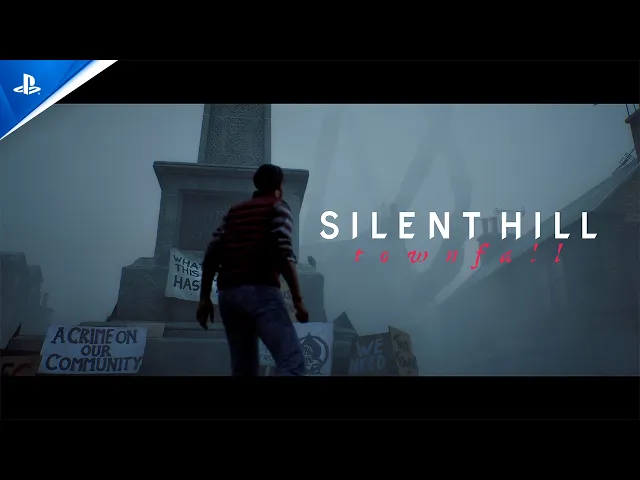
The game's fourth "main character" — the town of St. Amelia itself — is a real success for the developers. It greets Simon with cold coastal fog and total desolation. On the main square there's a fresh memorial dedicated to some tragedy, along with protest signs. From scraps of information it becomes clear: some kind of catastrophe has happened on the island.

St. Amelia perfectly conveys the spirit of a somewhat remote town, cut off from the wider world yet not lacking its essential comforts. Its narrow streets, crammed with houses and all sorts of shops, reflect the local color and let you soak in the atmosphere. Besides the streets themselves, you'll also get to explore the inside of several larger buildings over the course of the game.
The alternate version of the world looks just as atmospheric and memorable — especially in contrast to the Dark Shrine from Silent Hill f, which at the time struck me as utterly bland. On the one hand, Townfall's "Otherworld" clearly references previous entries in the series: first and foremost through its mix of industrial elements and unusual imagery. On the other, it has its own innovations, directly tied to the story.

Townfall's save points are phone booths: their keypads are interactive — if you come across a phone number during your playthrough, you can call it later to learn more about the town's lore.
One of the most important components of the game's atmosphere is its music and sound design. Unfortunately, Akira Yamaoka didn't work on the soundtrack this time. But his replacement, Anthony Scott Burns, known under the alias Pilotpriest, did a worthy job and seems to have caught that very Silent Hill vibe: both the ambient tracks and the rarer lyrical compositions in Townfall are top-notch.
Which of the latest Silent Hill games is closest to your heart?
Stealth, Not Survival
While the new entry inherits the formula of the series' canonical games fairly well in terms of atmosphere and storytelling, there are a few nuances when it comes to gameplay. The main one is that Townfall is a stealth action game. The game expects the player to get through most enemy encounters without direct confrontation, sneaking past them.

The main stealth tool is the CRTV: a portable handheld device combining a radio and a TV, a kind of alternative to the franchise's classic radio. It lets you detect enemies from afar and track their movements around locations on a small screen, even through walls. On top of that, the gadget is regularly used for solving puzzles.
You can also distract monsters by throwing various "improvised" items: stones and glass bottles. And if you throw them directly at an enemy, you can stun it for a moment, which helps when you've been spotted and are trying to get away. Locations also feature plenty of wardrobes and hidden nooks — places where you can hide from a pursuer and catch your breath.
You can also face an enemy head-on: in melee or with firearms. However, melee weapons — planks or pipes — break quickly, and ammo is extremely scarce. The combat system itself is basic at its core: attack plus block. Melee feels extremely primitive — with sparse animations and odd hitboxes. Monsters love to "spam" counterattacks after every hit they take, and some of them aren't shy about grabbing the protagonist: sometimes you can get caught in a new grab almost immediately after escaping the first one. Firearms fare better — mostly thanks to the satisfying impact of each hit.

Given the limited resources, you really do have to rely on stealth a lot. And in Townfall it's frankly weak: the enemies' AI is far too feeble — they patrol the same routes along simple paths (which, by the way, often means waiting a long time to slip through to the right spot); they regularly fail to notice the character right under their noses, and if you are spotted, it's enough to run a few circles around some piece of furniture or scenery for the monster to lose interest in the hero. Another strike against it is the lack of interesting gameplay situations where you'd actually want to use stealth. By the middle of the game, the stealth segments become downright boring and even start to get annoying.
Apart from an invulnerable enemy who becomes the game's only boss in the finale, Townfall has just 4 types of monsters, which barely differ from each other in behavior, and their design isn't particularly memorable. Only one type deserves a special mention — the one that appears in the penultimate story chapter: in their behavior, these enemies strongly resemble the Mannequins from the Silent Hill 2 remake.
The hero's survival relies on several types of healing consumables — some of them can be combined with each other to boost their effect. And Simon's makeshift IV drip, when fed with a special resource, can revive him after taking fatal damage.
Variety and Repetition
The puzzles, on the other hand, are good — as in the classic entries of the series, they are often built on wordplay and intricate logic. Although closer to the final episodes the developers seem to have slightly overdone their number.

In pre-release interviews, Screen-Burn representatives mentioned that the player's playstyle would affect the ending: a similar system was used in the beloved Silent Hill 2. In reality, the ending depends on two key parameters, which are not at all hard to predict once you figure out the game's core concept. Three endings are available on the first playthrough, differing essentially only by a short scene before the credits. Two more outcomes can only be seen in New Game+.
Some of Townfall's episodes rely on repetition: this especially applies to the segments in the alternate reality, which are built around unavoidable and rather tedious stealth. Because of this, several times during my playthrough I got really tired and frustrated and took long breaks.

The game's horror relies primarily on atmosphere, but there are also plenty of classic jump scares: in some episodes it even feels like there are too many of them. And after your first playthrough, you unlock a bonus weapon and alternate costumes for the key characters.
How do you feel about stealth in horror games?
***
So, did Konami once again shoehorn an experimental project into a big-name franchise? Or does the new Silent Hill deserve to be called Silent Hill after all? I'd say — just barely. Yes, thanks to its more down-to-earth setting and recognizable imagery, Townfall feels a few steps closer to the notorious "canon" than last year's f. But the abundance of stealth sections spent crawling around in a crouch and watching monster silhouettes on a tiny screen isn't what I personally associate with the franchise.
I don't want to bluntly criticize Townfall or call it a bad game: it has plenty of interesting and distinctive ideas created with an eye on the classic entries of the series. Still, I can't shake the feeling that I didn't play a new Silent Hill, but yet another indie horror game on Unity: not a survival horror, but rather a "walking simulator" with survival elements. In the end, for myself, I'll probably consider it a kind of "fanfic" inspired by the original games. The visuals, atmosphere and story are good. The gameplay, however, left me with mixed feelings that turned into boredom and frustration toward the end. It seems the Japanese are actively testing the waters with experiments like this, trying to answer the question: how far can you go in trying to make the series evolve?
Overall, I liked Townfall. Although there are plenty of controversial and outright unsuccessful decisions here. Still (at the risk of incurring readers' wrath), I liked Silent Hill f — which many refused to accept as a legitimate part of the franchise — more.
-
 Silent Hill: Townfall All 5 Endings and How to Unlock Them
-
 Silent Hill: Townfall Clinic Scales Puzzle Solution
-
 Silent Hill: Townfall All Weapons and Pistol-3000 Location
-
 Silent Hill: Townfall All 7 Resource Container and Lockbox Key Locations
-
 Silent Hill: Townfall All 15 Strange Postcard Locations
-
 Silent Hill: Townfall Organ Box Code and Scalpel Location