
NVIDIA DLSS 5: A new hope for indie studios or a convenient excuse for mass layoffs?
 Arkadiy Andrienko
The hosts of the tech podcast Linus Tech Tips have voiced serious concern over the long-term implications of implementing NVIDIA DLSS 5 technology. In their view, the new neural rendering algorithm unveiled at GTC carries with it, not so much a technical revolution, but a risk of fundamentally reshaping employment structures within the gaming industry.
On one hand, the technology could serve as a lifeline for smaller studios with limited budgets, allowing them to leverage AI to elevate their projects’ visual quality to a level previously only attainable by market leaders. However, the hosts argue that the flip side of this process looks far more grim.
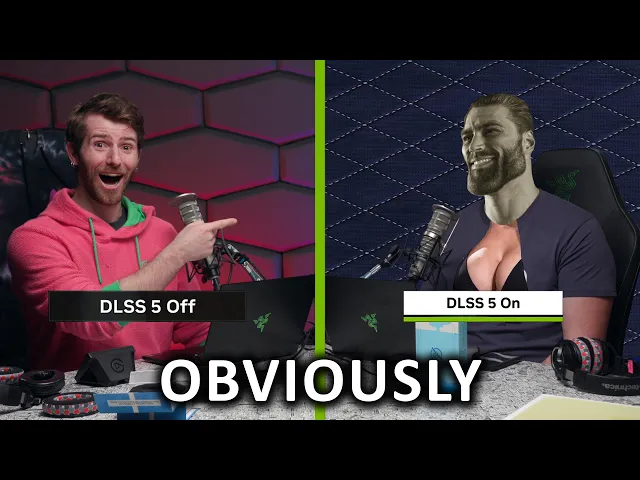
Corporate bosses are already launching successful games and then laying off half the team. With DLSS 5, they’ll have even more opportunities to hire fewer developers and artists while churning out more AI-generated slop. The crux of the issue is that publishers might view this new technology not as a tool for creativity, but as a way to optimize costs—cutting staff in favor of having neural networks generate content.
NVIDIA insists that DLSS 5 isn't just a "filter" applied to a finished image, as is often the case with photo-editing apps. The company’s CEO, Jensen Huang, called the criticism of the technology "absolutely wrong," emphasizing that the algorithm operates at the geometry level. A key risk factor is NVIDIA’s market power; if a tool like this had been released by an independent modder, the community’s reaction would likely be different. But a company that controls the vast majority of the discrete graphics card market (around 95%) is effectively attempting to set a new direction for the entire industry.
Concerns also extend to potential future monetization models; in the pursuit of profit, the manufacturer could introduce a subscription model for different "quality" tiers of DLSS functionality. If the technology becomes enabled by default, players would lose the ability to choose, and the industry could reach a point where baseline hardware performance is artificially limited without a monthly fee. DLSS 5 finds itself at the center of a complex ethical and economic conflict. A tool capable of democratizing game development simultaneously sets a precedent for job cuts and the homogenization of artistic styles.
What do you think—will the widespread adoption of neural networks in rendering bring more good or harm to the gaming industry? Share your thoughts in the comments.
-
 AMD FSR 4.1: Image detail has finally caught up, but NVIDIA can rest easy
-
 “It’s just generating a picture”: NVIDIA confirms DLSS 5 doesn’t see the 3D scene, just redraws the 2D frame
-
 NVIDIA Unveils DLSS 5, Draws 82% Dislikes as Gamers Rebel Against 'Photorealistic AI'
-
 NVIDIA’s Surprise? DLSS 5 Reveal Catches Even Developers Off Guard
-
 NVIDIA CEO Says This Is How Much a High-Performing Engineer Should Be Spending on AI