
Can’t Stop the RTX 50-Series Now? New Utility Breaks Factory Limits
 Arkadiy Andrienko
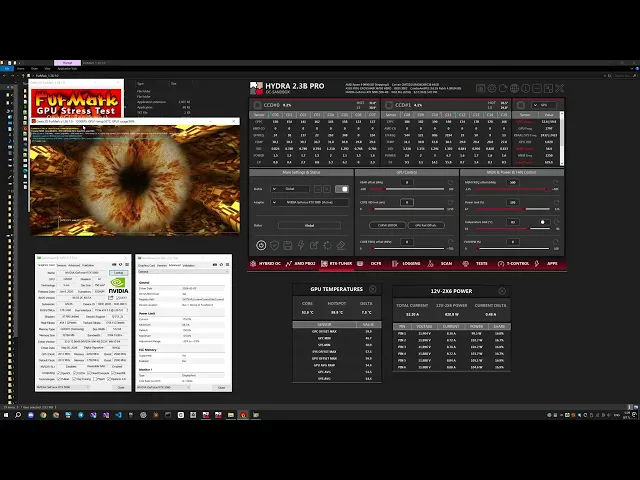
The overclocking tool HYDRA has been updated to version 2.3B Pro. The developer added a mode to the utility that bypasses factory software restrictions on GeForce RTX 50-series graphics cards.
Until now, the overclocking range was tied to a specific model, and on most cards in the series, memory ran within 28–34 Gbit/s – only the RTX 5080 officially allowed frequencies up to 36 Gbit/s. At the same time, the headroom on the chips, PCB, and cooling could be higher, but regular utilities would hit a ceiling set at the software level. A similar situation applied to power: many models kept the limit locked at 100%, even if the power delivery and cooler could handle more. Now, on GeForce RTX 50 cards from any manufacturer, you can overclock the memory up to 36 Gbit/s and push the power ceiling to 125%.
The developer stresses that the initial limits were chosen with a safety margin: 36 Gbit/s for GDDR7 and 125% power aren’t the absolute maximums of the hardware, but rather a broader envelope compared to stock settings. Going forward, they will likely be tweaked based on user feedback. For demonstration, the author used an ASUS ROG Astral LC GeForce RTX 5090 OC. Memory frequency was successfully pushed to 36 Gbit/s, which, on a 512-bit bus, gives a theoretical bandwidth of about 2.304 TB/s. The card's power draw in the test came out to roughly 640W instead of the standard 600W, with the power limit only raised to 105%.
Additionally, in the RTX-Tuner that comes bundled with HYDRA, restrictions on editing the voltage-frequency curve have been removed. For extreme-cooling enthusiasts, MSVDD and NVVDD voltage offsets have been added, along with direct XBAR offset control. These features are primarily aimed at those working with liquid nitrogen or custom cooling loops. At launch, the expanded capabilities are available in the paid version of HYDRA 2.3B Pro. The author doesn't rule out that some features may become free over time, but no specific timeline has been given.
The risks of such modes are equally obvious. Overclocking memory and raising the power limit increase the load on the GPU dies, the VRM, and the cooler. With insufficient cooling or overly aggressive settings, the card may lose stability, accelerate component degradation, or even fail entirely. Before enabling these kinds of modes, it’s worth making sure your PSU and case can handle the extra heat.
Are you planning to test the new limits on your RTX 50-series graphics card, or do you prefer to stick with factory settings? Drop a comment below.
-
 NVIDIA CMP 170HX Mining Cards Are Being Turned Into AI Hardware
-
 NVIDIA announces DLSS 5 with AI rendering, due this fall for RTX 50 owners
-
 NVIDIA RTX 50 Prices Have Jumped Up to 41% and Keep Rising
-
 NVIDIA Raises RTX PRO 6000 Blackwell Price to $16,000, Nearing 87% Above Launch
-
 NVIDIA RTX Spark N1X leaks beat Ryzen AI Max+ and Panther Lake in Geekbench