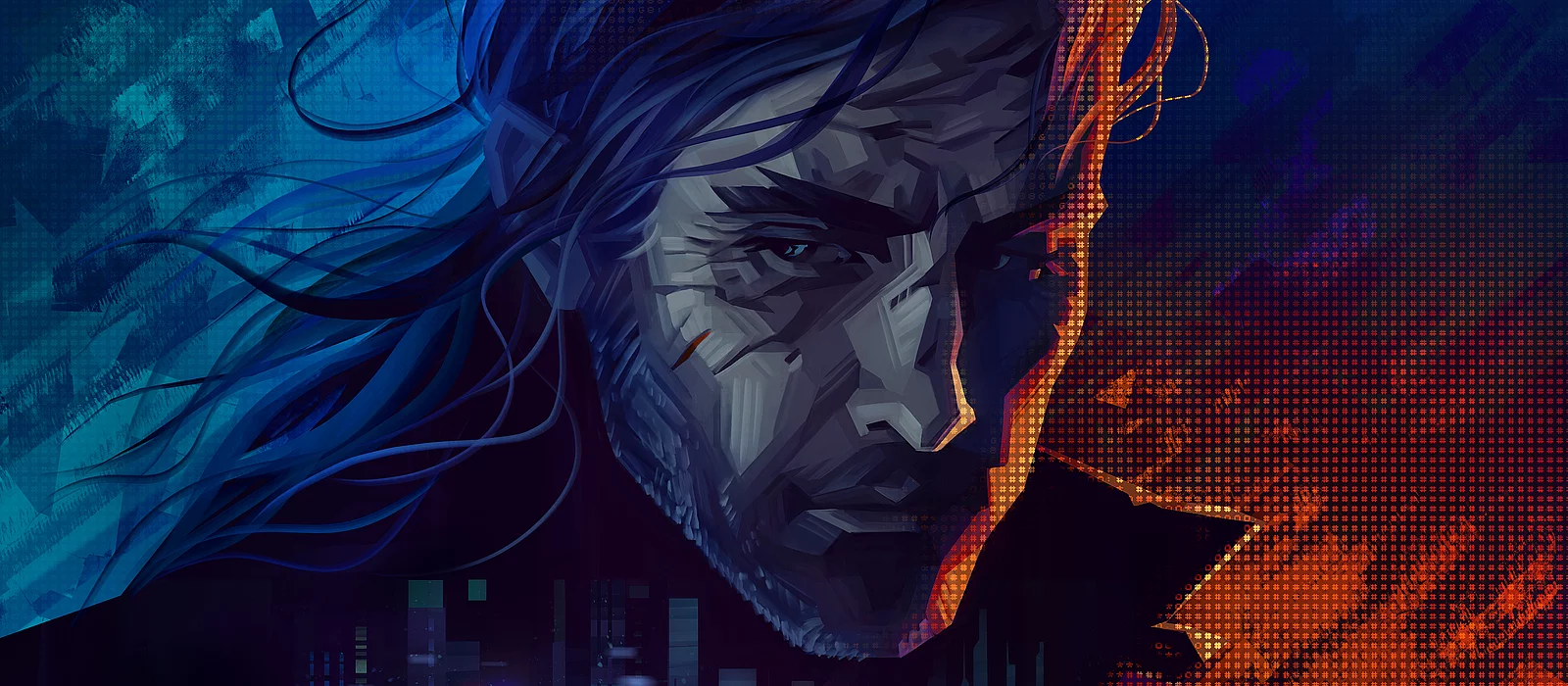
Replaced Review. In this game, we learn how it’s possible to live without a larynx
7.0 Dmitry Pytakhin
Replaced is a new 2D platformer. Don’t let the pixel art fool you. This is a major debut project from the Belarusian studio Sad Cat Studios, released after several delays. This new title combines the gameplay of Uncharted, the combat system of Batman: Arkham, and the style of Blade Runner. We definitely couldn’t pass this up—and now we’re sharing our impressions with you.
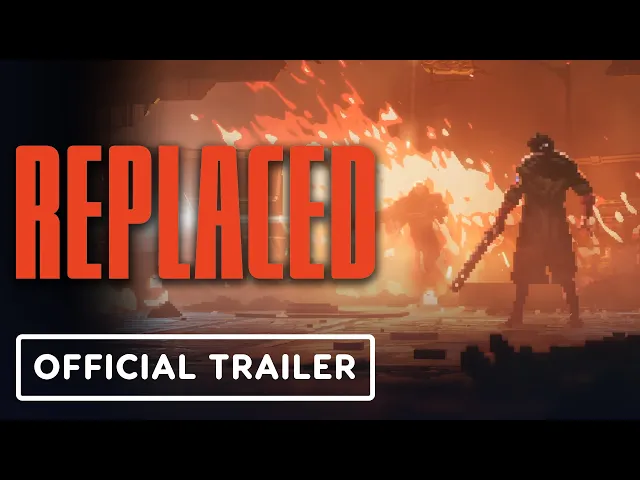
Platform: Xbox Series X/S;
Playtime: 11 hours.
Dystopia and cyberpunk
The world of Replaced suddenly transports us to the past—specifically, to the 1980s. Following a nuclear disaster, American society had all but vanished, but a volunteer organization called “Phoenix” unexpectedly emerged, dedicating all its resources to saving the people. This is how organ donation began to gain popularity. Very little time passed before the small "Phoenix" group grew into a corporation so vast and powerful that it could dictate its own terms to both the government and the people. A Wall went up around the main city, and then came the forced organ harvesting of all undesirables. Those who had been used were dubbed “Waste” and cast out of the city with the grand name of Phoenix City, somewhere far beyond the Wall.

Some time later, a talented scientist named Warren joins the corporation and invents a new form of artificial intelligence—R.E.A.C.H.—that functions similarly to a neural network. The machine is supposed to help, among other things, identify and locate potential new donors, so the idea is, shall we say, controversial. However, the first launch doesn’t go according to plan, and R.E.A.C.H. finds itself trapped inside Warren’s body. That’s when the game begins.
As you’ve probably already guessed, the central theme is humanity and its limits. To what extent have humans become machines with replaceable parts, and to what extent can a machine become human? The idea, on the whole, isn’t new, but it still works quite well if presented correctly. Replaced handles this fairly well, but it’s far from perfect. Around the middle, it seems like the plot points lack the depth and introspection typical of this cyberpunk genre, and that’s indeed the case, but by the end, the story picks up pace and squeezes everything it can out of the “machine in a human body” concept. If this had been present throughout the entire playthrough, Replaced could easily have been called a masterpiece. But, alas, not this time.

Conceptually, the gameplay is divided into two segments: active combat and social/peaceful activities. It is only in the latter that you can truly experience the atmosphere and the very tragedy of the dystopia. The former, by and large, offers the player nothing but a backdrop. At the same time, the peaceful moments always take place in the same location, which severely undermines the sense of a vast world. The cyberpunk setting here is far from the scale of Night City or the city from Blade Runner. At best, it’s on the level of a derelict town. Phoenix City itself only appears toward the end, and even then, for just a couple of hours.
One could argue that the developers simply ran out of budget, and we understand that. But it’s hard to miss the attempt to artificially pad out the runtime with aimless wandering back and forth, rather than delivering a short but tightly crafted project. If all the gameplay segments had focused solely on atmosphere and immersion, they would have been more compact but also more memorable. To better understand the difference between linear and nonlinear storytelling, we recommend the collection best nonlinear games.
Where is the cyberpunk atmosphere best captured?

As a result, the main theme develops in fits and starts. One moment, the protagonist is a soulless machine—and this goes on for a very long time—and the next, he’s suddenly a being with emotions and understandable reactions, the number of which grows exponentially. This somewhat disrupts the immersion in the story.
The endless corridors filled with sewers also detract from the atmosphere. There are very few scenic spots in Replaced, which feels like a missed opportunity for a cyberpunk setting. For most of the game, players are forced to run through identical dark tunnels where there’s nothing to catch the eye. The overall sense of the game’s world barely comes together.

Another downside of the modest budget is that most of the lore is conveyed through those infamous notes. There are so many of them that you sometimes have to stop every five minutes, especially at the beginning. They usually reveal important and interesting details, but reading through it all is extremely tedious. You can play without the notes, but you’ll only see a third of the prepared narrative and won’t be able to fully immerse yourself in the story.
That said, I still don’t want to criticize the local atmosphere. When Rich first arrives at the Station—the local waste dump—the pixel art quickly sets just the right mood. People are trying to create a semblance of normal life under completely abnormal conditions, living in places unsuited for that purpose, yet they still don’t lose hope. That’s exactly what you expect from a good cyberpunk dystopia, and here it is.

All in all, after going through the story, narrative, and atmosphere, there’s only one thing to say: it’s not bad, but it could have been much better. The central idea echoes its main source of inspiration—Blade Runner—in many ways, and it was portrayed much more interestingly in the movie. Here, everything looks like broad strokes on a massive canvas. Overall, the meaning is clear, but there just aren’t enough details. And no, it’s not a bad film, but the target audience is likely to be disappointed rather than pleasantly surprised.
Sometimes you have to fall before you can rise
Unfortunately, the simplicity of the plot is far from the only problem with Replaced. We’ve already outlined the two pillars on which the game’s core gameplay rests. The problem is that there are too many action sequences, and they all feel the same, while the quiet moments are few and far between; they’re short, but the game drags them out in every possible way.

During your missions, you’ll be doing three things: climbing ledges and walls, solving spatial puzzles—that is, dragging crates to the right spot and figuring out how to jump to a beam—and fighting, fighting, and fighting some more. All these elements do develop, but so little and so slowly that they practically stand still.
As you progress through the game, you’ll acquire a pickaxe that lets you latch onto certain walls and jump further, as well as strong air currents that you can use to… jump a little farther still. Solving puzzles—both spatial and standard—rarely strays from the rule: get over there to that box, move it, and climb to a new spot. Toward the end, you’ll get the chance to hack certain devices, but after the level where you’re actually taught the mechanics, this happens rarely.

All this jumble of jumping, lugging heavy objects, and fighting gets tedious by the third hour—and, as a reminder, the game runs about eight hours in total. As a result, the core gameplay—which serves as the foundation and the core that holds the player’s attention—gets old way too quickly and intensely. Once that feeling sets in, it doesn’t go away; it only grows stronger. Platforming is a genre where monotony is unforgivable, and the best 2D platformers convincingly demonstrate what it can be like in the hands of those who know how to keep the pace.
The peaceful interludes, intended to break up the monotony, force you to run back and forth across four small maps connected by loading screens, so they don’t improve the situation—they actually make it worse. There are some side activities at the Station, but they’re all ridiculously trivial. Usually, you need to find something lying around within the safe zone, so go search every corner. In other words—run around these four maps over and over again. And then again. And again. Completing side quests isn’t mandatory, but they grant experience points, which are extremely scarce on combat levels. So instead of spending 10 minutes at the Station, the player ends up spending an hour and a half there. On top of that, you can’t pick up quest items right away—that would also speed up the process significantly. New activities only appear if you’ve received an additional task. Picked up another one along the way? Well, that means you’ll have to run through it all over again.

By the middle of the game, the only thing that can be said about the gameplay is that it’s stifling. This vivid word perfectly describes everything you’ll be doing. On top of that, the developers managed to amplify the effect by adding such “pleasant” touches as respawn points as far away as possible, one-hit kills, and chases where you have no room for error. The chases are particularly annoying, since the creators had only one “correct” route in mind, without accounting for the protagonist’s animations. Because of this, I, the author of these lines, got stuck on one of the final chases—not because I was doing something wrong, jumping in the wrong direction, or missing my targets. I died simply because the animation for climbing onto the ledge was too long, and I needed a shorter one. What helped me succeed was deliberately falling into the void for an extra couple of seconds. Naturally, before I figured out the character’s behavior pattern, I had to die about fifteen times and, of course, start the entire chase segment over from the very beginning time and time again.
When it comes to combat, things aren’t quite so straightforward. Replaced offers an interesting take on the mechanics from Batman: Arkham in a 2D format. Porting Batman: Arkham’s combat to 2D is no easy feat, and very few games manage to pull it off. What constitutes a truly sophisticated combat system is a topic for another discussion, and it’s already featured in the top games with the best combat. At the start, Rich’s arsenal is small—attack, dodge, and counterattack. However, his capabilities gradually expand. By the end, the number of skills is impressive, though, in essence, nothing changes, including the weapons. It’s an unusual take on a familiar formula that very few can replicate, and even fewer can build upon.

However, the combat has several serious drawbacks. The first is the lack of variety among enemies. Yes, they do gain some new attacks by the end, but they’re still the same three types of enemies you faced at the start of the game. You’ll have to fight them using the same old combos. If you have to chip away at a heavily armored brute’s armor with a pickaxe before shooting him down in the early chapters, you’ll have to deal with him the same way later on. The expanding capabilities don’t break the behavior patterns, change them, or make them more complex—even though that’s exactly what you’d expect.
The second issue is the format. The combat in Batman: Arkham doesn’t mesh well with a flat perspective. Dozens of enemies are thrown at Rich at once, after which the action starts to turn into a chaotic mess. You can’t target a specific enemy because there are five more standing right in front of him. Because of this, there’s no sense of fluidity or the ability to juggle enemies with just two or three buttons. You’ll have to jump around the arena like a headless chicken, missing your strikes and getting hit by counterattacks. Plus, the character doesn’t always respond quickly to button presses. Apparently, the developers wanted to make the fights measured and heavy, where every hit feels impactful. In reality, it turns out that everyone moves faster than the protagonist. By the way, in fights, you don’t get killed on the first hit, for which I’d like to say a sincere “thank you.” The mechanic where you restart after a single hit, fortunately, only works in chases; however, sometimes they deliberately try to make your life harder by triggering several fights in a row, which, to put it mildly, gets annoying.
Life without a larynx
But I do want to praise the visual style. Pixel art helps keep costs down, but even so, the developers have gone out of their way to add a wealth of details and objects. Monotonous tunnels are filled with wires, environmental elements, and pipes. The colorful Station showcases the complex everyday reality of waste. There’s graffiti, inscriptions, and optional but pleasant touches everywhere. To reiterate, the eye rarely latches onto anything particularly memorable, but the visuals are rich—there’s no denying that.

The camera isn't static either. Very often, the angles are chosen specifically to enhance the impact, which lends a cinematic quality to the action. It's clear that the cinematographer worked on every scene, striving to find interesting visual solutions wherever possible.
However, in a pixel art style, it’s very difficult to grasp the characters’ appearances. For example, the main character wears a cloak and has long hair tied back in a ponytail, but otherwise he’s completely featureless. The things Rich has to do while inhabiting Warren’s body are impressive, but the player has no sense of how a scientist who’s spent his entire life in a lab could be capable of such feats. Is the main character young or old? Is he struggling or not? All these questions and visual cues would help the player better connect with the character.

The situation is similar with other NPCs. All the “Waste” should be missing body parts, and their Station is supposed to be a pretty creepy place, but you don’t really get that sense from its appearance. One of the female characters doesn’t have a larynx at all, so speaking is a struggle for her. But unless she mentions it herself, it’s impossible to pick up on that detail. Some might consider my words nitpicking, but personally, I felt all these visual elements were missing. Without them, the local cyberpunk feels as though it’s been stripped of its own identity—an identity it undoubtedly possesses, but cannot fully express.
The soundtrack was also a point of contention. Many of the ambient tracks are pleasant, but as the story unfolds, there are additional songs (which, by the way, are good) that simply can’t be played in the background. In other words, you’re literally forced to stand still for three minutes and stare at the game’s version of a smartphone to appreciate the new track. Not every player will be willing to put up with that.
Other game reviews
- Samson: A Tyndalston Story Review. What's Wrong with the "GTA Killer" from the Creators of Just Cause and Mad Max
- The Occultist Review. A high-quality, but not scary at all horror
- Roombattle Review — A Friendly Robot Vacuum Showdown. Who Can Pop the Balloons Faster?
- Marathon Review: The Most Stylish and Polished Extraction Shooter You Can't Put Down
- Trail Out Review for PS5
- Reanimal Review
- Nioh 3 Review: A Worthy Sequel, But Still Far from Perfect
- Hotel Architect Review: Skyscrapers, Lobsters, and Toxic Waste Under the Bed
***
You might think that all I did in this review was criticize the game, but that’s not actually the case. Replaced has its own charm, but you need to lower your expectations—they won’t be met. As a first attempt and a debut project, this new release is beyond praise, but it’s far from being a recognized masterpiece. Repetitive gameplay, a generally drawn-out pace, and pixel art that sometimes makes it impossible to tell what the characters even look like, along with a string of less-than-ideal design choices—like distant respawn points—are all too significant to simply overlook. I can recommend it, but only at a steep discount or through Game Pass. Eight hours is enough for the story to say everything it wanted to. If you appreciate this format, check out a selection of the best short games to enjoy over a few evenings.
What appeals to you most about Replaced?
-
 REPLACED All Codes and Passwords — Slave Cell, Box, and Safe Solutions
 -
 Gambonanza Review: New Chess by Roguelike Rules
 -
 It freezes and resets all progress: the authors of Replaced warned about the problems of the game on Xbox Series S
 -
 «AI-based adventure»: Replaced's reputation is at risk because of one phrase in the review
 -
 REPLACED Walkthrough — All Main and Side Quests, Upgrades, and Item Locations