
Bloom Control Preview — What Happens When You Cross an Idle Game With an Arcade Shooter?
 Dmitry Kartashov
Incremental games usually don't ask much of the player: launch, click a bit (or simply wait), collect resources, upgrade your stats, and repeat until you win. Indie studio Element Games decided to take a different route: keep the familiar formula of gradual progression and add elements of an arcade shooter to it. The result is Bloom Control, where relying on ever-growing numbers isn't enough — you have to learn to aim precisely and set priorities.
A free demo is already available on Steam, and the full release is planned for 2027. I set out to see whether this unusual combination can become something more than just another experiment for fans of progression and endless upgrades.
Playtime: 3 hours.
Artificial Intelligence vs. the Bloom
The game's premise is somewhat reminiscent of sci-fi horror. Remote space stations report an unusual problem: the spread of a mysterious biomass known as the Bloom. It quickly takes over their infrastructure, and conventional countermeasures no longer work.

The player takes control of an artificial intelligence aboard an autonomous ship. Its task is to connect to the defense systems of infested facilities and destroy the Bloom before the signal transmission window closes. In the demo, most of the action takes place on the Starbase 144 space station, but the developers promise to send the player to other infested locations in the full version.
Still, the main thing in idle games isn't the story but the gameplay. And here Bloom Control has something to surprise even genre regulars.
From Passive Observer to Defense System Operator
Bloom Control is hard to call a typical idle game. Here you actually have to take an active part in the process — even if it looks fairly simple.

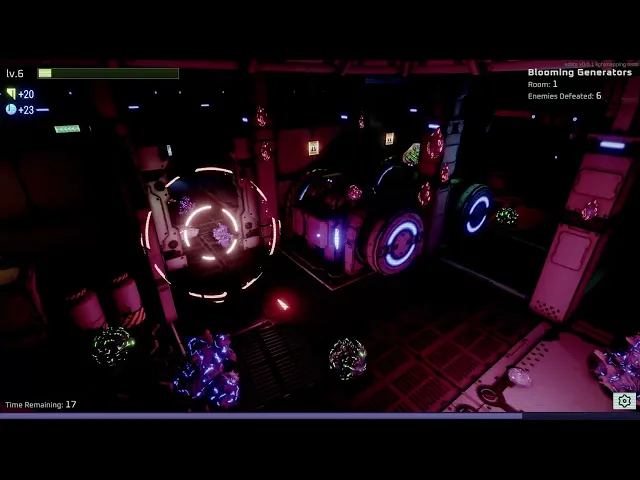
Every mission is a race against time. The Bloom keeps spreading across the location, and the player has to quickly target the growths and destroy them with the available defensive weaponry. The camera is fixed, and the whole thing resembles an arcade shooting gallery: you move the cursor between targets, pick out the most dangerous ones, and make sure the infestation doesn't get out of control. On top of that, the run-upgrade-run loop takes very little time, so the gameplay quickly turns into a dopamine loop.
The first mission looks elementary: the biomass growths are still static, so the player's main "enemy" is the ticking timer. But as you progress, the formula changes noticeably — different varieties of the Bloom become more aggressive: they can move from place to place and spread. The key to success is the ability to adapt to what's happening on screen and optimize your own efficiency literally on the fly.

Reaction speed is essentially what sets Bloom Control apart from most games in the genre. There's no option to calmly wait for another stat to grow by a few percent. Zone bosses come as a separate surprise — special varieties of the infestation with increased health and their own behavior patterns. To successfully take them on, you need to "crack" their pattern and adjust your playstyle to it.
More Than Just Endless Numbers
Another important part of the formula is gradual progression. There are far fewer revelations here, but it still has its nuances.

For shooting down growths, the player earns several types of special fragments used for upgrades. After completing or failing a mission, you can go to a separate screen with a branching skill tree and boost your combat potential.
In the demo, progression relies on Codons and Exoprograms: the former let you boost your stats, while the latter expand your set of available abilities. The full version promises to add Modules and Specialization Profiles — although there are no real details yet on how they will work.

Bloom Control also flirts with a rhythm mechanic: if you use certain tools (for example, a cluster bomb that hits a small radius) in time with the background music, their damage and area of effect increase noticeably. There are few such elements in the demo, so it's too early to draw full conclusions.
New Abilities Mean New Tactics
Notably, your playstyle changes as you progress: for example, after increasing the turret's blast radius, you start firing not at individual growths but at the space between them, so a single shot hits several biomass fragments at once. Another layer of tactics is using the environment, in particular explosive barrels.

There's also an equivalent of the Prestige mechanic — resetting accumulated progress to gain new boosts. In the demo, it works like this: the currency earned after a reset lets you boost each talent in the skill tree by a percentage. However, the developers promise to change the system at release — it should grant permanent stat increases.
Completing missions unlocks higher difficulty variants: the higher the number in their name, the more infestation will appear at locations, and the harder it will be to deal with it without the right upgrades.

The game's main dilemma (one that could potentially turn into a problem) is the balance between the two genres. Make the action too simple, and the game turns into an ordinary incremental with a pretty wrapper. Overload it with active mechanics, and you lose the appeal of gradual progression and the relaxing feeling of constant growth. For now, Element Games' project sits somewhere in the middle — and that's exactly what makes the demo interesting.
What matters more to you in incremental games?
***
For now, Bloom Control is hard to see as a full-fledged game: what we have is still a small demo designed to show off the core loop. Many of the systems the developers promise to add in the release version aren't here yet.
But the main thing already works: there's a clear goal, fast-paced gameplay, a constantly growing threat, and a fairly pleasant sense of progression. Bloom Control resembles a kind of "incremental arcade shooting gallery," where instead of mindless waiting you constantly have to look for a more efficient way to destroy the next threat.
For now, it's just a curious experiment. But if Element Games manages to keep up the pace of development, add enough variety, and stop the late game from turning into a mechanical repetition of the same loop, Bloom Control could well become one of the most unusual representatives of the genre.