
Pragmata Review. A Kind, Gameplay-Polished, and Refined Capcom Masterpiece
9.2 Ilya Yakimkin
Modern Capcom is literally a lifeline for the gaming industry, which is bogged down in endless open-world projects, bloated budgets, tiresome inclusivity that gamers are force-fed, and prolonged development cycles. And what's most surprising: the Japanese company doesn’t fixate on any particular series, but instead develops in virtually every possible direction — horror, fighting games, slashers, RPGs, and so on.
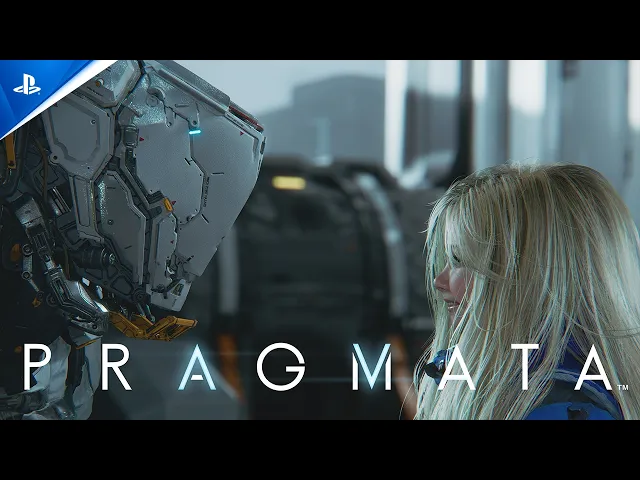
Pragmata is not just Capcom’s first new franchise in 16 years, but also a bold step toward narrative-driven games with maximum audience reach. It's yet another project we didn’t really expect anything from, but in the end, we got one of the best games of the year. It doesn’t revolutionize anything, but it delivers what every game should: excellent gameplay, creative mechanics, an interesting story, beautiful visuals, and the joy of flawless technical execution. Pragmata is the first game in a long time that we simply couldn’t put down, and in this review, we’ll explain why you should give it a try.
Platform: PC (i7-9700K, NVIDIA RTX 4080, 32 GB RAM);
Completion time: 19 hours.
System Requirements
Minimum: Ryzen 5 3500 / i5-8500, 16 GB RAM, RX 5500 XT / GTX 1660, SSD 40 GB.
Recommended: Ryzen 5 5500 / i7-8700, 16 GB RAM, RX 6600 / RTX 2060 Super, SSD 40 GB.
A Kind, Naive, and Very Touching Story
Pragmata is a story-driven game with a straightforward plot, free from the modern writers’ favorite dramas, subtexts, hidden meanings, and ambiguous characters. For some, this approach to storytelling may well be the main downside, as modern society can no longer simply enjoy a story where good and evil have clear boundaries and limits. But for us, this story was an emotional relief. It’s just a very kind and heartfelt game that makes you smile, feel touched, and even shed a tear during the final credits.
Despite its simplicity, Pragmata is skillfully written from a narrative standpoint. The introductory cutscene and short prologue are more than enough to understand the structure of Capcom’s invented universe, as well as the main character’s personality and the overall goal the player will pursue throughout the game.

The main character, named Hugh (suspiciously reminiscent of Sam from Vanquish and Metal Gear Rising: Revengeance), arrives with his team at a lunar base, where a scientific corporation is researching lunar soil and actively using it in 3D printing. Entire buildings are created from scratch on the printer, and one of the locations is literally a “printed” copy of New York. And, as usual, this huge scientific station is serviced by an AI, which is responsible for security and takes on all the resource-intensive work. There’s even a funny moment in a holographic message where employees complain they have nothing to do because the robots do all the work for them. In short, it’s an idyll. By the way, if you enjoy games with a science fiction theme and a near-future setting, be sure to check out our list of the best space games on PC: RPGs, horror games, puzzles, and strategies.
But our team doesn’t find this idyll: the station’s staff mysteriously disappears, the AI predictably goes insane, and a lunar earthquake wipes out all of the main character’s allies in a single cutscene. Hugh miraculously survives, and this little miracle is a curious android with the body of a seven-year-old girl. DI-0336-7, who later gets the more familiar name Diana, just like the protagonist, doesn’t know what happened at the station, so they decide to team up to deal with the rogue AI and return to Earth together.

Pragmata doesn’t try to deconstruct the adventure genre or bring anything new to the already standard man-vs-AI conflict. It’s a completely overused story with easily predictable plot twists that we’ve seen dozens of times in movies. The essence of the plot lies in showcasing “healthy” relationships between the main character and the android girl. In just a couple of minutes of screen time, Hugh transforms from a hardened childfree man into a caring father who would sacrifice everything to protect Diana from any danger. And she reciprocates.
There’s no long period of adjustment, hidden resentment, or slow relationship-building like in The Last of Us. And that’s not a downside, but a conscious decision by the writers: Diana is an android whose memory was wiped and who was tossed aside as unnecessary. She has nothing but a programmatically ingrained childlike innocence and hacking abilities. Hugh is the first person she sees and becomes attached to. And the main character isn’t a jerk like Joel or a world-hating Kratos, but just a kind guy who knows firsthand what it’s like to be an orphan and how hard it can be for kids without adult support. That’s why he spends his time looking for toys, playing hide-and-seek, and telling her about life on Earth — because he sees a living child in Diana who needs care.
Social networks are already full of conspiracy theories that Capcom created Pragmata and Resident Evil 9 to awaken the parental instinct in modern gamers. Of course, that’s complete nonsense, but here’s the thing: Pragmata really does foster love for children much more than The Last of Us, God of War, or other similar games. Diana is much younger than companions in other games, so she doesn’t annoy with puberty, doesn’t do reckless things, and doesn’t try to be rebellious or show off her “self.” Instead, she always encourages the player, asks to play hide-and-seek, and even makes very cute drawings as a thank you. There’s no dynamic or toxicity in Hugh and Diana’s relationship — just pure kindness and mutual understanding. The only similar parent-child relationship we’ve seen is in Telltale’s The Walking Dead, where Lee and Clementine had a similar bond.
It’s also worth noting that the main story, despite borrowing from other works, thoroughly reveals the structure of Pragmata’s universe and answers absolutely every question that might arise during the playthrough. Yes, even the main conflict is a copy of Resident Evil 2, but it’s presented with much more attention to detail and is closely tied to the main idea — parent-child relationships. By talking to Diana in the shelter (and you should do this as often as possible), you’ll learn more about Hugh’s past, which will ultimately reveal his character. By collecting data logs and watching holorecordings, you’ll find out how people of the future live, what problems the staff had, and what devious plans the corporation was hatching. And the coolest thing is that Capcom’s writers really put effort into the notes, delivering hilarious mini-stories mixed with the classic problem of workaholism in Japanese society.

Pragmata’s story is a kind, at times naive, and very touching tale, with the core being the relationship between Hugh and Diana. The light and simple formulaic script doesn’t suffocate with ambiguity, pointless anxiety, or forced drama. Every moment when the main character gives Diana a piece of childhood—like a slide, a skateboard, chalk for drawing, a butterfly net, or even a sandbox — touches the soul. And that doesn’t mean the main conflict is worse or forgettable. We played the game from start to finish and enjoyed it just like a good family movie. Which, by the way, has more action than quiet scenes. For fans of great stories, we recommend checking out the best games with strong narratives on PC, PS4, PS5, and Xbox.
Which Capcom game series do you like the most?
A Mechanic That Changes the Genre
Pragmata’s gameplay is excellent as well. It’s a standard 15–20 hour adventure with dynamic, spectacular action, platforming sections, subtle metroidvania elements, and one unique mechanic — real-time hacking of anything possible. It’s funny how, when we watched early gameplay footage, we couldn’t understand how you could possibly solve a puzzle right in the middle of a fight with enemies. Turns out, you can. And surprisingly, it’s actually very convenient.

Here’s how it works: when you aim at an enemy, a grid appears on the screen, and you have to manually plot a route by pressing buttons on the gamepad (or holding a mouse button). It’s important to pass through special symbols that increase the damage multiplier. Without hacking, Hugh deals minimal damage to robots, but if Diana — who is also controlled by the player — solves the puzzle with perfect accuracy, the gun starts popping enemy heads like nuts.
At the same time, hacking happens in real time — there are no slowdowns or pauses. So you always have to keep an eye on what’s happening on the main screen while solving the “snake” puzzle. Then you need to aim for enemy weak spots, dodge attacks with dashes and jumps. In words, it sounds complicated, but in practice it’s simple. Capcom has polished this mechanic so well that you quickly get used to the quirks of the game design, and your brain easily switches between the main fight and the puzzle.

At first, we were afraid this kind of gameplay would get old fast. But the developers came up with so many features and situations for using the hacking mechanic that it stays fun right up to the very end. At first, you have basic hacking: you need to collect as many blue squares as possible with the “snake” to deal more damage to robots. Then equippable bonuses — yellow symbols — appear. They give different modifiers if you pass through them with your route. For example, you can make an enemy fight for you, stun them, temporarily remove their armor, or even overheat them. Throughout the game, you’ll get new perks that change your tactics and ways to clear arenas.
The grids used for hacking also change depending on the enemy type. Armored enemies and bosses have huge grids with obstacles that punish mistakes by sending your “snake” back to the start. Later, you’ll encounter cells that slow down the process and other unpleasant debuffs. It’s important to always have a plan and activate only those modifiers that are useful in a specific situation. Planning your route during the puzzle phase is almost the most important part of combat. Some enemies can be killed with just the damage multiplier, armored mortar guys need their resistance cut, and fast spear-wielders should be stunned, and so on.

It’s also important to note that the “yellow” programs are consumables, so you always need to use them wisely. Their number gradually increases, adding variety to the gameplay. When leaving the shelter, you can take a pack of modifiers for all occasions, and this will save your life more than once in boss fights. But if you use up all the “yellow” squares you brought from the safe zone while progressing through a level, the game will provide more — either dropped from defeated enemies or found in crates scattered around.
And what about weapons? Here’s the answer: there’s a standard pistol with an overheat mechanic, like in Mass Effect. By default, it’s always at hand. Later on, you can swap it for a rifle. By the way, the rifle is trash, not a real gun. We immediately sent it to storage. The pistol, however, can be upgraded with resources found throughout the levels — more damage, more ammo. But because of the overheat, you can’t fire it endlessly. Cooling the barrel takes too long, even with perks that speed it up. That’s why you always have other, more powerful but consumable “toys” in your arsenal. You can grab them in the shelter or find them in locations.

Hugh’s arsenal also includes heavy-hitting weapons: a grenade launcher, a railgun, a shotgun, and so on. They usually have a small ammo pool, so spraying everywhere is unwise. Of course, you can upgrade them over time, but armored enemies will become much more common, too. In the end, it’s better to save the big guns for special occasions — like when your main pistol or rifle overheats. However, you can’t take the entire arsenal with you at once. Only one heavy weapon can be equipped, with an extra slot opening in the second half of the story.
The main character also has tactical gadget slots: slowing nets, stun grenades, mines, hacking accelerators, and other tools to make battles easier. As with heavy weapons, you can only bring one at a time, with an additional slot unlocking later in the story. The bottom slot is for consumables like decoy holograms, drones that attack nearby robots, and dome shields. You’ll need to juggle all this arsenal to deal as much damage as possible, keep up with efficient hacking, and avoid waiting for the pistol to cool down after overheating.

All these nuances make up Pragmata’s combat system. You constantly have to think tactically, monitor your resources, assess the situation, and instantly switch between hacking and shooting. Every battle is a kind of puzzle with several solutions, depending on your arsenal, the features of the arena (some have traps you also need to hack), the presence of “yellow” programs, as well as the build and passive modifiers set up in the shelter. Each fight — especially in the later levels — is a real challenge. Your brain has to control a ton of operations at once: hack, shoot, dodge, survey the arena, pick up scattered weapons, stun enemies, gather resources, hack again — and so on until you win. The action is so energetic and well-crafted that it never gets boring, even up to the very end.
The exploration segment is built on the principles of classic metroidvanias. There are fairly large, but structurally linear locations that feature both story-driven and optional paths. Resources for upgrades, toys for Diana, and bonuses — like costumes that unlock in the shelter — are hidden everywhere. Some areas are locked until certain story moments, so you can always return to previously completed levels and fully clear them. And, true to the genre, all defeated enemies will respawn, and upgrade resources will reappear in their places.

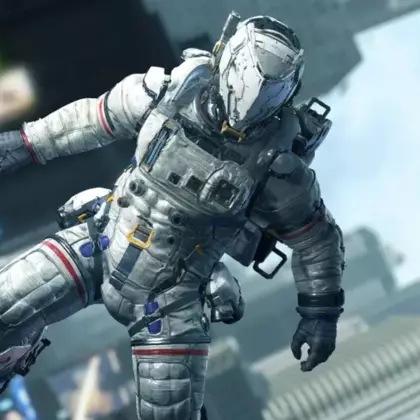
The platforming sections, which the game has in abundance, aren’t punishingly difficult but can be a bit frustrating due to the main character’s unique physics. Hugh, in his spacesuit, is very clumsy and slow. Jumps, dashes, and climbing have noticeable inertia that takes some getting used to. Plus, without upgrades, he can’t dash properly or jump often, which is annoying at first. Thankfully, after upgrading Hugh’s suit, the gameplay becomes much more comfortable.
Overall, Pragmata is excellently structured, with the listed gameplay mechanics smoothly replacing one another, and the game keeps up the pace. A bit of running, some fighting, some jumping, searching for resources — and so on until the final boss battle.
Giant robots, against which Hugh and Diana look tiny, are a signature feature of Japanese culture. Boss fights are both spectacular and reasonably challenging, with lots of variety. In one battle, you need to jump quickly, dodge, and take up positions. In another, you’ll hack homing mines and lure out the weak spot of a giant worm. As for the scorpion boss, it’s best to keep your distance and hit its tail with everything you’ve got. The fights are staged perfectly: with great finishers and awesome scripted moments.
Exploring locations is motivated not just by the story, but also by upgrades. In Pragmata, you can improve absolutely everything: stamina, health, the number of repair kits, Diana’s abilities, “yellow” programs, and the damage of every weapon. In short, there’s definitely motivation for replaying levels. It’s also nice that you don’t have to start a previously completed level from the very beginning: in the shelter, you can select a checkpoint in advance and see exactly what you’ve collected in that area. Plus, Diana will get a handy scanner that highlights all rare resources.

There are also passive modifiers in the upgrade system, which are the foundation of build-crafting. For example, you can take a perk that increases robot overheating during hacking, or if you have a rifle equipped instead of a pistol, you can kill enemies quickly with a critical attack instead of standard shooting.
For those who want even more, Pragmata has a training simulator with lots of challenges, rewarding you with both resources and cards used with the robot Cubic. He gives out not only various cosmetics as rewards but also new weapons and consumables. The challenges, let’s be clear, aren’t easy. Most are timed. And here, the platforming sections with Hugh’s awkward inertia and an unupgraded suit become a real pain. In combat arenas, you’ll have to quickly take out all enemies with the basic pistol (which, as you already know, overheats constantly) and avoid taking any hits yourself. And precision shooting with the railgun on moving platforms against the clock — will haunt your nightmares. That’s Japanese game design for you.

Despite the challenge of the trials and the backtracking for resources, we just couldn’t resist clearing all the content the game has to offer. And for those who want more than the main story campaign, Capcom has prepared “New Game+” and “Unidentified Signal” modes. The latter adds an extra level with even harder challenges and a pleasant bonus in the form of an extended ending. In short, it’s the classic package for a great single-player game.
Technical Execution
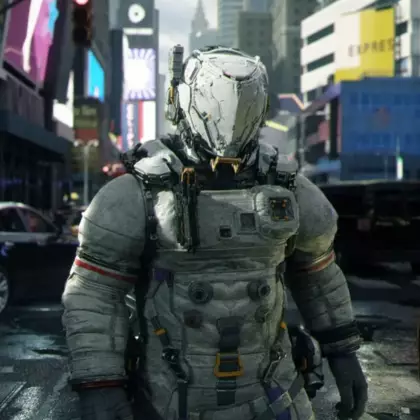
Pragmata is a very beautiful game by modern standards. The RE Engine still never ceases to amaze with its visual quality. Each level is unique in its own way. For example, the printer-generated New York — with static glitches and errors like taxis sunk into the ground or broken geometry in boutiques — is stunning! Capcom’s artists revealed they intentionally designed the level to look like AI-generated “neuroslop” to showcase the sloppiness of artificial intelligence. There are also full-fledged levels with beach sections and overgrown greenhouse environments. And of course, there’s a walk on the Moon with special gravity, muffled sounds, and breathtaking views of Earth in the background.

In enclosed spaces, Pragmata shows off sterile white corridors, which stand out a bit from the overall level of detail. It’s not that they look bad or ugly, they just feel dull compared to the rest of the locations.

Enemy design is also impressive, and the variety of robots is a delight. Each type has an interesting design that highlights its unique features, which really helps with readability during combat. Hugh’s model is quite detailed, but the developers clearly saved on facial animation by giving him a closed helmet visor (except in certain cutscenes). On the other hand, it’s clear why they did this—all the time and resources went into Diana’s design and animations. There’s nothing more to say here — she’s just incredible! Every action is polished and refined to the level of Naughty Dog’s best work. If you love projects with stunning visuals, be sure to check out our list of the best-looking games of 2025 — the most beautiful new releases that will amaze you with their realism.

The soundtrack is excellent. It immediately sets the right mood and works perfectly in any situation, from battles to funny scenes. Keyboards (a signature of Japanese soundtracks) are present as well. So the game isn’t limited to just sci-fi and synthwave.

Performance is flawless. With settings maxed out and ray tracing enabled, Pragmata always delivered a stable frame rate with not even a hint of drops. Diana’s hair rendering technology is something incredible. In most other modern games we’ve played, hair looks like a bunch of jagged pixels, which is especially noticeable when using DLSS and resolutions below 2K. In Pragmata, the child’s hair is solid, neat, and crisp. The locks react to physics and behave differently depending on gravity. There are no bugs or rough edges at all. The game is polished to a shine, which is already a technological miracle in today’s gaming industry.
Are you ready to collect toys for Diana at the lunar base?
More articles about space
- Best Space Games for PC: RPGs, Horror, Puzzles, and Strategy
- Best Space Games on PS4 and PS5: Exclusives and Hits for PlayStation
- Dead Space 2 Turns 15 — A Look Back at One of the Greatest Action-Horror Games of All Time
- Conquering the Moon in Reality and Video Games — On the Occasion of the Launch of Artemis 2
- The Best Space Movies: TOP 15 Films Everyone Should Watch
- Top 30 Best Story-Driven Space Games for PC
***
Pragmata is a magnificent project in every aspect, where a single interesting mechanic turns third-person action game design on its head, transforming it into a tactical puzzle where quick thinking and sharp wits matter more than precise headshots. The formula combining hacking and shooting, despite all the skepticism, turned out to be not just functional, but genuinely interesting and engaging.

In the end, as we now know, it wasn’t for nothing that Capcom kept Pragmata in the studio for so long and delayed its release—to ultimately deliver a balanced, polished, and gameplay-rich project that’s well worth your time and money. This is one of the kindest games on the market right now, filled with touching relationships between the main characters, adorable moments, and a universe crafted down to the smallest detail. Yes, the main story is rather clichéd, but the way it’s presented—and its excellent integration into the game design — easily outweighs that minor flaw.
-
 Pragmata is even more beautiful — Capcom has released an update that improves the graphics on consoles
 -
 Pragmata sold 1 million copies in two days — Capcom explained why this is a great result
 -
 April Becomes Denuvo’s Worst Month: After Pragmata and Atomic Heart, Two More Ubisoft Games Are Cracked
 -
 “I Couldn’t Even Tell My Brother”: Pragmata Voice Actor Kept the Secret for a Year — and Finally Exhaled
 -
 “Hello dudes” — a Russian gamer registered a website from Pragmata and filled it with Resident Evil memes
 -
 27 Best Games Like Call of Duty: Shooters Set in the Past, Present and Future