Saros Review — A Lovecraftian Nightmare Wrapped in a Laser Show
 Fazil Dzhyndzholiia
Saros is the spiritual sequel to Returnal, one of the best PS5 games, which sadly never managed to break into the mainstream. Calling it a commercial failure would not be fair either: Returnal sold more than 800 000 copies in its first year and later expanded its audience through PS Plus and the PC version. Still, by Sony’s standards, it remained a fairly niche release, and far from every buyer actually saw it through to the end. Returnal pushed many players away with its high barrier to entry, unusual blend of genres, unconventional narrative, and melancholic atmosphere, but those same elements made it one of the most memorable PlayStation exclusives of the current generation. Saros, the new game from Finnish studio Housemarque, tries to appeal to a wider audience without sacrificing its identity. Let’s see how well it succeeds.

Platform: PlayStation 5;
Completion time: 22 hours.
A Stranger in Lost Carcosa
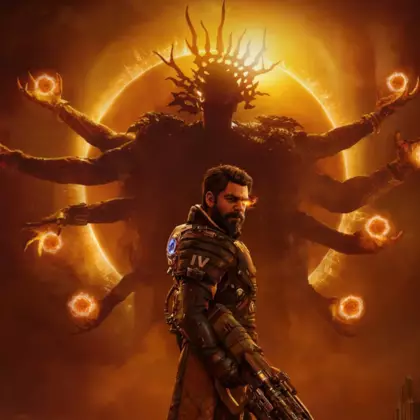
Narratively, Saros has no connection to Returnal: the events of the new game take place on the planet Carcosa, where protagonist Arjun Devraj arrives in search of his wife. He is played by the talented Rahul Kohli, the star of Midnight Mass. Devraj travels to Carcosa as part of a small expedition hired by the Soltari megacorporation. The group’s mission is to find out what happened to the previous colonists Soltari had sent to explore the planet. Contact with them was lost, and no one knows whether they survived at all, because Carcosa is a dangerous place. It is not only home to aggressive wildlife: time itself flows differently on the planet because of mysterious recurring solar eclipses, which affect everything around them, distort people’s minds, and drive them to madness.
Devraj’s main goal is to find his beloved, who arrived on Carcosa with the very first expedition, but the player is also motivated by other mysteries: the origin of the ancient civilization’s ruins scattered everywhere, the true cause of the eclipses, and the explanation for the protagonist’s immortality — whenever he dies, he resurrects in the local hub.
Saros tells its story in the same fragmented and cryptic manner as Returnal, although after finishing it, you will probably have fewer questions than you did after completing Housemarque’s previous game. Returnal’s story can be interpreted in many ways — up to and including questioning the reality of everything the heroine went through — while Saros leaves much less room for alternative readings.

That does not mean there is nothing to think about here: there are plenty of mysteries. How could it be otherwise in a story inspired by Hinduism, Robert Chambers’ The King in Yellow, Stanislaw Lem’s Solaris, and the works of Howard Phillips Lovecraft? By the way, if you are interested in other games that explore the same concepts and ideas of cosmic horror as Saros, do not miss our list of the best Lovecraftian games.
One important difference between Saros and Returnal is the presence of other characters, with whom the protagonist communicates both in the central hub and outside it during expeditions into the dangerous wilds of Carcosa. Arjun also finds plenty of audio logs left by members of previous expeditions. In Returnal, by contrast, the narrative is focused entirely on the main heroine. As a result, Housemarque’s previous project overwhelms the player with an all-consuming sense of loneliness, which Saros does not do — and many players will surely appreciate that.

In terms of themes and storytelling, Saros resembles Bloodborne: in a similar way, the game gradually pulls the player into stranger and more unsettling subjects. Even the NPCs begin to lose their minds as the story progresses, just like in FromSoftware’s project. And, as in Bloodborne, piecing together Carcosa’s lore bit by bit is a real pleasure.
It is only a shame that the game’s finale shifts the focus away from cosmic horror and toward a domestic family drama. The idea itself is not bad, but throughout the game, you keep waiting for some grand revelation that never really comes. For some, this will be a critical flaw, but a weak ending still does not change the fact that, for most of the playthrough, untangling the web of mysteries created by the writers is highly engaging.
Do you prefer ambiguous or straightforward stories?
(Not) Much Easier

Returnal often appears on lists of hardcore games: it also earned a place in our selection of the hardest games. After all, it is a brutal mix of bullet hell action and roguelike mechanics, where, on the one hand, you need fast reactions to dodge energy orbs and laser beams flying at you from every direction, and, on the other, you need patience, because runs in the game last almost two hours on average. With Saros, the developers tried to make the game more accessible, but not by simplifying the action component — instead, they reworked the roguelike elements.
For example, Housemarque added a teleport system that lets you travel directly from the hub to any previously unlocked biome. The idea is to shorten each expedition to roughly half an hour. By comparison, in Returnal, every run always has to start from scratch.
The developers also introduced a system for upgrading the protagonist’s stats using a resource collected from defeated enemies during runs. This is permanent progression: the character becomes stronger even if the player dies often. You can upgrade, for example, the health bar and the weapon level Arjun Devraj starts each new expedition with: going through the starting biome with level-one guns is one thing, but doing it with level-17 weapons right away is something else entirely. Among the early upgrades, you can also unlock a “second life” — the ability to resurrect once after death and continue the run.

On top of that, the game now has a modifier system that lets you adjust the difficulty to your preferences: you can increase the hero’s damage or reduce incoming damage. There are also modifiers that make the gameplay harder. At the same time, you have to maintain a balance between positive and negative effects: you cannot head out on an expedition with buffs alone, as they must be paid for with drawbacks. In practice, however, this is not a problem, since the player chooses which debuffs to activate.
Does this mean Saros has completely lost the hardcore edge of its predecessor? No — the game is still demanding enough that it cannot be called trivial. The new systems really do speed up runs noticeably and let you return more quickly to the place where you died, but the actual battles against enemies remain quite tough. Yes, even with all the assistive elements. Moreover, the combat has become deeper than in Returnal (more on that below) and requires even greater engagement with the chaos unfolding on screen. The bosses in Saros are also generally harsher than in the previous game.
The difficulty modifiers do not simplify firefights all that radically, and they are not unlocked right away. And if the player constantly uses teleporters, they skip older biomes and reach bosses with less-upgraded weapons than they would have after going through each run from the very beginning.

Even so, newcomers will objectively have an easier time getting into Saros. The same permanent progression greatly softens the frustration after death and removes the feeling that you have wasted an hour of your time. The problem is that, in their pursuit of smoothing out such gameplay rough edges, the developers got a little carried away and sanded down the elements of Returnal that made it a more interesting roguelike.
During a run in Saros, you are much less often forced to make the difficult decisions typical of the best representatives of the roguelike genre. In Returnal, for example, you had to unlock weapon traits by using a gun in combat, which made choosing a weapon more complicated. You also had to decide which consumable items, such as medkits, to take with you, whereas the new game has no consumables at all. From run to run, Saros’ gameplay does not fundamentally change, because there is almost no room here for creating full-fledged builds that differ strongly from one another. Underdeveloped roguelike aspects were a problem in Returnal as well, but in Saros, the developers simplified them even further, which had a negative effect on variety.
It is worth noting that the reduced number of difficult dilemmas the player faces during a run does not mean they are gone entirely. You still have to make tough decisions from time to time: for example, you often need to think about whether to take a powerful artifact with a useful bonus, such as health regeneration after killing enemies, if it also has an unpleasant side effect — say, increasing the cooldown of the dash used to dodge attacks. The most important decision is when to trigger the eclipse: it makes enemies and the environment more dangerous, but gives the player more resources and powerful artifacts. In some biomes, however, the game forces you to trigger the eclipse right at the start — otherwise, you cannot progress further.
The Best Defense Is Good Offense

Housemarque has clearly trimmed down the roguelike component in favor of more focused action. For example, the randomly generated levels have become simpler and somewhat more monotonous in terms of design than in Returnal, but this change directly affects the game’s pace: in Saros, the player practically races through each biome, moving from one battle to the next almost immediately.
The combat engajments themselves have become far more engaging than in the previous game — and that is actually high praise, considering how fun and exciting combat already was in Returnal. In Saros, it is still important to dodge thousands of projectiles flying at Arjun from every direction, but now you also have to pay attention to the color of the energy orbs.
Blue projectiles can be absorbed with an energy shield — a new tool in the player’s arsenal. In the process, it recharges a powerful power weapon that, unlike the main gun, cannot be used constantly. If the player takes a hit or accidentally absorbs yellow projectiles with the shield, their maximum health is temporarily reduced. There are also red energy orbs, which deal damage even if you dash through them: these must be parried, sending them back at the enemy. Parrying is another new mechanic without which, apparently, no modern AAA game can now exist.

Saros’ new mechanics push the player to behave more aggressively: rush into the very center of the multicolored laser show unfolding on screen, absorb energy with the shield to use the power weapon more often, and parry the most dangerous projectiles. The game turns defensive mechanics into an important part of offense. This approach noticeably deepens and transforms the gameplay, although it will not appeal to every player — rather, to those who enjoy intensity and momentum. The evolution of the combat system from Returnal to Saros is somewhat reminiscent of the jump in tempo between Doom (2016) and Doom Eternal — or from Hollow Knight to its sequel, as I wrote in my Hollow Knight: Silksong review.
What Saros’ combat lacks, however, is the interesting main-weapon traits Returnal was known for. In the previous game, for example, you could find a rocket launcher with a trait that transformed it into a fully automatic, extremely rapid-fire killing machine. Unfortunately, Saros has no such traits that fundamentally change a weapon.

On the other hand, every gun in Saros has an alternate fire mode, which essentially turns each weapon in the arsenal into two functionally different guns. This is an excellent game design decision. But it was a mistake to assign alternate fire to the same DualSense trigger as the power weapon. The idea is that a light press fires the main weapon’s alternate mode, while a harder press switches to the power weapon. Predictably, in the heat of battle, there is no time to monitor how hard you are pressing the trigger, which leads to incorrect inputs.
After a couple of hours of struggling with the default control scheme, I remapped the buttons: I separated the two weapon types from the same trigger and moved dodge to the good old “O” button, as in most console action games. Even after that, however, the controls still did not become fully ideal: no matter how you look at it, melee attack and the energy shield always have to be assigned to the same button, and that is hard to call an optimal solution.
In the Land of Titans

On the base PS5, Saros’ technical execution is almost flawless. The FPS rarely drops even during the most spectacular firefights, when the screen is filled with effects and streams of particles.
Graphically, the game looks magnificent — perhaps with the exception of conversations with NPCs, where the facial animations are too simplistic. Otherwise, it is extremely difficult to find fault with the visuals. Moreover, while many Unreal Engine 5 games look somewhat similar to one another, in the case of Saros, hardly anyone would guess that this is a UE5 project at all without learning it in advance somewhere like Wikipedia.
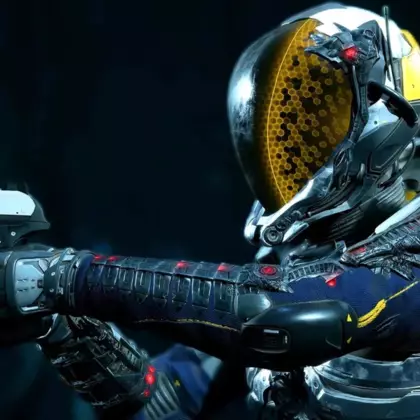
Interestingly, Saros is even more pleasing to the eye during rare moments of calm, when you can take in the grand architecture of Carcosa. Giant statues, cathedrals, abandoned fortresses, and industrial zones straight out of The Matrix make you feel like an insect in the frightening world of powerful aliens. And wherever you look, the ominous supernatural eclipse looms above you.

The excellent visuals are complemented by an aggressive electric-guitar soundtrack and an extremely high-quality audio component: if you play with headphones, you can quite accurately tell which direction projectiles are coming from, even when you cannot see them.
Thanks to its strong sense of immersion, you want to spend as much time as possible in the world of Saros, but unfortunately, after finishing the main storyline and unlocking the true ending, there is not much left to do in the game. Grind character upgrades? What is the point if the game is already finished? Saros badly lacks bonus endgame content, such as runs through some kind of endless dungeon. Of course, as with Returnal, it may be added in the future, but we are evaluating the game here and now.
More articles about fast-paced action games and shooters
- Best First-Person Shooters: Top FPS games on PC, PS4, PS5, Xbox, and Switch
- Best Action-Adventure Games
- Top 35 Hardest Video Games For PC and Consoles in 2026
- Best Metroidvania Games
- The Most Brutal and Bloody Games on PC and Consoles — Top Picks Not for the Faint of Heart
- The best superhero games on PC, PS4/PS5, and Xbox
- Best Short Games to Enjoy Over a Few Evenings
- TOP-25 Best Shooters for Low-End PCs and Laptops
***
In any case, when you finish a game and think, “I want more,” that is always a mark of quality. Saros is not better than Returnal in every respect, but overall, it stands shoulder to shoulder with it as one of the most interesting PS5 exclusives.
The most disappointing thing about Saros is its rudimentary roguelike component, but the energetic action compensates for this flaw so well that you start to wonder: should Housemarque abandon roguelikes altogether and make a full-fledged linear shooter next time? Provided, of course, that Saros sells well enough for the developers to start a new project. Yes, it is generally more accessible to newcomers, but it is still a fairly difficult and specific game, even despite the many compromises in its formula. As I wrote in the article about PlayStation’s return to exclusives, according to rumors, Saros will not be released on PC, but this decision looks like a mistake: the PS5 audience alone may not be enough to recoup the costs of this blockbuster with an indie soul.
What kind of science fiction appeals to you most?


-
![“Today we’re only talking about PS5”: Saros developer dodges question about a PC port]() “Today we’re only talking about PS5”: Saros developer dodges question about a PC port
“Today we’re only talking about PS5”: Saros developer dodges question about a PC port -
![Returnal gets PS5 Pro patch on its 4th anniversary]() Returnal gets PS5 Pro patch on its 4th anniversary
Returnal gets PS5 Pro patch on its 4th anniversary -
!["A masterpiece heir to Returnal" — Saros scores 91 on OpenCritic]() "A masterpiece heir to Returnal" — Saros scores 91 on OpenCritic
"A masterpiece heir to Returnal" — Saros scores 91 on OpenCritic -
![«It made sense»: the former head of PlayStation spoke sharply about exclusive games]() «It made sense»: the former head of PlayStation spoke sharply about exclusive games
«It made sense»: the former head of PlayStation spoke sharply about exclusive games -
![Saros True Ending Guide — How to Unlock the Secret Ending]() Saros True Ending Guide — How to Unlock the Secret Ending
Saros True Ending Guide — How to Unlock the Secret Ending