Dark Souls Trilogy
Add to My games

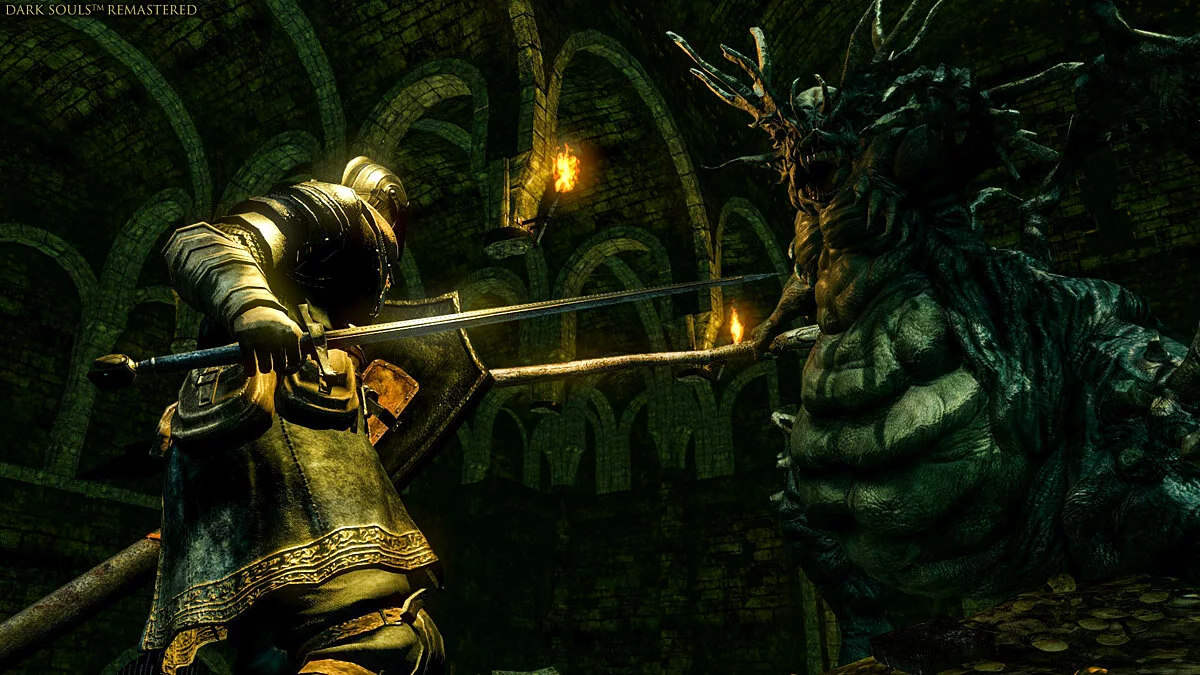
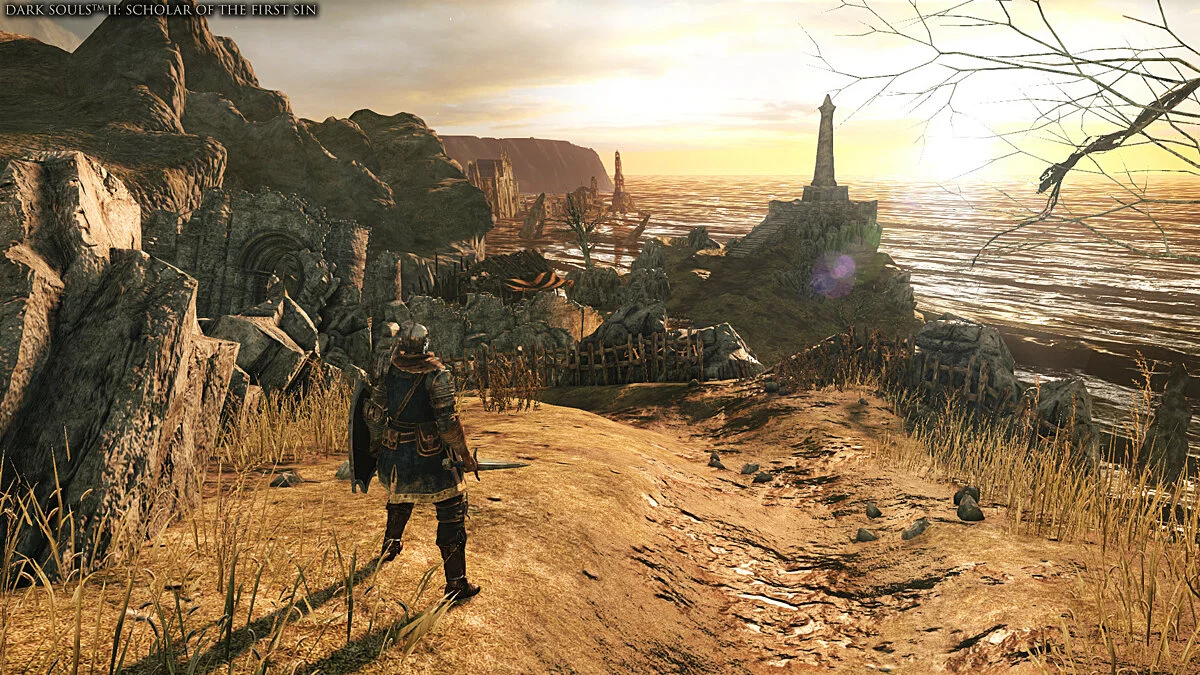


Dark Souls Trilogy is an anthology of three hardcore role-playing action games with a third-person perspective for PS4 and Xbox One, which includes: Dark Souls... Read more
Dark Souls Trilogy is an anthology of three hardcore role-playing action games with a third-person perspective for PS4 and Xbox One, which includes: Dark Souls Remastered, Dark Souls 2: Scholar of the First Sin , and Dark Souls 3, as well as all expansions with updates.
The backstory of the game world

The Trilogy takes place in an alternate reality over several millennia, in a fantasy world frozen in the Middle Ages.
Long before the start of the first game, the world of Dark Souls was plunged into darkness and cold, and the Dragons that inhabited it, along with other forms of life oppressed by them, existed outside of such concepts as life, death, and even time. This was the Age of Ancients, as it was later called, and it ended with the arrival of the Flame, which emerged from the ground and bestowed warmth and light, life and death.
The era was marked by the emergence of four Great Souls. Three of them were acquired by the giants – the necromancer Nito, who controlled death, the witch Izalith, a powerful fire sorceress, and Gwyn, the Lord of Light and a mage capable of casting enormous lightning.
The fourth soul, known as the Dark (since the Flame gives not only light but also shadow), was acquired by a dwarf named Pygmy. And although the first three souls granted incredible power, it was in the fourth that the true strength lay, as Pygmy shared his soul with all the "undead." Thus humanity was born, and all people born later carried a part of his soul.
Having gathered enough power, the alliance of Lords (Nito, Izalith, and Gwyn) waged war against the Dragons, and in victory, the trio became true gods. The world of Dark Souls began to flourish, with incredibly beautiful cities emerging. Humanity multiplied, and the gods watched over them. The first kingdoms were founded, ruled by the gods.
Over time, the world reached its peak, with many kingdoms scattered far apart, each with its own religions, knightly orders, magic, and unusual technologies for producing medieval weapons and armor.
One thousand years before the beginning of Dark Souls, the Flame began to fade, and the world began to perish. The power of the three Great Souls weakened, panic spread across the kingdoms, and the Lords and gods tried to recreate the original Flame, but these attempts failed. Chaos was unleashed, giving rise to demons, as well as mutants, various abominations, and other dangerous creatures.
The main character

Each game in the anthology has its own protagonist, as hundreds or even thousands of years pass between the events.
In the first game – it is the Chosen Undead. Through various rituals of the gods , a curse spread among people, turning many into living dead, resurrecting after death and wandering as restless spirits. They retain their mind and motor skills, but over time, they turn into hollows – true zombies.
The protagonist lives out his last days as a zombie among hollows, but by a stroke of luck, he escapes from the cell where he was imprisoned. In the future, he will learn about the prophecy that states that the undead who reaches Lordran (the kingdom of ancient gods), sacrificing their soul for the burning Flame, can change the fate of all undead and free the world from the curse.
The protagonist of Dark Souls 2 is a man who has lost his memory, recently died, and was resurrected before the events of the game. He is called the Cursed, as curses have become an element of gameplay in this part. Guided by the plot, he sets off to the once-prosperous kingdom of Drangleic, founded by a strong personality on the ruins of Lordran.
The Cursed is required to clear everything in his path to reach the royal castle and rid the local lands of the curse. It is important not to lose sanity, for which he will have to absorb the souls of encountered enemies. The possibility of saving his soul motivates the hero, but he must find and absorb four great bosses.
In the third game, it is the Unkindled, a special class of characters in the game world. A kind of failures who tried to change the fate of the undead, like the protagonist of Dark Souls, but were rejected. They must find those who managed to extend the cycle of the Flame's burning, and who have been reborn, defeat them in battle, gather the ashes, and return them to the Firelink Shrine.
The plot of the anthology

The idea of the Dark Souls writers is to show the cycle of life. But to understand this, one must work hard: the protagonist is silent, the encountered characters deliver abstract monologues, cutscenes do not reveal the essence, and information about the world is hidden in notes.
The Flame is, in a way, the soul of the people, who owe their existence to the Chosen One. Over time, any Flame extinguishes, leaders possessing the Great Soul weaken and degrade, and their attempts to hold on to power only worsen the situation. Ordinary people require more and more Humanity (a special gameplay term) to maintain a normal life.
Since the Flame cannot burn forever, it goes out, and at that moment darkness approaches from all sides, which the game identifies with a vast bestiary of various abominations, monsters, and huge bosses. At such a moment, more and more people become "living dead," kingdoms collapse, and a sacrifice is needed to reignite the flame of the people.
But another ten or twenty centuries will pass, darkness will approach again, and a sacrifice will be needed once more – thus the cycle of life continues. Meanwhile, in Dark Souls Trilogy, one can always retreat and leave the world to its fate.
Gameplay features

Dark Souls Trilogy is known for its harsh gameplay. The protagonist has two main characteristics – health and stamina, so one cannot swing weapons endlessly. The character exhausts quickly after a few strikes or a short run, and he needs to rest for a few seconds to recover.
Enemies have high durability and strength, killing with just a couple of missed strikes, but poor agility, allowing one to dodge attacks by rolling or simply evading. Defeating bosses in the Trilogy is very difficult, as each uses different abilities and can summon minions. Often, specific equipment and battle tactics are required.
In the anthology games, you need to create your character and choose a class (from 8 to 10), possessing certain characteristics (physical strength, intelligence, faith, and so on). In addition to the familiar Knight, Warrior, Mage, and Assassin, the player can choose the class of Beggar, Cleric, Thief, or Wanderer, with all classes having different base characteristics and using different equipment.
The feature of the RPG system is that any class can level up any characteristics, use all suitable equipment according to the requirements, but different weapons. Knights use sabers, while sorcerers use staffs. The hero at the end of the game can differ significantly from the starting class.
Almost all weapons and armor in Dark Souls Trilogy can be Upgraded, increasing their characteristics, gaining effects for attack or defense. You can also perform a Transformation – a complex upgrade that, if successful, will completely change the nature of the weapon. Only a blacksmith can handle this process, requiring rare resources.
Single-player game

The gameplay of all Dark Souls Trilogy games is similar. The player wanders through manually created levels, predominantly corridor-like, kills numerous regular enemies and mini-bosses, examines left notes, and learns story details.
Each level has short branches to points of interest and unique bosses, but always ends with a battle against a plot boss in a unique arena for the fight. Many levels are designed to slow down the player's progress as much as possible.
To recover after battles and long journeys, replenish health flasks, stop bleeding, save, or level up the hero, Bonfires are used in the game. By sitting down to rest, the player can stay as long as they wish, but all defeated enemies (except for bosses and some mini-bosses) will respawn.
The controls are a separate challenge. The protagonist in each game cannot jump, is slow by nature, and reacts to commands with a delay. The hero has a simple animation that does not allow for jumping over obstacles or parkour, so you need to dodge attacks in advance and not linger in battle, preferring the "hit-and-run" tactic.
Multiplayer game
From game to game, Dark Souls Trilogy offers practically the same concept of multiplayer.
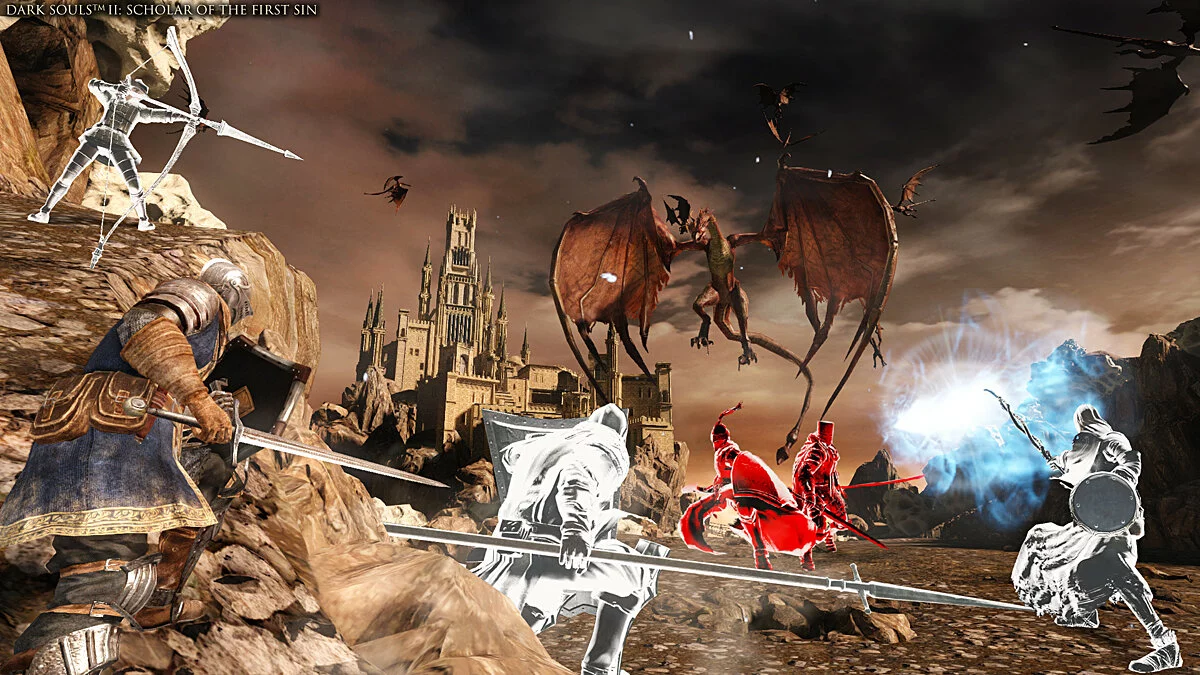
The player summons other players into their world or invades a random one. In this case, each player will remain in their own world, while the opponent is seen as a ghostly Phantom – a projection from another world.
The multiplayer mode allows players to go through the game together, cooperatively (useful for defeating particularly difficult bosses), or determine who is stronger through PvP mode (in prepared locations or separate arenas). In each game of the anthology, multiplayer has its nuances.
Among other types of online interaction is the ability to leave a message for someone (or receive one from someone), see the last seconds of another player's life (by standing on "bloodstains"), or during regular gameplay, replace the ghost (another player who is currently near you in their world).
In online play, you will have to fight more powerful and dangerous versions of monsters, demons, and bosses from the regular mode, as well as unique multiplayer enemies.
Key features:
- In Russia, the PS4 and Xbox One versions are sold with subtitles in Russian, and the edition also offers soundtracks from all three games – over six hours of music;
- The enhanced versions of the first two games contain new storylines, characters, events, more detailed item descriptions, as well as improved graphics and animation.
- The writers intentionally left many gaps and presented all events in fragments, allowing each player to create their own version of the events of Dark Souls Trilogy.
![Dark Souls Trilogy (PC) [Global] [Standard]](https://files.vgtimes.com/si/shop_194047466.webp)
![Dark Souls Trilogy (PC) [Global] [Collectors]](https://files.vgtimes.com/si/shop_194047467.webp)
![Dark Souls Trilogy (XB1) (Account) [Global] [Standard]](https://files.vgtimes.com/si/shop_121740982.webp)
![Dark Souls Trilogy (PS4) (Account) [Global] [Standard]](https://files.vgtimes.com/si/shop_116411439.webp)
![Dark Souls Trilogy (PC) [Global] [Standard]](https://files.vgtimes.com/si/shop_194103322.webp)
![Dark Souls Trilogy (PC) [Global] [Collectors]](https://files.vgtimes.com/si/shop_194103323.webp)