Intel Docs Reveal First Confirmation of Nova Lake CPU Development
 Arkadiy Andrienko
Intel's development of next-generation processors codenamed Nova Lake has received its first official confirmation, spotted within technical documents related to the company's Time Coordinated Computing (TCC) technology. This positions Nova Lake as the successor to both Arrow Lake and Panther Lake.
In the desktop segment, Nova Lake-S will be preceded by Bartlett Lake-S, also mentioned in the documents. Interestingly, Bartlett Lake-S is described as utilizing only high-performance P-cores (up to 12) while maintaining compatibility with existing platforms (LGA 1700/1800 sockets). This suggests Bartlett Lake-S may be positioned as a stopgap or specialized solution before the transition to a new platform.
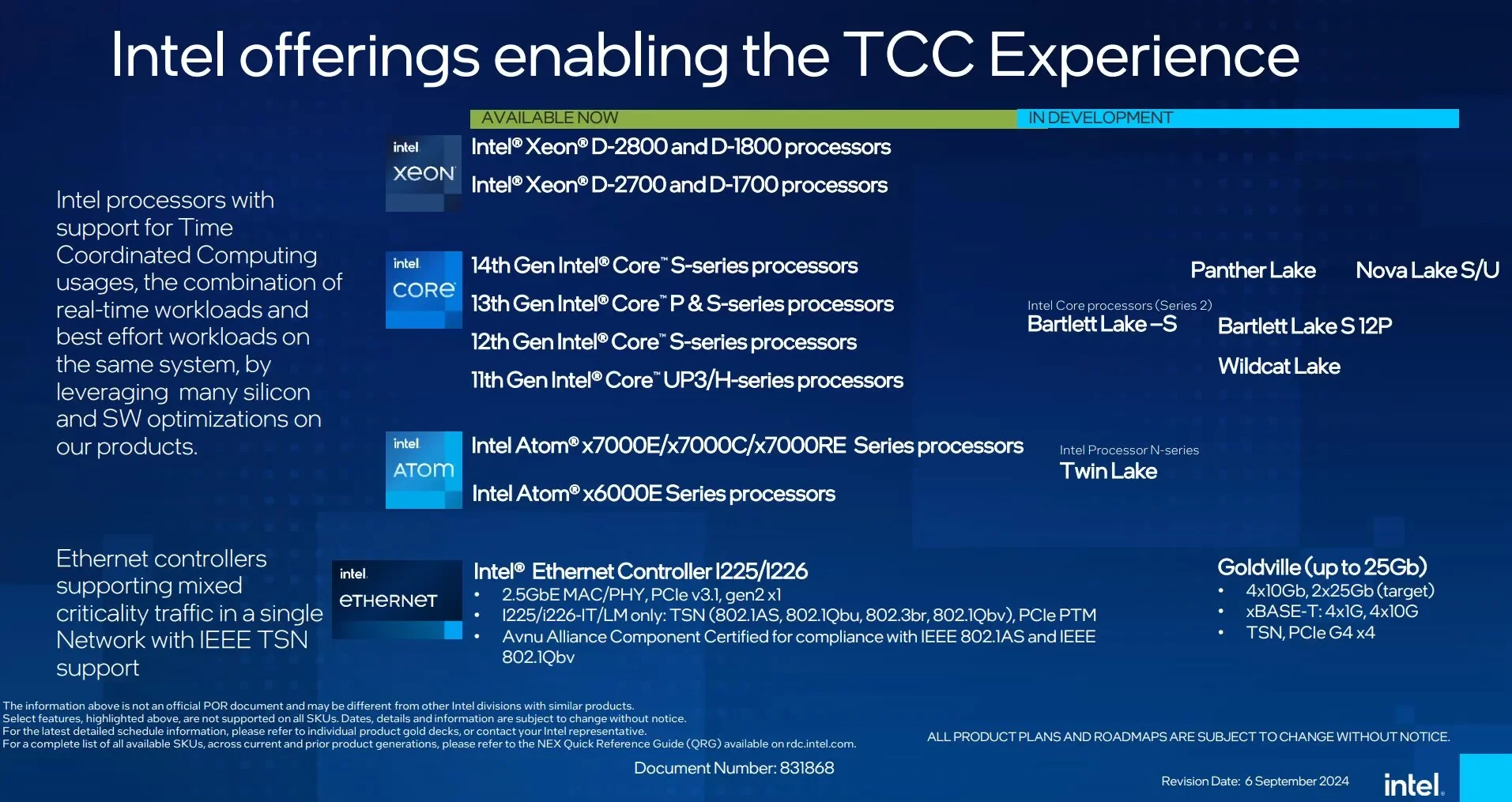
Nova Lake-S, however, will require a brand-new platform. These chips will use the LGA 1954 socket and, according to current information, are set for a significant core count increase. They are expected to feature new architectural designs (tentatively named Coyote Cove for P-cores and Arctic Wolf for E-cores). Rumors suggest configurations combining up to 16 P-cores and 32 E-cores, totaling 48 compute units (an earlier figure of 52 cores likely included additional auxiliary elements).
Therefore, these documents not only confirm the existence of the Nova Lake project but also clarify its place in Intel's long-term roadmap, coming after Bartlett Lake-S (desktop) and Panther Lake (laptop). The key highlights for Nova Lake will be a new desktop platform, a massive core count jump, and the next generation of Intel's hybrid architecture.
-
 Intel Unveils Arc Pro B50 and B60 GPUs, Plus Dual-GPU Battlematrix Platform
 -
 Intel Unveils New Core Ultra 200 Series Processors
 -
 New Intel LGA 1954 Socket Keeps Dimensions, Cooling Compatibility with Predecessors
 -
 Intel Unveils Working Panther Lake CPU Prototypes — Launch Set for Early 2026
 -
 Intel Tests AI Gaming Assistant That Doesn't Need the Cloud