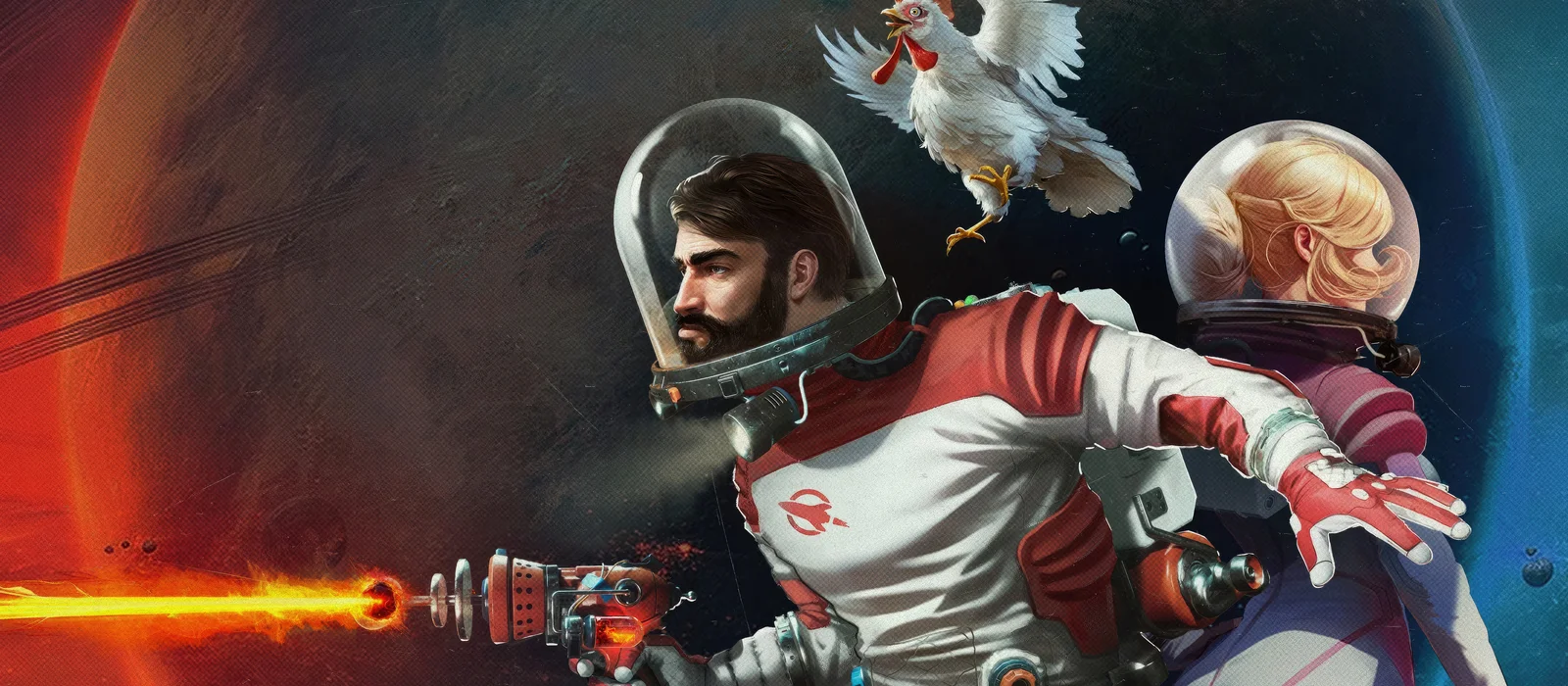
Breathedge 2 Preview — A Man, a Chicken, and Outer Space
 Dmitry Kartashov
After the very successful first installment in the adventures of "an ordinary man in space," the developers at RedRuins Softworks have presented the sequel — Breathedge 2, now available in early access. For now, players can go through the first chapter of what is set to become a large-scale adventure.
Has the sequel kept the spirit and gameplay foundation of the original? Has it fixed the flaws and major drawbacks players pointed out? And most importantly — what does the chicken have to do with it all?.. Answers to these and other questions are right here!
Playtime: 8 hours.
A Familiar Story Continues
The sequel is directly connected to the events of the first game, yet it doesn't try to repeat that story beat for beat. After a global catastrophe, humanity continues to exist in chaotic space, and the hero once again has to deal with the aftermath of a massive accident. This time, however, the story moves to a new region of space, and the familiar theme of surviving among the wreckage gets a much broader scope.

At the center of it all is once again a nameless man who has to survive in the middle of space with no proper infrastructure and limited resources. Instead of a ready-made base, he now has a damaged train frozen in the middle of a huge area waiting to be explored. The story constantly ties these circumstances to the gameplay mechanics: to move forward, you have to restore equipment, look for resources, study your surroundings and gradually upgrade your gear.
At the same time, Breathedge 2 doesn't require you to remember (or even know) the whole plot of the original. The game keeps the shared universe, the familiar absurd humor and the concept of space survival, but introduces new circumstances and characters. By the way, the famous immortal chicken — the protagonist's key companion — is right where it belongs. The familiar elements work more as a bridge between the two games than as a prerequisite for understanding what's going on.
A Junkyard in Space
The gameplay loop hasn't changed either: head out into space, gather resources, return to the train, craft new tools and use them to reach previously inaccessible locations. Unlike the first game, where you had to drill ore deposits far more often, here many useful materials have to be pulled from the environment: ripping out emergency shaft hatches, taking apart broken-down robots and so on.

This approach fits the gameplay cycle well: space turns into a giant junkyard that you gradually take apart piece by piece. Problems arise, however, when an important recipe is just one or two units short of a specific resource. In that case, you have to comb through already cleared areas again and literally go "pixel hunting."
As a result, resource gathering feels mixed. While you're opening up new territory, it blends naturally into exploration. But when the game demands a specific component for the next task, a tedious search among dozens of similar objects begins.
Oxygen, Resources and New Possibilities
The main limiting factor during zero-gravity expeditions is oxygen. The farther you go from safe zones, the more carefully you have to plan your route. You need to know in advance where the next refill point is, how long gathering resources will take and when it's time to head back. Oxygen is replenished at special stations that produce it from ice. The ice, in turn, is mined from ice blocks scattered around in abundance.

Besides oxygen, you need to keep an eye on hunger, thirst and fatigue. At launch, they drained far too quickly, so the developers slightly reworked the system in one of the patches — a good example of how early access lets the balance be adjusted right in the middle of development.
Crafting in Breathedge 2 is mostly built around tools and upgrades. New gadgets give access to objects you previously had to skip, and upgrades let you travel through space longer (and more comfortably). Thanks to this system, exploration gets a clear motivation: every new component brings you closer to the next upgrade, which in turn opens up another part of the location.
Combat and Quests
The sequel introduces the beginnings of a combat system: you now have to deal not only with stationary traps and turrets, but also with moving enemies and hostile robots. They appear periodically throughout your journey, so it is impossible to ignore combat entirely.

In its current state, however, combat falls well short of the game’s exploration. Melee encounters lack a convincing sense of weapon weight, while hits do not always provide clear enough feedback. More often than not, it is much easier to disable turrets beforehand or simply sneak past your enemies. There are no conventional firearms in the current version: in combat, the protagonist primarily relies on tools designed for survival and exploration.
It's important to clarify: the game isn't built around fights. Most of your playtime is still spent exploring space, gathering resources and progressing. Right now, combat is clearly only at its starting point — if it's refined and improved in the future, Breathedge 2 will benefit greatly.

The story of the first chapter constantly ties the various gameplay systems together. You have to restore equipment, look for missing parts, get infrastructure up and running and explore every nook and cranny of the locations. At first, this works well: the tasks encourage you to learn the mechanics rather than just follow markers.
Over time, however, quest objectives become cyclical: find an object, figure out what it's missing to function properly, go get the components, come back and repair it. In the end, the tasks feel like mechanical routine that pulls you out of the immersion a bit.
Will you play Breathedge 2 in early access?
***
Breathedge 2 already shows a solid working foundation capable of hooking fans of the genre. What works best, in my opinion, is exploration: the environment keeps surprising you with new objects, the variety of resources gives clear motivation for expeditions, and upgrades gradually expand the accessible territory. Crafting is built into this cycle just as naturally. And the signature humor, often walking a fine line, remains an important part of the adventure.
The fights look much weaker: they lack weight and expressiveness. Quests sometimes repeat the same pattern, and hunting for specific resources can turn exploration into a chore. The main limitation right now is scope. The first chapter offers enough content to understand the direction of development, but doesn't yet allow you to judge the full structure of the sequel.
What we have here is a strong foundation for a survival adventure that is only beginning to show its potential. The final impression will depend heavily on what RedRuins builds on that very foundation.
-
 Breathedge 2 Crafting Tools and Upgrades Guide
 -
 Breathedge 2 Walkthrough Guide: Collectibles and Achievements
 -
 Breathedge 2 Materials: Where to Find Every Resource
 -
 Breathedge 2 Attendant Parts: All Locations
 -
 Breathedge 2 launches in Early Access on Steam as a comedic space survival adventure
 -
 27 Best Games Like Call of Duty: Shooters Set in the Past, Present and Future