
Co-op games have been taking over the media landscape more and more in recent years, and thanks to word of mouth — social media, streamers, and content creators — they keep pulling in more players. Unfortunately, though, plenty of them turn out to be "one-hit wonders": a strong launch and a big concurrent player count don't necessarily mean a game actually deserves your attention. That's what happens with the endless wave of games in the vein of Lethal Company — they trend hard at launch, only to be forgotten within a couple of weeks, mostly because of thin content, repetitiveness, and a lack of ongoing support from developers.
When I first heard about Big Walk, I assumed it was exactly that kind of game — undeservedly "viral" and, most likely, forgettable. In reality, though, it turned out... well, you've already seen it in the headline, but let's talk through the details anyway.
Platform: PC (Ryzen 5 7500F, NVIDIA RTX 4070 Ti Super, 32 GB RAM);
Time to complete: 9 hours.
System Requirements:
Minimum: Intel Core i7-7700K or AMD Ryzen 5 1600X, NVIDIA GeForce GTX 750 TI (2 GB) or AMD Radeon R7 370 (2 GB) or Intel Arc A380 (6 GB), 12 GB RAM, 10 GB available space;
Recommended: Intel Core i5-10600K or Ryzen 7 3700X, NVIDIA GeForce GTX 1070 (8 GB) or Radeon RX 5600 XT (8 GB) or Intel Arc A750 (8 GB), 16 GB RAM, 10 GB available space.
Voice Chat, Gestures, and Tools

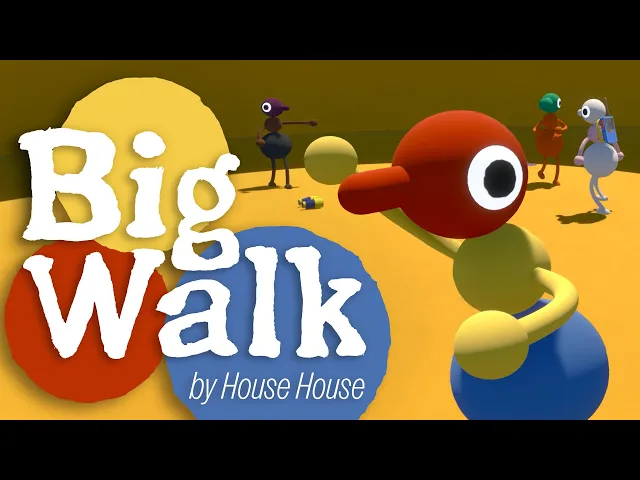
It's worth noting that Big Walk comes from House House, the team that gave the industry the indie gem Untitled Goose Game — a game about chaos, absurdity, and mischief. Their new project is the polar opposite: calm, measured, cohesive, and carrying an almost meditative atmosphere.
Big Walk has no story in the traditional sense. Players, taking on the roles of goofy ant-like characters, appear on a training ground with no introductory cutscene, no explanations, and not even a specific goal. All they have is voice communication through a built-in proximity chat, gestures, and, of course, a growing sense of curiosity.

The game doesn't explain its rules — it actively demonstrates them through the environment instead. Signs with control hints are scattered across the walls, and here and there you'll find simple mechanisms with buttons and levers — the starting "staging ground" naturally teaches players everything they'll be interacting with throughout the playthrough.
Big Walk's core tool is communication. The built-in voice chat runs on spatial audio technology: voices fade with distance, echo inside caves, and get distorted through walkie-talkies. The mechanic itself isn't new and gets used heavily by plenty of co-op games, but this one develops the idea further and applies it in fresh ways.
Another important detail is the gesture system. You can precisely control each hand individually here: spread them apart, raise them up, and so on. And this isn't just an immersion flourish — it's a mechanic that becomes an integral part of solving the in-game puzzles.
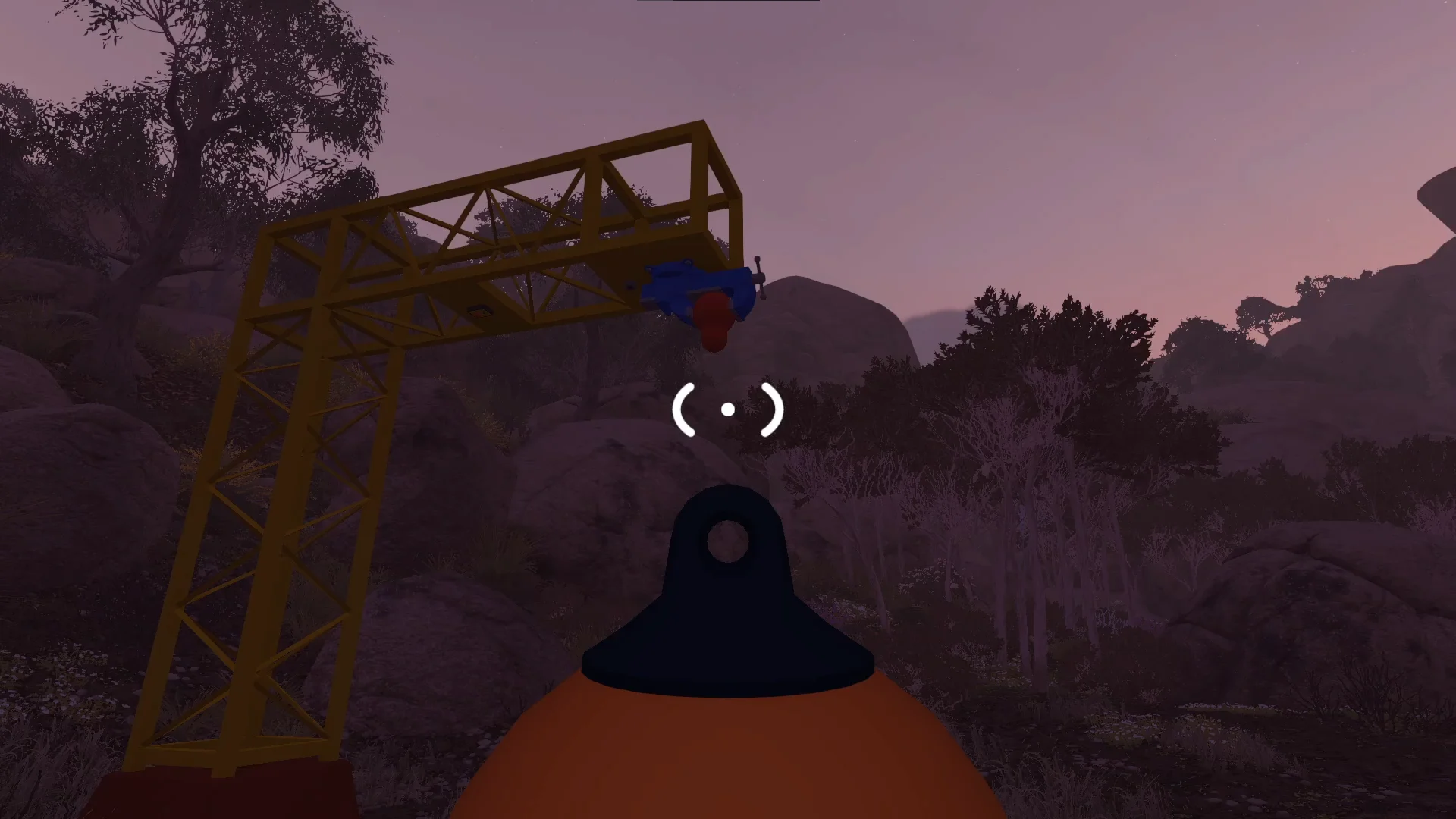
The third "pillar" of Big Walk is its wide array of tools. Some are fairly practical, like a radar that highlights interactive objects, or a flashlight; others are optional but intriguing, like laser pointers and walkie-talkies. Notably, two walkie-talkies can't be linked to each other directly — only to special receivers, which are scattered plentifully across the map.
And finally, the last key gameplay element is walking — the title itself pretty much gives it away. But it's not just walking in a vacuum; it's a proper journey from point to point, involving reading a map, a compass, and landmarks scattered around the terrain. Structurally, Big Walk is one large island packed with points of interest, and plotting a smart route between them without getting lost is its own kind of art form. There are no hints, no interactive highlights, no markers — but there is a massive cartography room that tracks the players' progress. To finish the game, you need to be able to navigate space, plan routes, and remember them.
There's a flip side to all this: you'll be doing a lot of walking — a lot — often looping back over the same routes repeatedly. That might not sit well with everyone.
The Island, "Pears," and Keys

The starting area, built around one large hub, is essentially an extension of the tutorial, walking players through an obstacle course and introducing the game's core objectives. Those objectives boil down to: work your way through a series of puzzles to earn special "Pear" activators as a reward; deliver them to a key point, usually a tower; grab a key and sharpen it by running it through a chain of special mechanisms; and open something previously locked — a passage, a system, or a fast-travel point. The latter includes a funicular, a monorail, and a web of underground tunnels running beneath the entire map.
Once you've solved the first puzzles and gotten your hands on a key, players gain freedom, though a conditional and somewhat limited one: there's no fixed route through the game. Big Walk has a dynamic day-night cycle, and the nights here are very dark — moving around without a light source becomes extremely difficult. Thankfully, large spherical lanterns are scattered around every location, and you can carry them along with you.

Each player can only carry one object at a time: a lantern, a tool, or a "Pear." But a bit later, in certain special locations, you'll discover dedicated accessories, like backpacks and belt straps, that let you attach extra items.
The game's visuals also deserve a mention. The characters are goofy, rounded, almost cartoonish. The world around them, though, is detailed and realistic, with living vegetation and dynamic lighting. Overall, the graphics are quite simple, and the biggest eyesore is the low-quality anti-aliasing. Still, Big Walk definitely has its own charm.
The middling optimization is also worth a small complaint. Despite the modest recommended requirements, Big Walk can be fairly demanding. I didn't run into any obvious issues on my PC, but the friend I played through the game with frequently complained about low frame rates and stuttering.
But all these minor shortcomings pale in comparison to the game's main strength.
Spoiler-Free Puzzles

The key feature that makes Big Walk worth selling is its meticulously crafted puzzles, built entirely around cooperative interaction. You can't finish this game solo — only with company (up to twelve friends).
And here I'm walking on pretty thin ice, because explaining the exact logic behind these puzzles would rob readers of part of the valuable experience Big Walk is built around. So here's how we'll handle it.
Most of the puzzles here are built around "fragmenting" the information needed to solve them (or splitting up the actions) — most often, it's a password made up of a sequence of symbols. One player (or group of players) gets the code, the other gets the panel where it needs to be entered. And the first player has to relay that code — through all kinds of unusual, not always obvious methods — to the second player.

Depending on the situation, everything gets pulled into service: voice, sound, tools, gestures, the environment. The sheer number of conditions and quirks packed into the game's puzzles is impressive. They rarely repeat and gradually ramp up in complexity, pushing players toward maximum cooperation and coordination.
The closest thing to Big Walk out there is the We Were Here series, with the difference that Big Walk trades cramped, closed-off locations for a large island you can freely explore. Very often, you'll need to establish a specific, pre-agreed system of communication using whatever tools are at hand — and it works beautifully. If this whole setup appeals to you and you're planning to play the game yourself, I strongly recommend skipping the rest of this section and jumping straight to the next one. That way your first encounter with the game will be more complete and won't be spoiled by even the most seemingly harmless details. For those who want more, though, here are a few concrete examples.
Scenario: there's a wall between you. One player has a set of speakers playing different tunes and sounds, out of which they need to build a sequence. The other player has that exact sequence. Your only communication channel is a microphone built into the wall. Good luck!

Have you ever tried describing a melody to a friend? For us, it turned into a mess of chaotic "doot-doots," "bam-bams," and "clang-clangs," all tangled up with laughter and jokes.
Second scenario: a platform on a tall mountain with several telescopes pointed at specific spots holding hints. There's also a slot for placing tiles depicting figures in different poses. One player's job is to run to every point, read the hints, and use gestures to show the second player, who's watching through the telescopes, which specific tiles need to go into the input slot.
And one more: a chair with headphones that block out ambient noise, plus several two-channel microphones. One player sits down in the chair and puts on the headphones. The other runs through the microphones, saying absolutely anything into each one, so the first player can figure out which microphones are "glitching" — sound only coming through on one channel, left or right.

Big Walk also features other kinds of puzzles, like ones where you need to simultaneously activate two switches located far apart from each other. Though first, you have to actually find those switches, since they're usually cleverly hidden. There are also puzzles built around finding coordinates: here you'll need a map and a special tool that displays latitude and longitude.
And sometimes, the game just asks you to... wait. You get locked in a small room with comfy little couches and a big monitor with a timer. All you have to do is wait out the allotted time. It's an arguable design choice, sure. But we genuinely got into it: sitting there, chatting about random topics, telling jokes, and venting about whatever's been on our minds.
The Ending and Secrets

Despite having no direct story, the game does carry a certain throughline: the characters need to reach a huge spherical structure hiding a strange, alluring artifact inside. To do that, you'll need to progressively activate every tower and collect every key you can get your hands on.
At the finale, players face the ultimate test of teamwork — you'll need to actually put every bit of knowledge, skill, and cooperation technique gained across the playthrough to real use.
The main ending isn't the only one, either. There's a bonus ending too: to unlock it, you need to gather every single "Pear" on the island and deliver them to a special building.

Every challenge in Big Walk can be beaten with just two players. That's how I played through it, together with a close friend, and it felt like the best way to take in the full range of everything on offer. That way, players don't miss even a fraction of the content, and the playthrough ends up feeling richer and more well-rounded. The more participants join the process, the more chaotic and unpredictable the gameplay is likely to become — though that's just an assumption on my part.
The only collectible in Big Walk, besides the quest-related "Pears," is a set of musical tracks you can play through a portable radio — another nice little touch for the atmosphere.
What do you think about playing games with friends?
***
Big Walk is a great co-op adventure for a couple of evenings, maybe three (or more, depending on your pace). It's not something revolutionary or "genre-defying," but it's a solidly made and distinctive game that blends mechanics from other popular titles while finding new solutions of its own. If you're looking for a way to relax, laugh, and rack your brain over some genuinely clever puzzles with friends, this one is not to be missed under any circumstances. The minor technical hiccups, whether graphical, audio-related (for instance, there's no way to adjust your friends' voice volume), or otherwise, undoubtedly pale next to the impression the final experience leaves behind.

-
 The Best Games for Low-End PCs and Laptops
 -
 Best Video Games for People with Short Attention Spans
 -
 Best Open World Games: TOP-100 from Skyrim to GTA 6 (2026)
 -
 Best Games to Play in 2026: Top Picks Across PC, PS5, Xbox & Switch
 -
 Best Cyberpunk 2077 Mods in 2026: Graphics, Gameplay, Romance and Optimization