Magic: The Gathering Arena
Add to My games

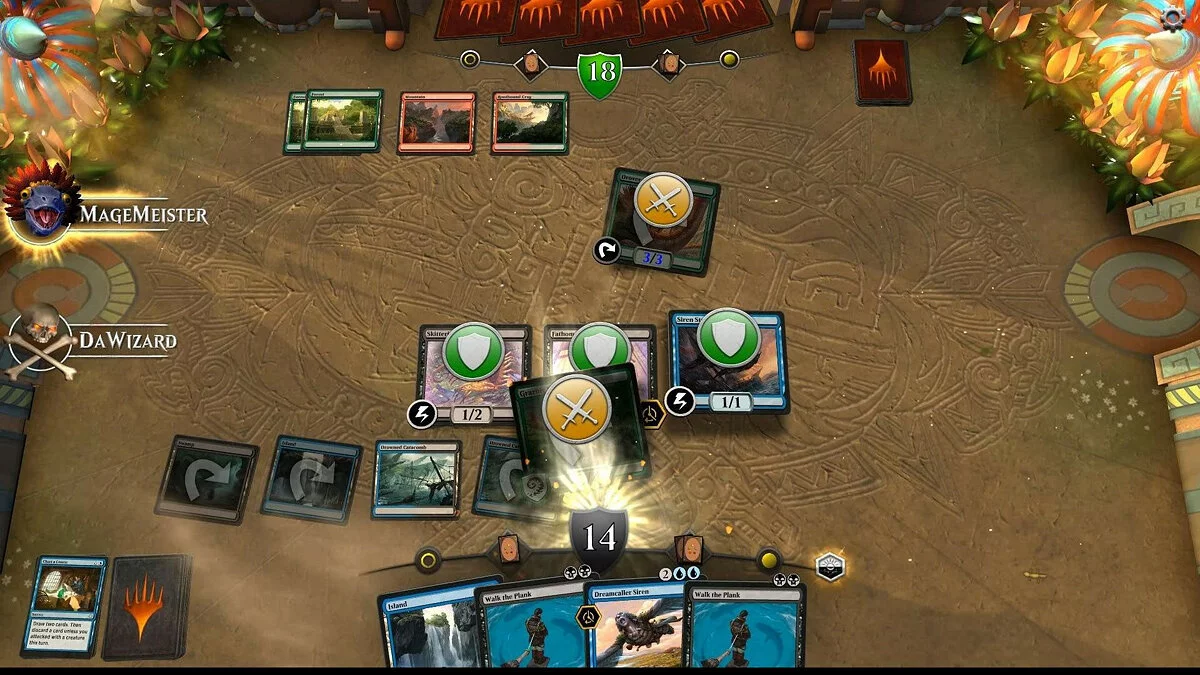
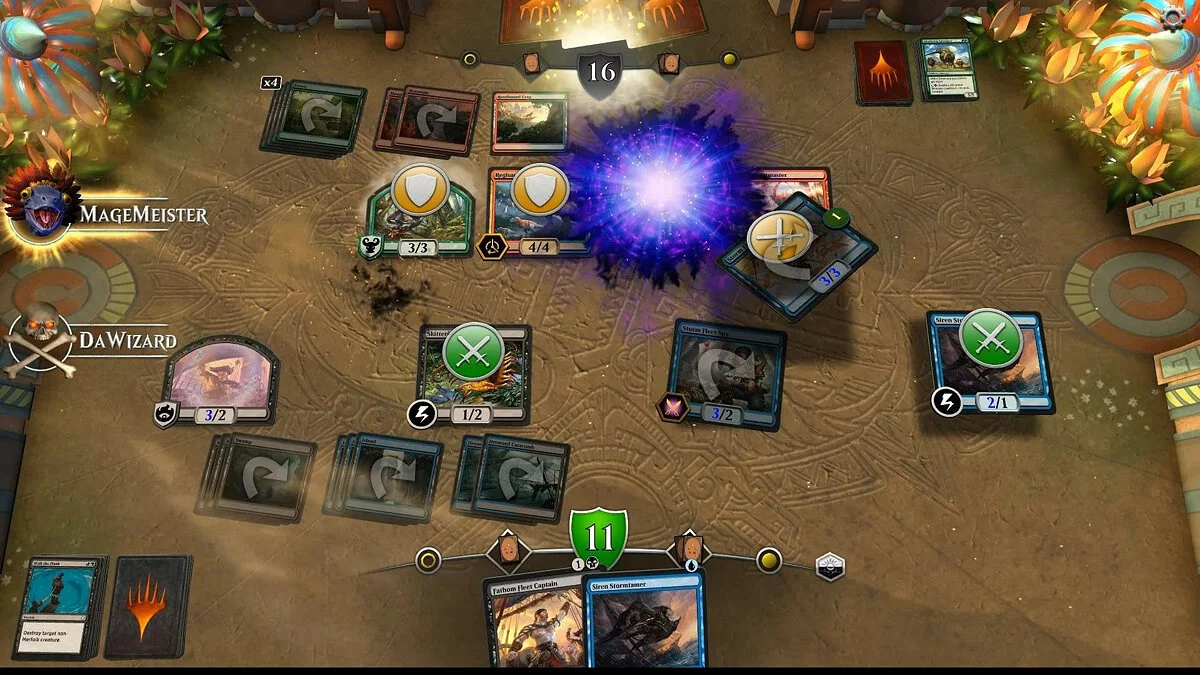



Magic: The Gathering Arena is a fantasy collectible card multiplayer game with strategic elements and an isometric view based on the popular CCG Magic: The... Read more
All languages (9)
Deutsch: interface, subtitles
Español (Latinoamérica): interface, subtitles
Français: interface, subtitles
Italiano: interface, subtitles
日本語: interface, subtitles
한국어: interface, subtitles
Português (Brasil): interface, subtitles
Español: interface
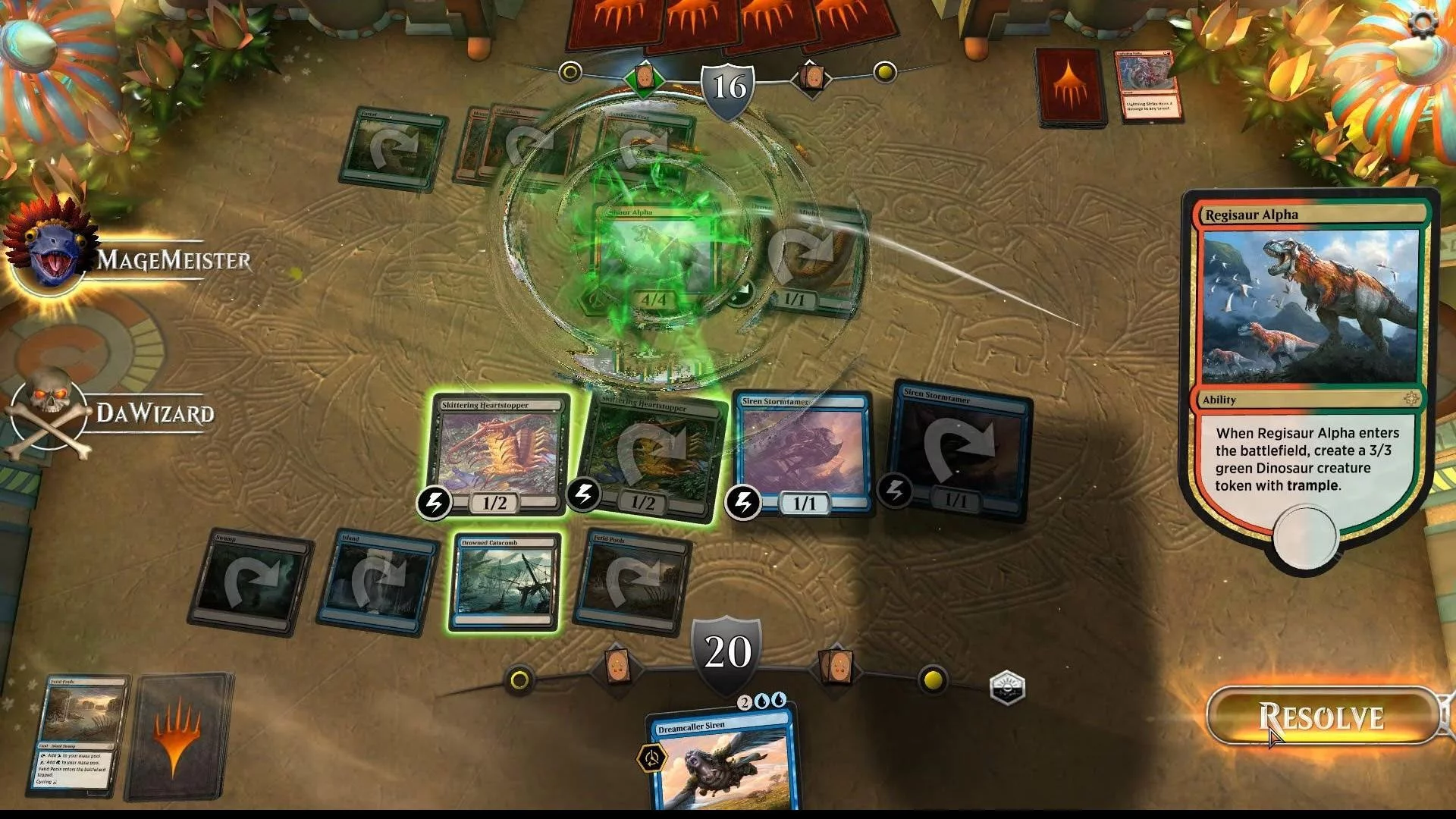
Magic: The Gathering Arena is a fantasy collectible card multiplayer game with strategic elements and an isometric view based on the popular CCG Magic: The Gathering. From the very beginning, players have access to 280 cards, and their number will increase by a thousand each year.
Additionally, the game is being developed on a completely new Game Rules Engine, which, the developers hope, will allow them to bring all their ideas to life. These include support for current and future rule sets of Magic, alongside the physical version of the game, implementation of rules and effects at the card level, which has expanded gameplay activities.
Gameplay
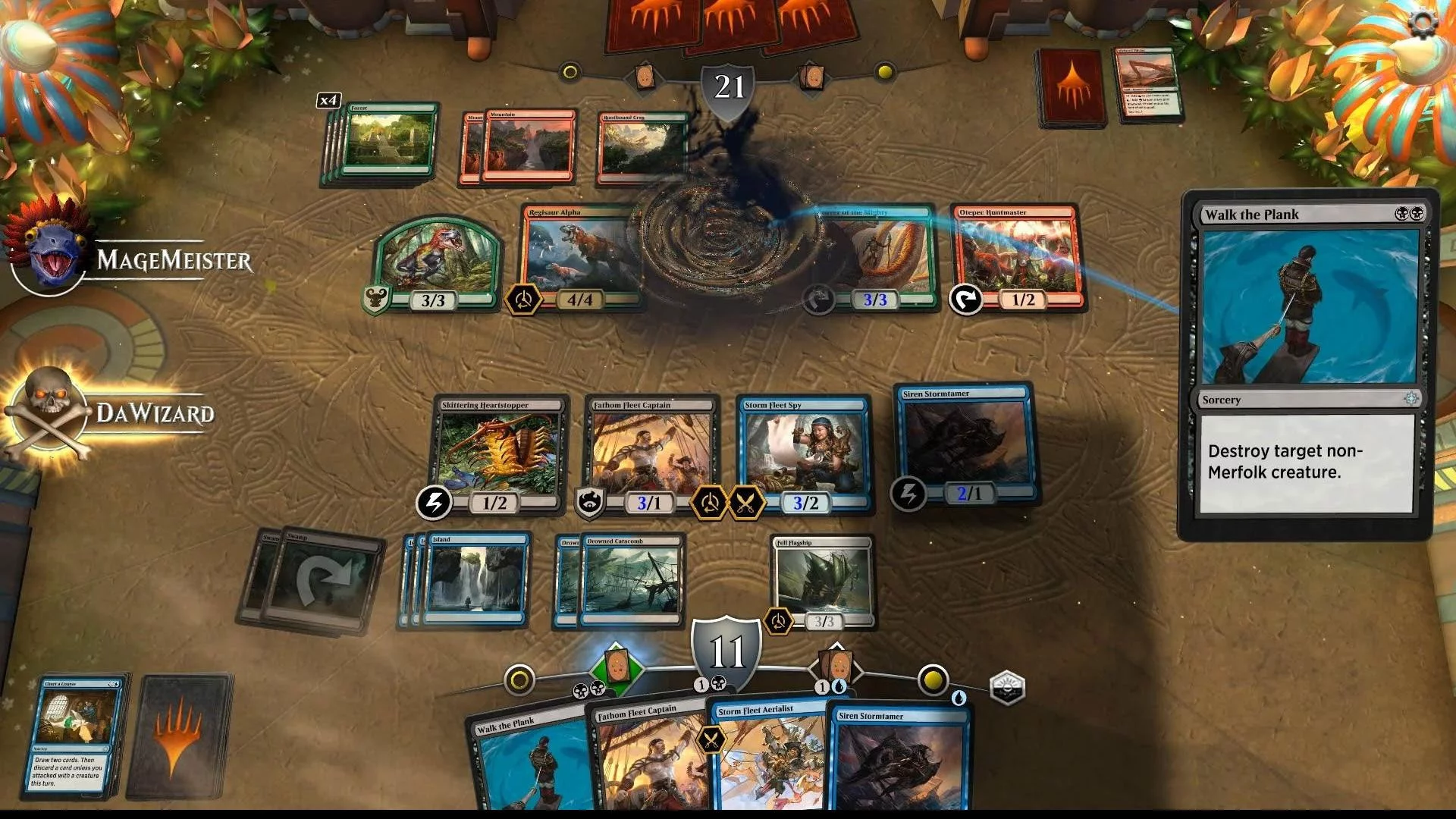
Unlike Hearthstone: Heroes of WarCraft and Thronebreaker: The Witcher Tales, MTG: Arena offers a comprehensive, complex gameplay experience with extensive options and strategy selection for victory. Currently, Arena's gameplay is focused on playing with the cards available in decks, without getting carried away with creating complete game sets as provided by the paper standard.
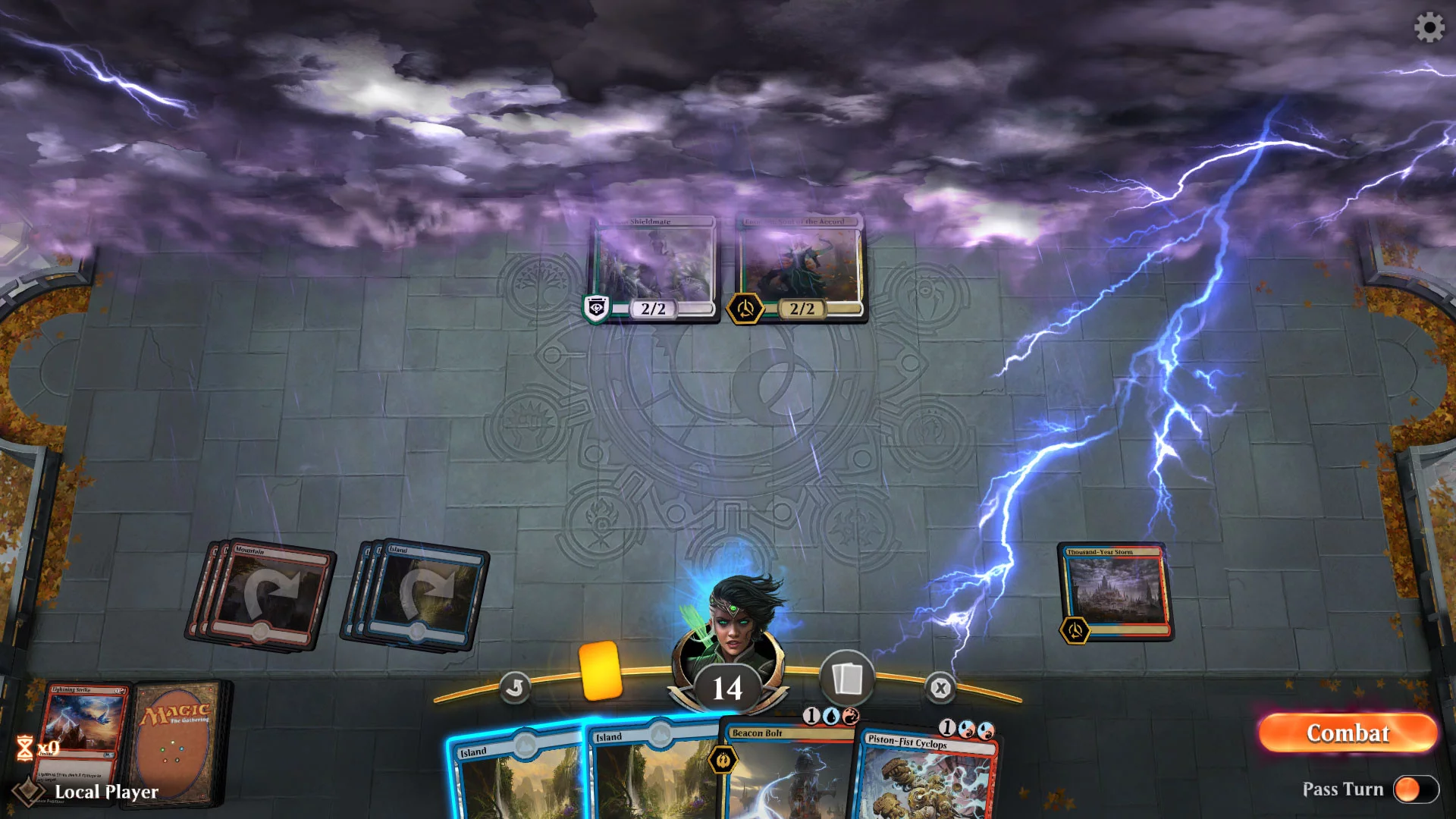
The gameplay is based on mana of five colors — white, blue, green, black, and red, generated by Land cards. Then, according to the color, Creature and Spell cards are chosen, which consume this mana. The more Land cards you have, the more actions you can take; they remain with the player throughout the match and do not interact with other cards.
The main characters are Creature cards, which are placed in front of the player's avatar on the board, blocking the path of enemies. Each creature has attack and health points, but also special abilities; for example, a creature can fly and will be inaccessible to ground creature cards. All damage dealt to creatures is healed at the end of each turn.
There are also Spell cards that act in various ways — not only enhancing the attack or health of a Creature card but also allowing you to freeze an enemy, instantly kill them, and various other effects.
MTG: Arena offers turn-based gameplay, with turns passing between opponents, but with the ability to counter each other's actions if the right cards are available. First, the first player lays out their Land and Creature cards, decides whether to attack or defend, after which the combat phase begins, when their cards attack the opponent or defend. Then the right to attack passes to the opponent.
Each player determines actions based on the current layout of cards, the state of lands, and the availability of spells, and can also give commands during the combat phase. Attacks often switch to defense, countering, or even restoring the commander and army. To win, you need to reduce the other player's health points to zero before the opponent does the same to you.
This is just a general overview of the mechanics; in the rules of Magic, there are many nuances that can overturn the chosen strategy or at least disrupt all plans. However, unlike the physical version, the computer game knows the rules, nuances, and specific details itself and suggests, for example, which card can be played now, and which one lacks mana, so players can focus directly on the gameplay.
The backstory of the game world
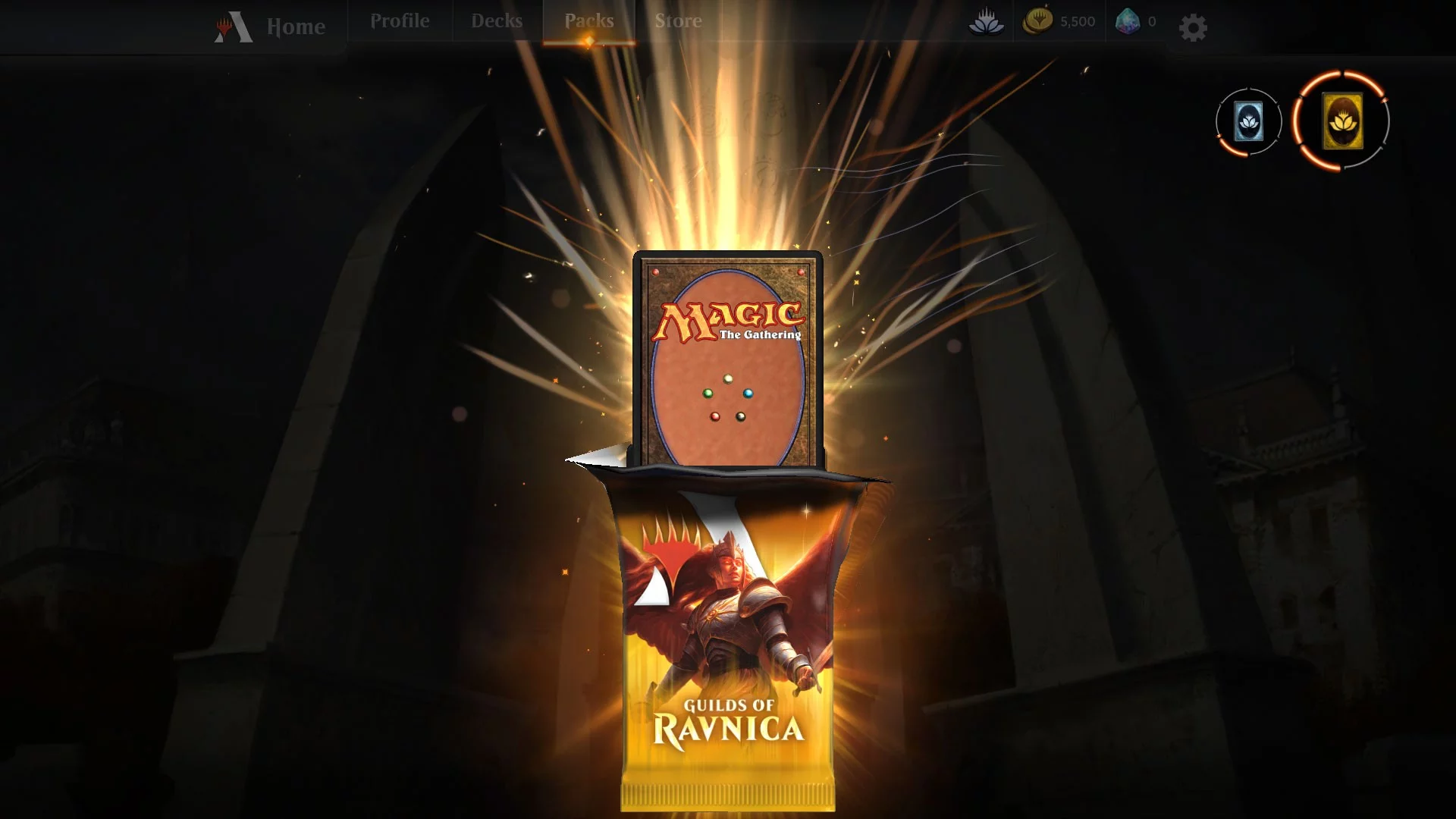
The events of Arena unfold in the same world as Magic: The Gathering — literary works in the fantasy genre. This is a multiverse where many different worlds exist: Mirrodin (a world of metal), Kamigawa (a world of Japanese mythology), Ravnica (a hive world in the style of Eastern Europe), Dominaria (a world of humans), Phyrexia (a world of machines), and others.
Some of these worlds are inhabited by humans; others — by elves, dwarves, sentient plants; others — by robots; others — by angels and demons; others — by mechanical beings. Because of this, the game's lore is constantly enriched with hundreds of new cards.
The best representatives of these worlds and races become heroes (villains), acquire specialization (wizard, inventor), and are embodied in the form of a card. This also allows playing with beloved characters in a certain gameplay style.
Card sets
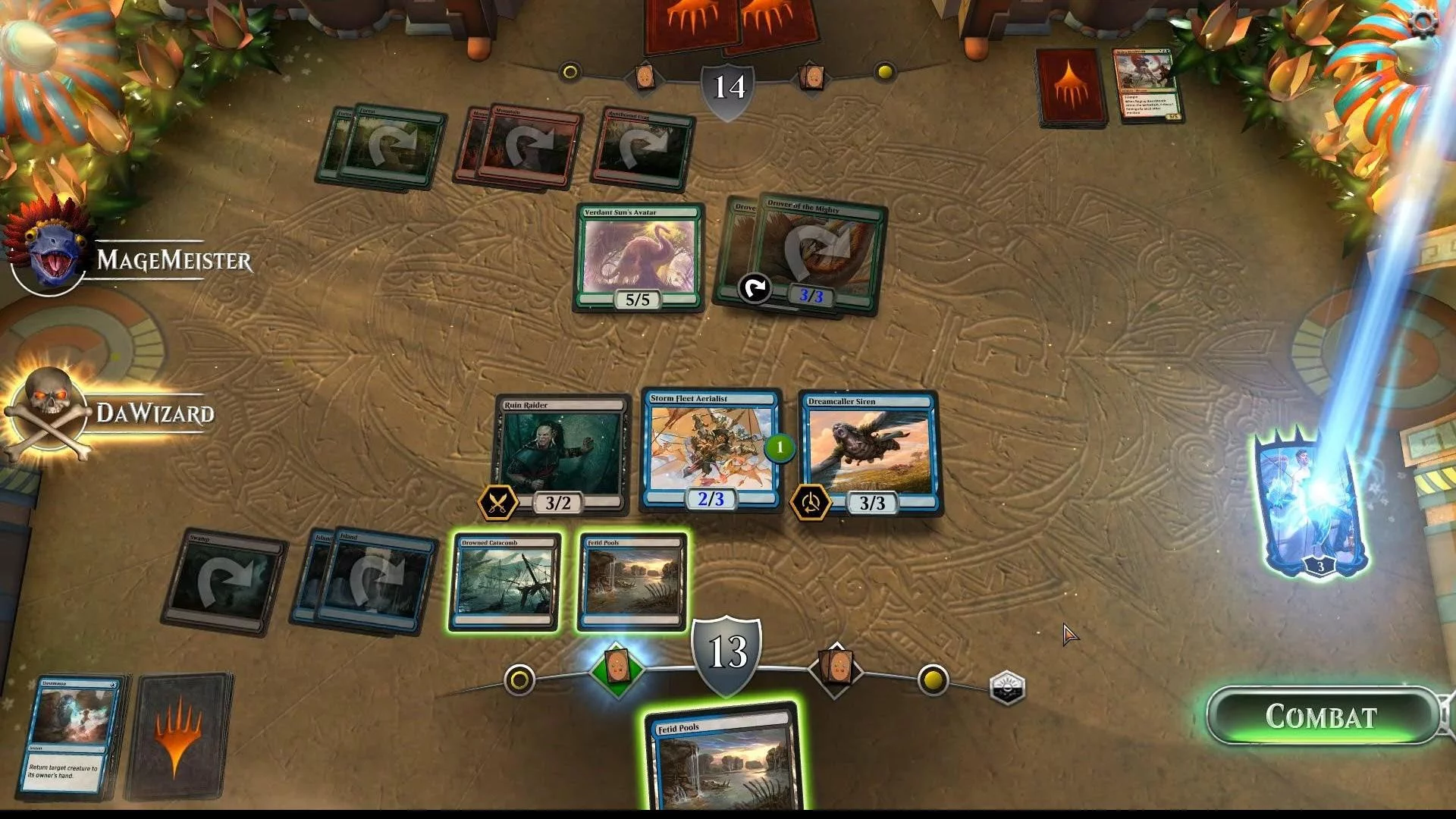
Newcomers to MTG: Arena receive a library of basic cards and ready-made decks from these cards, but the main way to get new cards is to win matches (during the day and week), complete daily quests, or invest money in the game.
In any case, the player receives a "booster" — a set with random cards (duplicates are possible), and thus replenishes their library, can customize and improve card decks. Decks are made up of 60 any cards, and the player is not required to collect them all — it is enough to take the ones they like, and then the game will balance them itself. However, experienced players create decks independently according to certain criteria.
In Arena, a booster contains only 8 cards, divided into four quality levels: "common" (black border), "uncommon" (silver border), "rare" (gold border), and "mythic" (dark red border). As expected, the higher the quality of the card, the stronger it is.
Since the starter decks are quite weak and suitable for playing against similar starter decks, it will be quite difficult to face a somewhat upgraded player. The principle of "the strongest card is the credit card" also applies in MTG: Arena, so here you can find ready-made sets of budget decks that allow for mid-level play.
Monetization
MTG: Arena operates on a freemium model with microtransactions. The game features 2 in-game currencies — gold, earned during battles, and crystals, which can be purchased for real money. Both currencies can be spent on buying "boosters," but it is also allowed to buy complete sets of cards, for which you will have to pay even more. The monetization is quite aggressive.
A successful and experienced player can earn 7 "boosters" per week, which, combined with the 8 cards in it (1 mythic or rare, 2 uncommons, and 5 commons) gives 56 cards per week. Since there are thousands of cards in MTG: Arena, building complete game decks and sets without spending money on the game will be a complex, unpredictable, and extremely time-consuming process.
Multiplayer modes
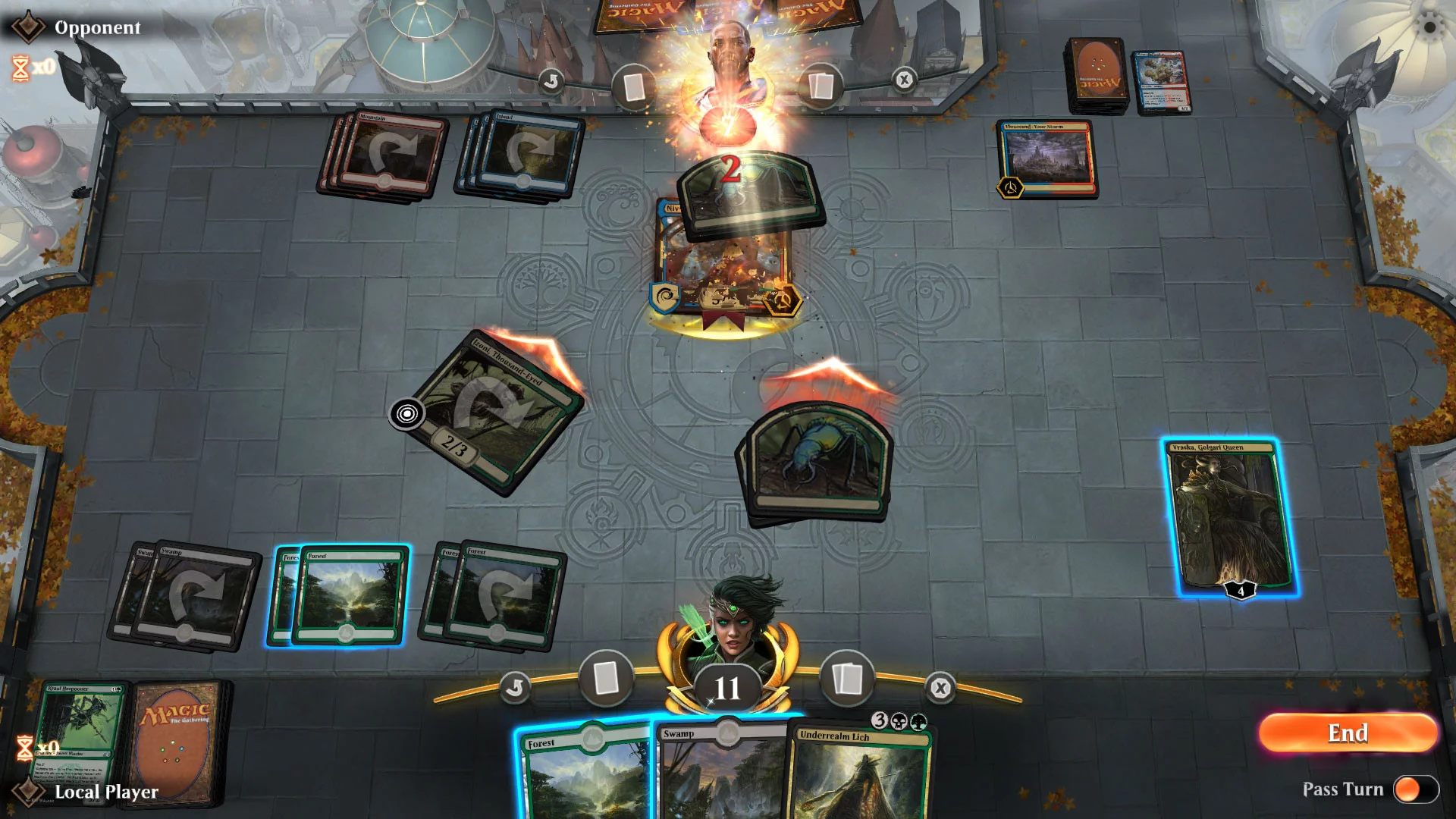
The developers of MTG: Arena offer players several modes according to their skill level:
- Casual play with a constructed deck – a no-entry-fee mode where a pair of random players determines who is better and whose cards are cooler in a best-of-three format.
- Casual ranked play – the same as above, but victories or defeats affect the player's rating, with 6 tiers from "beginner" to "mythically cool" level, and players receive special rewards for maintaining their rank.
- Direct play with a friend – the same rules as in the previous two modes, only instead of a random player, you have the chance to play with someone specific.
- The "Sealed Deck" mode is quite unusual – the player receives 6 "boosters," opens them, and then builds a 40-card deck to compete against other participants.
- Events – a more complex format with an entry fee paid in gold or crystals. They last for a long time. Access ends after a certain number of wins (usually 5 or 7) or losses (2 or 3), and participation only pays off with quality gameplay. The consolation prize is three cards of "uncommon" or higher rarity.
- Regular draft. An entry fee in gold or crystals is required, and for added interest, there are time-limited events that make the game less predictable (in one event, you need to win two out of three, in another, you play until the first win). Players simultaneously choose cards from three special draft "boosters" containing 15 cards each, for 15 rounds in a row. From the chosen cards, the player builds decks of at least 40 cards.
- Ranked draft – the same as in a regular draft, but with the consideration of a rating system with 6 tiers, and the rating in draft and casual play are different systems with separate leaderboards. Access ends after a certain number of wins (usually 5 or 7) or losses (2 or 3), and participation pays off only with a good winning streak.
- Wizards of the Coast plans large-scale esports tournaments aimed at the most experienced players. They will cover both Arena and classic Magic: The Gathering, with a prize pool of $10,000,000 in 2019, evenly split between both. An additional $1,000,000 will be awarded at the special Mythic Invitational event.
Nicol Bolas – The Deceiver!!!
- There is no and will not be a feature for trading or reselling cards to other players in the game. According to the developers, this could harm the game's economy and disrupt the matchmaking mechanics for online play.
- As new cards are added regularly, players need to consider the relevance of their decks and constantly learn from others. A deck that is promising today may lose all its advantages tomorrow and will need to be refreshed with new cards.
- Arena will not replace Magic: The Gathering Online, which continues to be supported and will serve as a repository for all card sets that have ever appeared in the series. Arena will only feature standard card sets from the moment the game is released and onward.
- Also, Arena is not considered a successor to Magic Duels, although it targets the same audience.
Store Offers and Discounts
![Magic The Gathering Arena Sliver Overlord Sleeve [Global] [Standard]](https://files.vgtimes.com/si/shop_186798725.webp)
![Magic The Gathering Arena Teysa Deck Sleeve (PC) [Global] [Standard]](https://files.vgtimes.com/si/shop_187867318.webp)
![Magic The Gathering Arena Dinosaur Deck [Global] [Standard]](https://files.vgtimes.com/si/shop_187867319.webp)
![Magic The Gathering Arena Teysa MKM Sleeve [Global] [Standard]](https://files.vgtimes.com/si/shop_188466677.webp)


System requirements and PC test
- Windows 7
- CPU: AMD Athlon 64 X2 Dual Core 5600+
- RAM: 2 GB
- VRAM: 1 GB
- Video Card: GeForce 8800 GTX
- Windows 10
- CPU: Intel Core 2 Quad Q9300
- RAM: 4 GB
- VRAM: 1 GB
- Video Card: GeForce GTX 560