
A Wireless PC: First Working BTF 3.0 Standard Computer Unveiled
 Arkadiy Andrienko
An enthusiast known by the handle DIYAPE, together with companies Colorful and Segotep, has shown the public the first fully functional PC build that is almost completely devoid of the usual internal cables. The system is built on an upgraded BTF 3.0 standard, which fundamentally changes the approach to powering components.
Unlike previous attempts where connectors were simply relocated to the back of the motherboard, the new specification offers a unified solution for the entire system. Power for the motherboard, CPU, and graphics card is now delivered through a single rear connector capable of handling over 2 kW of power. This eliminates an entire bundle of wires from the build—the 24-pin motherboard cable, EPS for the CPU, and PCI-e power cables for the GPU.
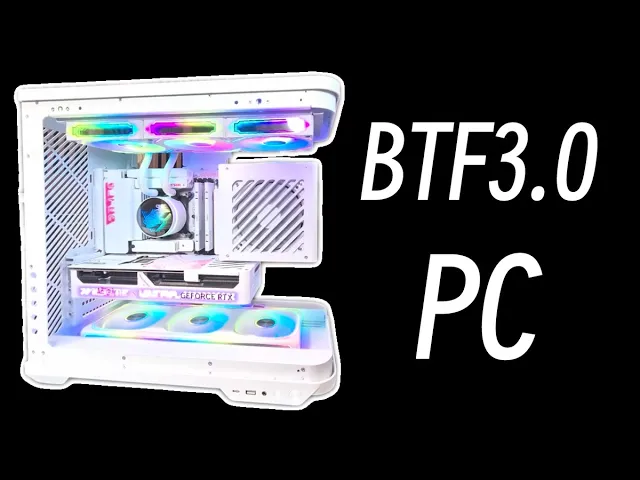
For user convenience, the components retain a hybrid design. For instance, a graphics card can operate in new cases via a contact pad, or in conventional builds, for which the traditional power connector is retained. A similar approach is applied to the power supply unit, which has done away with dangling cables but remains compatible with classic ATX systems when necessary.
The connection layout has also been rethought. All front panel ports and buttons, including USB and audio, are consolidated into a single module that connects to the motherboard with one ribbon cable, further cleaning up the interior space. For powering drives, dedicated contacts are provided directly on the motherboard, eliminating the need to run cables from the PSU.
The only components that still require wired connections for now are the fans. The developers note that technology for their wireless connection is already in active development. For the time being, this assembled concept is an engineering prototype, and its future now depends on the willingness of other manufacturers to join the BTF 3.0 alliance and start producing compatible cases, boards, and cooling systems. However, this working build clearly demonstrates that the idea of a completely wire-free gaming PC is technically feasible today.


