
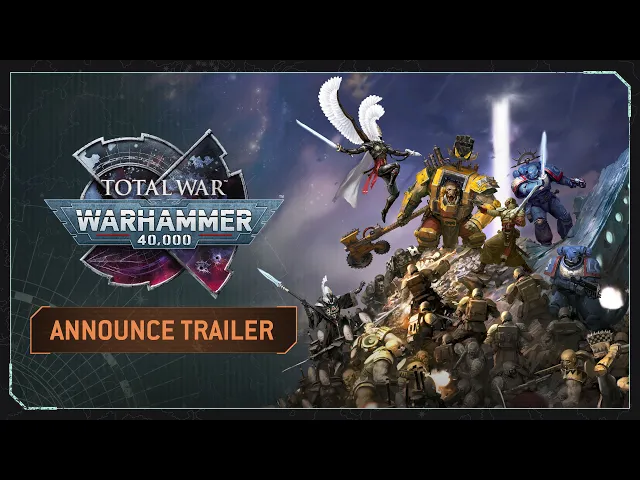
Recently, it was reported that Total War: Warhammer 40,000 has been added to Steam wishlists by more than one million users — an impressive figure for a game announced just about a month ago. Still, it hardly comes as a surprise: given the overwhelming popularity of the futuristic Warhammer universe and the proven success of the Total War series, many predicted in advance that a strategy game combining both franchises would top every possible chart. And that’s exactly what’s happening — even though we still don’t have a complete picture of what the game will ultimately be like. Some clarity does exist, however: we’ve gathered the key details about the project that are known at this point.
The Indomitus Crusade
For decades, the lore of the Warhammer 40,000 universe remained largely static: yes, important events unfolded here and there, but overall Games Workshop’s writers and the authors of official novels maintained a long-established status quo between the setting’s factions. In recent years, however, the situation has finally begun to shift. The forces of Chaos have grown more active and achieved notable successes, while the Primarchs of the Imperium — the Emperor’s own sons — have started to return to the narrative.

The events of Total War: Warhammer 40,000 unfold against the backdrop of the Indomitus Crusade — a galaxy-spanning military campaign launched by Primarch Roboute Guilliman at the twilight of the 41st millennium. Its goal is to defend and reclaim regions that have fallen under the threat of Chaos incursions and xenos invasions. The Imperium has initiated a massive mobilization of fleets and armies, including units of the new Primaris Space Marines — even more powerful defenders of humanity than their standard brethren. All these resources are being funneled into stabilizing an Imperium that has been split apart and pushed to the brink of collapse.
What are you more excited for — Total War: Medieval 3 or Total War: Warhammer 40,000?
Total Total War
The first thing many people think of when Warhammer 40,000 is mentioned is the sheer scale of the setting. This far-future age of eternal war is staggering in its scope: battles are fought by billions of soldiers over millions of worlds. Fleets capable of wiping planets from the face of the galaxy clash, while war machines the size of mountains stride across battlefields. In Warhammer 40,000, the annihilation of entire civilizations is considered a routine episode in humanity’s endless war against countless enemies from within and without.

At the same time, the Total War series is also renowned for a level of scale rarely seen in other strategy games. Battles in Creative Assembly titles featuring tens of thousands of units rival Hollywood historical blockbusters in spectacle. This makes it a genuinely perfect match for Warhammer 40,000 — something the developers have already proven with the fantasy Total War: Warhammer trilogy.
The team behind Total War: Warhammer 40,000 fully understands that they are working on a game meant to let players truly feel the magnitude of this fantastical conflict. Accordingly, the upcoming strategy won’t be about fighting over a single continent or even a single planet, but over entire star systems. The core idea is that players will not only capture regions and cities with ground armies, but also deploy space fleets to support operations from orbit. Moreover, colossal starships will allow players to traverse the void and conquer new worlds.

Creative Assembly also promises that Total War: Warhammer 40,000 will even allow players to carry out planetary Exterminatus — completely destroying worlds and leaving nothing behind. This is not a tool meant for frequent use, but in especially dire situations it may become a viable way to achieve strategic objectives.
Battles
Combat in Total War: Warhammer 40,000 is radically different from anything Creative Assembly has done before, while still preserving the spirit of Total War. Since Warhammer 40,000 is not just science fiction but, in many ways, fantasy wrapped in a futuristic aesthetic, magic-like powers and massive frontal clashes involving thousands of units in close combat still play an important role.

At the same time, Total War: Warhammer 40,000 places a much stronger emphasis on ranged units, cover systems, and full environmental destructibility. Another crucial element is the constant reinforcement of armies with new units right in the heat of battle. Each faction has fundamentally different ways of calling in reinforcements, and using them effectively has a direct impact on the outcome of a fight. For example, Space Marines can deploy drop pods from orbit at virtually any point on the map.
Asymmetrical Factions
At launch, Total War: Warhammer 40,000 will feature four playable factions: Space Marines, Aeldari, Orks, and the Imperial Guard. Not a huge number, admittedly, but Creative Assembly promises the most unique and deeply developed races in the entire history of the Total War series — both on the campaign map and in actual battles.

So far, the developers have shared only limited details, but it’s already known, for instance, that the Imperial Guard will function as a more classic Total War force. Its gameplay revolves around developing captured regions, building infrastructure, and clearly defined battlefield roles for different unit types. By contrast, playing as the Space Marines will be fundamentally different: where Orks and Guardsmen can throw thousands of soldiers into battle, the Emperor’s angels of death can field only a few hundred warriors — each of whom is capable of cutting down dozens of enemies.
Customization
One of the key aspects of tabletop Warhammer 40,000 is the ability to personalize your army — to make units truly unique and distinctly your own. Creative Assembly promises to fully carry this feature over into its virtual adaptation. Players won’t just choose factions; they’ll be able to create their own armies by giving them names, selecting color schemes, symbols, and heraldry, and finely customizing the appearance of individual warriors.
Customization will also have a direct impact on gameplay: soldiers can be equipped with different weapons, thereby defining a unit’s role on the battlefield.
New Engine — New Possibilities
Creative Assembly has finally transitioned to a new engine called Warcore. It promises not only improved visuals and animations, but also advanced destruction physics and support for systems such as cover mechanics. In addition, Warcore was designed from the ground up with future Total War releases in mind — not just on PC, but on consoles as well. It has already been confirmed that Total War: Warhammer 40,000 will be released on Xbox Series X/S and PlayStation 5.
The engine is also set to become a stable foundation for the development of Total War: Warhammer 40,000 over the next ten years. The developers plan to release regular updates, expansions, and DLCs, gradually expanding the game. There will be no full trilogy like the fantasy Warhammer series — no direct sequels are planned, with the focus instead placed on long-term content support.
***

There’s still a lot we don’t know about Total War: Warhammer 40,000 — the game doesn’t even have an approximate release date yet. It’s unlikely to arrive anytime soon, as Creative Assembly often announces projects years before launch. In this case, Warhammer fans speculate that Total War: Warhammer 40,000 could be released in September 2027, in celebration of the universe’s 40th anniversary.
Are you disappointed that there will be only four factions at launch?

-
 Total War: Warhammer 40,000 Hits 1 Million Wishlists Milestone One Month After Reveal
 -
 Rumor: Microsoft Prepping New Age of Empires on UE5, Next StarCraft to Channel Warhammer 40,000: Space Marine Vibes
 -
 Five minutes of new Warhammer 40,000: Dark Heresy footage shown by Owlcat Games
 -
 Warhammer 40,000 fans have seen a hint of the legendary event — the reunion of the two primarchs
 -
 The Warhammer game developer admitted that he does not understand AI, but forbade employees to use the technology
 -
 What You Need to Know About Dark Heresy — a New CRPG Set in the Warhammer 40,000 Universe