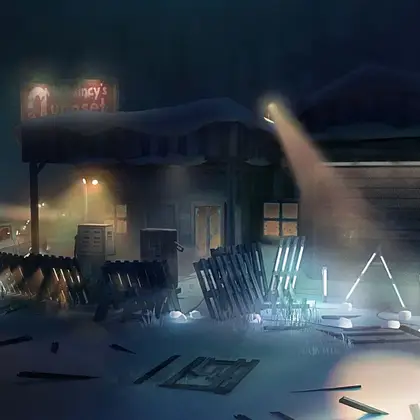
500 liters of whale oil, 600 liters of water, and a boiler that can explode: getting the Prototype Train running in The Long Dark: Iron Road is no simple task. And that's before you even get behind the controls, which take some getting used to. We've put together everything you need to know about this vehicle: where to find it, how to get moving, reverse, refuel, and keep it from breaking down along the way.
How to Reach the Train

Along the way, you'll find hand-drawn maps. They don't appear on the regular regional map you open with M, so look for them in the Notes tab of your Journal instead. The sketches are only approximate, so use major landmarks to work out where you are.
The journey to the train takes about an hour, so don't panic if it feels like you're heading the wrong way. Here's the route:
- Leave the lighthouse and turn left;
- Head downhill and cross the ice toward the hangars and railway station;
- Check the hangars for Brake Shoes. They're your first spare train parts, and they don't weigh much;
- The station itself is fenced off, so you can't get inside yet, but you can search the small buildings farther downhill;
- Get onto the tracks and follow them to the left, since the route to the right is blocked;
- Look for a cave to the right of the tracks. It leads up to the church and then farther uphill, where you'll need to attach your rope to a rock, climb down, and continue straight ahead;
- You'll enter the next region, Anna Island Track Section 5;
- Keep following the tracks without turning off. Toward the end of the section, past the second depot and the waterfalls, you'll reach a closed gate;
- Turn left at the gate and continue a little farther to find a climbing rope;
- Climb the rope to reach Anna Island Track Section 6, where the trail winds across bridges between cliffs for quite a while;
- Eventually, you'll reach the tracks again. There's a gate to the left, but you need to go right;
- Follow the tracks all the way to the end to finally reach the train.
Along the way, you'll pass cabins and caves you can loot, as well as depots stocked with water and whale oil. Those depots aren't much use at this stage, since you don't have the train yet.
Where to Find the Train Key

You can't just walk into the cab. There's a small building beside the train containing the train key, Wax Cylinder No. 7, and Alice's Journal. The journal is easy to miss because it looks like an ordinary book you might use as tinder. Another cylinder, No. 8, is lying outside nearby. Pick up some Scrap Metal while you're here, too. You'll need it for repairs.
What's Inside the Cab
Inside the cab, you'll find:
- A whale-oil-powered engine with a firebox and a spot above it for a cooking pot, where you can cook food and boil water;
- A gear selector with an indicator showing the selected gear;
- A brake with a sign showing whether it's engaged;
- A whistle;
- 2 gauges, one for whale oil and one for water;
- A bed;
- A kitchen cupboard with 45 kg of storage capacity.
Once you're aboard the train, a separate section appears in the menu showing its condition. There you can check the wear on 4 components (Wheels, Brake Shoes, Cowcatcher, and Boiler), along with your whale oil and water reserves.
How to Start the Train and Get Moving
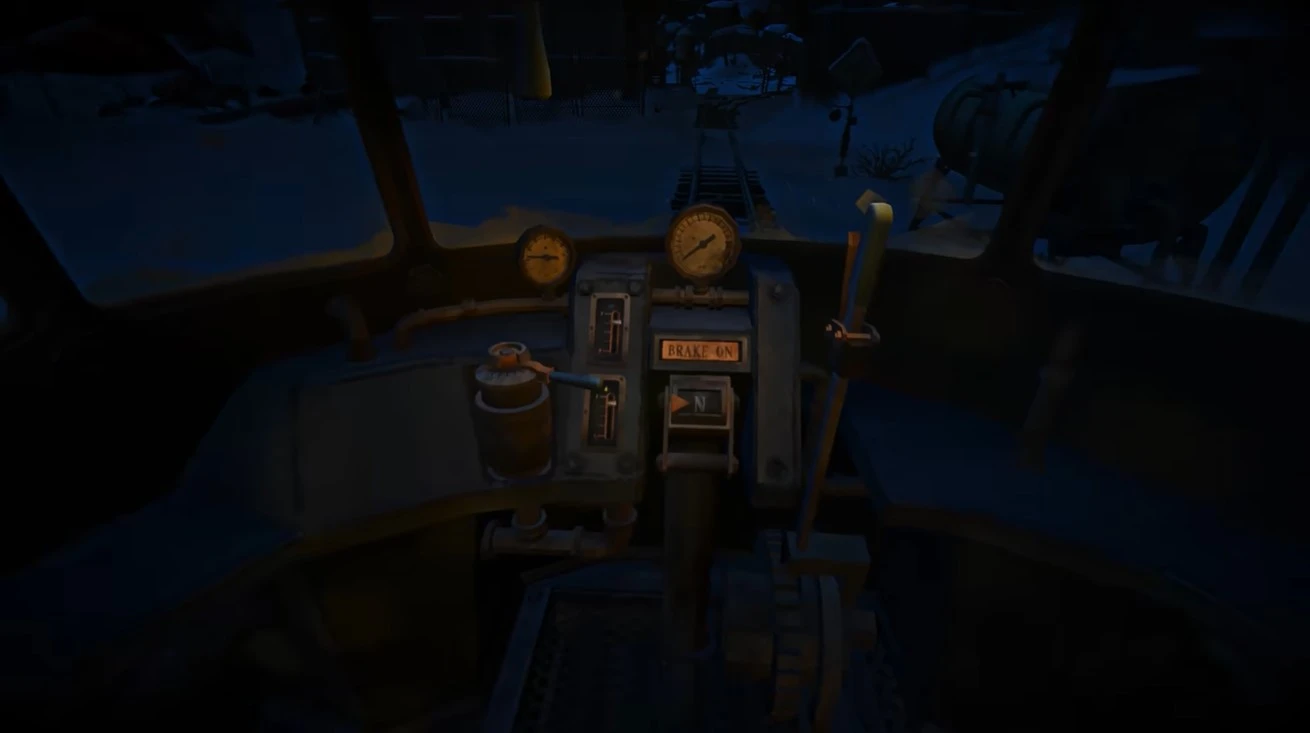
Before starting, check both gauges. The tanks usually already contain a decent amount, just not the maximum. For example, you might have 390 out of 500 liters of whale oil and 540 out of 600 liters of water.
Then follow these steps in order:
- Light the firebox so the boiler starts building pressure;
- Wait until the pressure gauge reaches at least 25 PSI;
- Release the brake and make sure its sign shows that it's off;
- Shift out of neutral into first, the slow gear.
If the firebox is burning but the train won't move, check all 3 requirements: pressure, brake, and gear. The train won't budge if even one of them isn't right. Pressure rises by roughly 7 PSI per second, and it's better to let it build beyond the bare minimum of 25 before setting off. That way, you'll have steam in reserve if you encounter an obstacle.
By the way, the train sometimes starts jerking in place. The fix is simple: leave the cab and get back in.
Slow and Fast Gears
The train has 2 forward gears, and each consumes steam at a different rate.
Slow gear uses 5 PSI per second, while the burning firebox produces 7. That means the pressure continues to rise slightly as you travel, and your top speed is 8 on the train's own speed scale. That's more than enough for ordinary trips.
Fast gear consumes 14 PSI per second, meaning the pressure drops by roughly 7 PSI every second. Starting at 300 PSI, you can keep it up for about 39 seconds before the pressure falls below 25 PSI and the train stops. So you can't stay in fast gear all the time. Switch to it before an obstacle, then shift straight back to slow gear afterward to let the pressure recover.
How to Reverse the Train

Reverse is on the same lever as the forward gears, in the R position. The normal interaction only cycles through the forward gears, so it's easy to miss. On PC, right-click the gear selector to engage reverse. Once you've shifted, check the indicator to make sure you've selected the correct direction.
You can barely see what's behind you from inside the cab, so look through the side window while reversing.
Reverse is especially useful at closed gates. Some lead to islands the developers haven't released yet: at the expansion's launch, only around 30 km of the promised 100-plus km of track is available. If a gate displays a message saying that the area will open later, back up and continue along the accessible tracks. There's also a launch bug that can leave the train stuck in one of these gates. If it happens, try reversing out.
How to Ram Through Obstacles

You'll come across blockages on the tracks, and the only way through them is to ram them. What matters is your speed at the moment of impact:
- Ordinary snowdrifts can be cleared at any speed, costing you about 1 unit of speed;
- Medium obstacles require a speed of at least 7, which slow gear can achieve;
- Heavy obstacles only break at a speed of 12 or higher, so you'll need fast gear.
If the train hits an obstacle and stops, the blockage will remain, and hitting it again at the same speed won't accomplish anything. Reverse, build up pressure, and accelerate along a straight stretch of track. Each impact costs the Cowcatcher 2 durability points for a medium obstacle or 4 for a heavy one, so don't waste fast gear on every little thing.
Not everything can be rammed. Railway switches are operated using levers beside the tracks, and some gates open as you progress. However, routes to the other islands remain closed until future updates. Be careful in Track Section 3: a switch there may fail to work even when you've set it correctly, leaving the train firmly stuck in a rail cart.
Damaged rails are another hazard. They damage the Wheels if you travel over them faster than 7. The higher your speed, the faster the damage builds up, until the wheels begin losing 5 durability points per second. Slow down below 7 before you reach the damaged section. Better yet, repair the tracks themselves: stop in front of them, shift into neutral, apply the brake, leave the cab, and use a Heavy Hammer to fix the rails. You won't need Scrap Metal, but the job takes around 2 in-game hours.
How to Refuel the Train

The train runs exclusively on whale oil. Firewood and coal won't work as engine fuel. While the firebox is burning, it consumes 0.5 liters of whale oil and 0.5 liters of water per minute, even when the train is stationary. A full oil tank lasts about 16 hours and 40 minutes of operation, while a full water tank lasts around 20 hours. Worn Wheels increase consumption.
The easiest places to refuel are the stations along the tracks, each stocked with 5,000 liters of whale oil or water. Alice marked some of these stations on the map inside the cab, but there are others as well. Here's what to do:
- Approach the station slowly;
- Look for a small round flag resembling a lightbulb. It stays black while the train is incorrectly positioned;
- Stop when the flag turns green;
- Leave the cab and use the transfer point at the station.
If the transfer option is unavailable and the flag remains black, move the train a little. You can't reliably judge its position from outside, so use the indicator visible from the cab.
Remember that refueling happens outside, so you can't wait it out in the warm cab. Filling the large water tank can take dozens of minutes, so if there's a blizzard, build a fire nearby beforehand. Check both tanks before leaving: finding an oil station won't help if you're almost out of water.
You can also top up with whale oil and water from your own supplies. The train has separate exterior panels for oil and water; interact with the appropriate one and select the option to transfer supplies to the train. Just remember that a standard canister holds only 5 liters, while the tank takes 500, so for longer journeys you'll still want to plan your route from station to station.
How to Repair the Train

All 4 train components wear down, and you'll need a Heavy Hammer to repair them. The repair costs are:
- Wheels: 1 Scrap Metal restores 20 durability points; below 50% condition, it costs 2 Scrap Metal to restore 25 points;
- Cowcatcher: 2 Scrap Metal restores 20 durability points; below 50% condition, the cost rises to 4 Scrap Metal;
- Boiler: 2 Scrap Metal restores 20 durability points; below 25% condition, it costs 3 Scrap Metal to restore 25 points;
- Brake Shoes: 1 spare Brake Shoe fully restores the component.
A normal repair takes about an hour, or roughly an hour and a half when condition is low. There's little point in repairing a component that's almost intact: a Cowcatcher at 92% condition will recover just 8%, but you'll spend the same amount of Scrap Metal.
Here's how wear affects each component:
- Wheels below 75% condition reduce top speed to 90% and increase fuel consumption by 10%. At 0%, speed is halved and consumption rises by 25%;
- Brake Shoes wear down when braking, especially above speed 8. Once completely worn out, the brakes are 4 times less effective;
- A broken Cowcatcher makes the train slow down much more sharply with every impact;
- The Boiler is the most dangerous component: at 0% condition, it explodes.
To preserve your Brake Shoes, slow down early and coast in neutral instead of holding the brake until the last moment. A spare Brake Shoe weighs only 0.5 kg, so it's worth keeping a couple in the train's cupboard.
One more thing about the Boiler. You can push the pressure beyond the usual 300 PSI to around 400, boosting top speed by roughly 15%. But at that pressure in fast gear, the Boiler wears out quickly. If its condition is below 50%, there's a 50% chance of an explosion every 10 seconds. Below 25%, that chance rises to 75%.
Using the Train as a Mobile Shelter
With the firebox lit, the cab becomes roughly 20 degrees warmer. The train also stores heat: for every hour of operation at full power, it accumulates about 12 minutes of residual warmth, up to a maximum of 3 hours. Even after the fire goes out, the cab stays warm for a while.
The bed provides roughly 6 degrees of warmth while sleeping and restores 2% health per hour. However, you can only sleep or pass time while the train is stopped. You can't drop items on the cab floor, and placing a cooking pot requires a separate interaction. So keep everything important in the 45 kg cupboard: your Heavy Hammer, Scrap Metal, and spare Brake Shoes should always be within reach before starting the next section.
Remember that whale oil and water continue to burn during long stops if the firebox remains lit. If you aren't planning to set off again soon, decide what matters more: warmth right now or enough fuel for the journey ahead.