
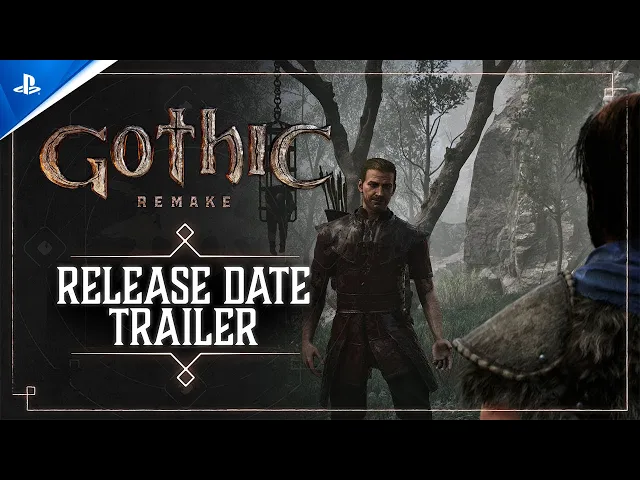
On March 15, 2001, the legendary Gothic was released on PC. It's a hybrid of RPG and third-person action with a well-designed open world, a solid storyline, and engaging gameplay that might seem quite hardcore by today's standards. A remake of the first Gothic will be released on June 5. But today, we invite you to reminisce about the original game and its direct sequels.
About Action and RPG Hybrids
Attempts to combine different genres in a single game have been made numerous times. For example, many developers thought it logical to add character stat enhancement to an action game alongside open-world exploration. About a month before Gothic, Blade of Darkness (2001) was released on PC, also known as Severance. It featured an excellent combat system, character class selection, and experience points for leveling up. However, the enemies were too powerful, so players had to spend a lot of time mastering their combos. The project failed to sell, and the planned Xbox version of Severance was canceled.

Gothic can also be considered an attempt to combine action and role-playing. And it proved much more successful than its competitors. The press claimed that it was one of the first such projects to strike a balance between all the components. Moreover, for 2001, it seemed innovative and bold. The game wasn't a hit, but it performed well in the European market.
It's fair to say that such genre hybrids are currently thriving, as all the Soulslikes released in recent years fall into this category. The most interesting action RPGs have made it into our selection of games with the most unusual combat systems.
The plot of the first Gothic. A prison from which there is no escape
Gothic is set in a fantasy world that is somewhat reminiscent of the early Middle Ages. Humans are waging war against the orcs, and victory requires the magical ore found on the island of Khorinis. To facilitate mining operations, prisoners were sent there and sealed behind a special barrier, allowing passage in one direction and preventing return. However, the dome turned out to be larger than planned, so the mages who built it, as well as the surrounding settlements, were accidentally trapped within.
The society beneath the barrier was led by the crime lord Gomez, who agreed to supply ore in exchange for food, weapons, and other resources necessary for survival. Furthermore, a steady influx of new convicts was ensured. The prisoners later split into three camps, named the Old, the New, and the Swamp. The inhabitants of the latter fell under the influence of the ancient demon Sleeper, who, with their help, sought to return to the world of the living.

At a certain point, a nameless hero appears under the dome. He will be the protagonist of the first three games in the series and a key character in the fourth. He will play a decisive role in the fate of the island, find a way to approach the cruel orcs, and witness with his own eyes the very Sleeper of legend.
We won't reveal all the plot details. Just believe us, the world of Gothic conceals many secrets that are best unraveled for yourself.
Gothic Gameplay. A Genre Hybrid with a Thousand Nuances
Gothic's capabilities can surprise even the modern player. There's a full-fledged combat system with simple combos, the ability to fight with melee weapons, bows, and crossbows, as well as magic. However, you won't be able to learn spells at first, so you'll have to master the mechanics of swordplay. The game also features lockpicking and pickpocketing, butchering, and secondary skills similar to acrobatics. Completing quests and killing monsters will earn you experience, but to master the necessary skills, you'll need specific trainers.

Each character here lives their own life. A daily routine that directly depends on their activities. Therefore, you might not find the same NPC who was there a couple of hours ago. Furthermore, locations change as the story progresses—areas cleared of enemies become populated by animals, camps come into conflict with each other, and new quests open up for the protagonist. These nuances create a convincing illusion that we are dealing with a truly living world, in which the player is not the center of the universe, but just another convict.
However, not all players realized these nuances. Many encountered problems early on, as even a fight with a weak wolf initially seemed like a real challenge. As you level up, you'll become stronger, but you'll encounter more challenging enemies, such as crawlers and orcs.

Another obstacle for newcomers is the local interface. To select an item, simply clicking on it with the mouse isn't enough; you also need to use the movement keys. A similar system is used during battles. This is inconvenient and can be off-putting during the initial learning phase.
Exploring the open world and choosing one of the opposing sides is offered in the very first chapter. This part of the game is closest to classic RPGs. Afterwards, we'll experience a more linear action game with role-playing elements. It's worth noting that many story characters can be killed if you have the strength to win and aren't afraid of the consequences.
The first Gothic was originally planned to receive a story expansion. However, publisher Egmont Interactive went bankrupt, and JoWood agreed to provide financial support only if the developers abandoned the expansion and focused on the sequel. This is precisely what happened.
Articles dedicated to the anniversaries of iconic videogames
- 10 years of The Witcher 3: Wild Hunt. Remembering one of the best RPGs of all time
- 10 Years of Bloodborne — Still the Best FromSoftware Game?
- 10 Years of Alien: Isolation. Remembering the Best Alien Game
- 15 Years of Red Dead Redemption: How a Cowboy Saga Became an Immortal Legend
- 15 Years of Heavy Rain: Remembering the Best Interactive Movie of All Time
- 15 Years of Dragon Age: Origins. Remembering the Best Game in the Series
- 15 Years of Metro 2033 — Remembering the Game's Strengths
- 20 years of God of War. Remembering the first part of the legendary series
- 20 years of Half-Life 2. Remembering one of the best shooters in history
- 20 years of Prince of Persia: Warrior Within. Remembering one of the best parts of the series
Gothic 2. A high-quality sequel that retains the original's strengths
The second part takes place on the same island, but the dome has collapsed, so the open world has grown significantly in size. For example, the large port city of Khorinis is now available for exploration. You'll spend dozens of real-time hours on its streets and surrounding areas as you complete all the available quests. Along the way, you'll need to decide what you'll become: a fearsome mage, a mercenary warrior, or a paladin who wields both sword and spells.

The plot revolves around an even more serious threat than the Sleeper — dragons have arrived, ravaging the surrounding lands. Fighting each one is a true challenge, for which you must prepare thoroughly.
Otherwise, this is an evolution of the ideas behind the first Gothic. The developers didn't overdo it, but they offered a high-quality sequel with roughly the same mechanics but a host of new features. RPG fans and connoisseurs were delighted and often call Gothic 2 the best in the series.

Today, it's advisable to go beyond the original game and install the Night of the Raven expansion. It adds a unique pirate-themed location and a new storyline that becomes part of the overall narrative. A similar approach was used in the War of the Chosen expansion for XCOM 2.
Gothic II attracted new players to the series, who eagerly awaited the third installment. However, things weren't quite as straightforward with it.
Gothic 3. Victim of Ambition
Gothic 3 turned out to be Piranha Bytes' final work on the series, after which the team parted ways with publisher JoWood. JoWood was criticized for the strict deadlines they had to meet to release the game, which resulted in it being technically unpolished. However, in our view, this isn't the only problem.

In the third game, the developers dramatically increased the scale, and instead of a single island, they offered us an entire continent, with snow-capped mountains, forests, fields, and deserts, as well as dozens of cities and small settlements. Each of these offers dozens of quests, as well as the opportunity to stage a revolution and overthrow the usurpers. It all sounds intriguing, but the delicate balance of the first two games has been shattered.
For example, there are obvious problems with the combat system — almost any enemy could simply be clicked on with the mouse. As a result, the former hardcore gameplay is completely gone. Leveling up the hero was still interesting, because new abilities were gradually unlocked, such as the ability to fight with two swords or rain of fire. But all of this turned out to be unnecessary, as the game lacks any overarching goal. The finale boils down to choosing one of the opposing sides and eliminating prominent figures from the other factions. Almost like Fallout 4, which will be released nine years later.

Today, many of the issues in Gothic 3 have been partially fixed thanks to fan-made patches. The most significant of these is known as Alternative Balance. If you're interested in the game today, we highly recommend installing it.
According to the plot, the humans ultimately lost the war to the orcs, and the occupying power has been established in the kingdom. The capital is holding out, but it's clear that its fall is only a matter of time. Some of the king's servants defected to their new masters, while the rest fell into slavery. Only a few are willing to continue the fight. Free cities still remain in the north, while in the south lie the Assassins, a desert people with secret plans to invade the north. But the ultimate fate of the continent depends on our nameless hero.

The official Forsaken Gods expansion has been released for Gothic 3. But it's best to skip it—it was developed by a different studio and turned out to be truly poor.
The best part of the Gothic series
The Legacy of the Gothic Trilogy. The fourth installment and the Risen series
Arcania: Gothic 4 was developed by Spellbound Entertainment, the creators of the excellent tactics game Desperados: Wanted Dead or Alive and its direct sequel. Compared to the first games in the series, the fourth installment was noticeably simplified—there are no trainers required to learn skills, no stat requirements for using weapons, no sleep mechanics, and other features that distinguished Gothic from other games in the genre. However, these simplifications were not beneficial to the game. It lost its uniqueness and gained almost nothing. Compared to Dragon Age: Origins, which was released a year earlier, the project seemed outdated in every way and simply boring. The game received the Fall of Setarrif expansion, after which Spellbound Entertainment and publisher JoWood ceased operations.

Piranha Bytes, meanwhile, was busy with a new series. The first Risen seemed like an attempt to return to the concept of Gothic 2, but using modern technology. It turned out well, but nothing more—while playing, it felt like a remake of a classic, not a new game. Furthermore, Risen was much smaller in scale than Gothic. While it wasn't exactly a failure, it wouldn't be considered a masterpiece either — it was more like a work on Gothic 3's mistakes and an attempt to return to its own gold standard.

The sequel and threequel to Risen moved towards piracy, a theme that had already been explored in the Night of the Raven expansion for Gothic 2. Firearms and voodoo magic were introduced, and in the third part — and ship control. However, they were still based on the same Gothic theme. While it was impressive in 2001, by 2012 it was completely unimpressive. Moreover, a year before Risen 3: Titan Lords, Assassin's Creed 4: Black Flag was released, which explored the theme of buccaneers much better.
In July 2024, Piranha Bytes studio was closed. It's fair to say that Gothic remains its crown jewel, and its other projects are attempts to develop or at least replicate its concept. They only ventured away from this concept once, during the development of the third installment, which led to disastrous consequences for the team.
A Moment of Nostalgia
I picked up the first Gothic on the recommendation of friends, who described it as one of the best games ever made. It took me several hours to master the interface and combat system, accept that not all quests would be completed immediately, and that navigating the world required caution, as danger lurked at every turn. Interestingly, I later felt similarly drawn to the first Dark Souls. But once I learned the rules, Gothic captivated me so much that I completed the first two installments in one go.

I also liked the third installment, even though I realized it wasn't as well-thought-out as the original duology. Gothic 3 seemed incredibly, But it was cozy — the local forests, snowy mountains, and hot deserts made me reluctant to leave even after completing all the quests in the region. My younger brother followed the game. Looking at the small settlement of Lago, he admitted that he'd like to stay and live there. And although the game's ending left a feeling of disappointment, the experience itself brought a wealth of pleasant emotions that remain etched in my memory to this day.
***
Gothic was a true breakthrough for the RPG genre. Thanks to its unique atmosphere, vibrant open world, and unique combat system, the project quickly won the hearts of RPG fans. Today, Gothic is considered a cult classic.
Have you played this game? Are you looking forward to Gothic 1 Remake? Share your thoughts in the comments!
Have you completed the first Gothic?

-
 15 Years of Heavy Rain: Remembering the Best Interactive Movie of All Time
 -
 20 years of God of War. Remembering the first part of the legendary series
 -
 15 Years of Metro 2033 — Remembering the Game's Strengths
 -
 15 Years of Dragon Age: Origins. Remembering the Best Game in the Series
 -
 25 years of PlayStation 2. Remembering the most successful console in history and its games
 -
 27 Best Games Like Call of Duty: Shooters Set in the Past, Present and Future