
Christopher Nolan’s Odyssey Review. A Psychological Drama in Bronze Armor
 Marat Usupov
Christopher Nolan spent 20 years bringing The Odyssey to life: a quarter-billion-dollar budget, complete creative freedom, and one of the most stellar casts in modern cinema. In the theater, the film truly feels like a cinematic event — the three hours fly by, the production and sound design pull you right through the screen, and the IMAX camera captures landscapes you'd want to hang on your wall. But when you start replaying the film in your head after the credits roll, questions arise. What did I just watch? A fairytale? A myth? A psychological drama? Yes, The Odyssey is impressive. Just not in the way you'd expect. We break it down in detail in our review!
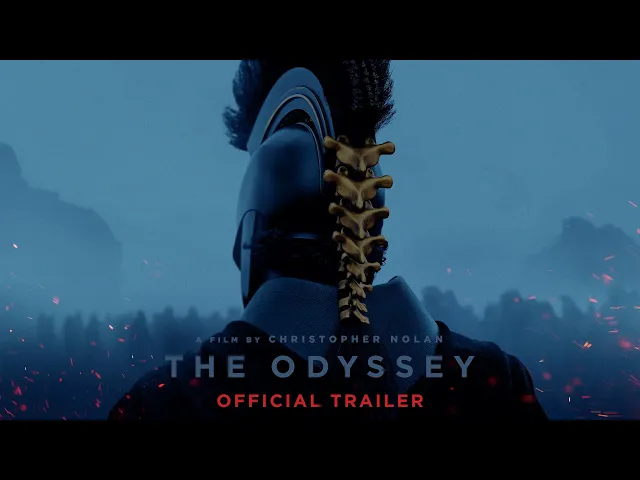
- Genre: epic, fantasy, adventure, drama;
- Country: UK, USA;
- Studio: Universal Pictures, Syncopy;
- Distributor: Universal Pictures;
- Runtime: 173 minutes;
- Release date: July 17, 2026;
- Age rating: R (18+) — for violence and some harsh language;
- Director and Writer: Christopher Nolan;
- Cinematographer: Hoyte van Hoytema;
- Editor: Jennifer Lame;
- Composer: Ludwig Göransson;
- Producers: Emma Thomas, Christopher Nolan;
- Budget: ~$250 million;
- Starring: Matt Damon — Odysseus, Tom Holland — Telemachus, Anne Hathaway — Penelope, Robert Pattinson — Antinous, Lupita Nyong'o — Helen / Clytemnestra, Zendaya — Athena, Charlize Theron — Calypso, Jon Bernthal — Menelaus, Samantha Morton — Circe, John Leguizamo — Eumaeus, Benny Safdie — Agamemnon, Elliot Page — Sinon, Himesh Patel — Eurylochus, Mia Goth — Melantho, Bill Irwin — Polyphemus.
What Nolan Did to Homer
Let's start with the most important point: The Odyssey is not a direct adaptation of Homer's poem. It's Nolan's interpretation, taking the skeleton of the source material — the King of Ithaca's ten-year journey home after the Trojan War — and tailoring it to the director's favorite themes. The very same themes Nolan has been revisiting for 20 years now: guilt, obsessive memory, the price of one's decisions, and a man crushed by the consequences of his own genius.

Entire chapters from the original were left out of the film; just listing them would inflate this review by several paragraphs, so it's better to highlight only the crucial moments. In our article Nolan's The Odyssey: Ending, Plot, and Meaning Explained, we broke down many aspects of the new film — highly recommended reading.
Take the main character. Homer's Odysseus was never a flawless paladin. He is a cunning strategist, a master of lies, manipulation, and mind games. He fools and then blinds the cyclops, vanishes for years in the embraces of Circe and Calypso, and upon returning home, orchestrates a bloody massacre of Penelope's suitors. Even the fall of Troy itself is the result of his cold-blooded, multi-layered scheme with the infiltrator Sinon, whose lies convinced the Trojans to willingly drag the fatal horse into their city.
Nolan's Odysseus, however, is a broken veteran with severe PTSD, eaten alive by the lingering thought: Did I do the right thing? We've already seen this archetype in Oppenheimer and The Dark Knight trilogy. The director habitually reshaped a three-thousand-year-old character to fit his signature template — and that's a fact worth keeping in mind before watching.
The finale is a whole other story. In Homer's work, after slaughtering the suitors, Odysseus plans to rob his neighbors to replenish the treasury without batting an eye, and nearly sparks a civil war. In Nolan's version, the hero voluntarily yields the throne to Telemachus and sails off into the sunset with Penelope in search of inner peace. Is it beautiful? Absolutely. Is it humanistic? Very much so. Is it Greek? Not at all.
On paper, all of this looks like a bold and conscious creative choice. On screen, however, we are presented with a film that has one foot in ancient myth and the other in modern psychological drama, never quite deciding which leg to stand on.
Which epic format do you prefer?
250 Million on Film, Water, and Wind
The Odyssey is the most expensive project of Nolan's career and, without a doubt, the most physically exhausting for the entire crew. This is the first feature film in history shot entirely on 70mm IMAX cameras. Each of these behemoths weighs around 330 pounds, and Matt Damon compared the noise they make to a blender set on maximum speed.

The sheer scale of the production is staggering. Ithaca was filmed on the rocky peaks of Favignana in southern Italy, where the crew had to hike 45 minutes up mountain trails every single day. Hades was brought to life on the black volcanic beaches of Iceland during the midnight sun. The Cyclops' cave is the actual Cave of Nestor in Greece, located by Voidokilia beach. Troy and Calypso's island were shot in Morocco, including the ancient Ksar of Aït Benhaddou. The sea voyages were filmed in Scotland and the North Sea.
Nolan stayed true to himself: minimal green screen and maximum practical effects. Even the cyclops Polyphemus was brought to life without CGI, using animatronics and complex prosthetics (the monster was operated by Bill Irwin, who voiced TARS in Interstellar). For the naval scenes, they rented the only fully operational, full-scale Viking ship in the world, which the actors had to sail for real. The storms were shot in a Universal Studios water tank, blasting the crew with torrents of water propelled by actual Boeing 737 engines.
These feats, along with many others, aren't just PR bullet points. The director wanted the audience to feel the physical weight of what was happening: if the ship tilts, it's tilting for real; if water floods the belly of the Trojan Horse, the actors are actually drowning and breathing through straws.
An Epic of Subverted Expectations
Does this realism translate well to the big screen? Absolutely — when it comes to the storms, the claustrophobia of the ship's hold, and the grueling voyage. Nolan invested colossal resources specifically into creating the feeling of a heavy, palpable journey. And herein lies the film's main problem. When an audience member buys a ticket for a quarter-billion-dollar ancient blockbuster, they expect the key action sequences — the siege of Troy and the final slaughter of the suitors — to have that same physical weight and epic scale. But they don't.

Nolan's Troy looks like the capture of a modest border outpost, hopelessly losing out in scale to Wolfgang Petersen's Troy from twenty years ago. And the famous massacre of Penelope's suitors feels more like a hastily shot local bar brawl than an ultimate catharsis. The money is definitely visible on screen in the new Odyssey. It's just that the budget went into the scenes Christopher Nolan himself was passionate about, rather than the massive, epic spectacle that many viewers go to the theater expecting to see.
An Odysseus Without Motivation
From the perspective of the creator's vision, the fall of Troy is not a triumph of will that granted eternal glory to all its participants. To Nolan, it is a tragedy, and to his Odysseus, it is a trauma. Not a proud "we won," but a broken "I was never the same after that." The filmmaker frames everything as if Odysseus subconsciously doesn't want to return home at all. Calypso feeds him the lotus not out of cruelty, but because the hero isn't ready to remember the horrors he has endured. It's a strong dramatic arc: the story of a man who fears peace more than war.

But the plot never fully commits to this direction. The result is an internal contradiction: if Odysseus is running away from peaceful life due to trauma, why does he fight so hard to get to Ithaca for ten years? If he truly wants to go home, why does the film barely show the emotional toll of this return? External obstacles, like the wrath of Poseidon and various monsters, constantly push the internal conflict into the background. As a result, PTSD exists here merely as an atmosphere, rather than a driving force for the plot.
The internal trauma feels like a modern filter applied over the myth, yet it never truly blends with it. Because of this, we never even get to see that peaceful home and blue sky overhead. Nolan doesn't show us a normal life either before or after the war. There is no contrast between who he was and who he became; there is no emotional anchor. We believe that Odysseus is broken, but we don't understand what exactly he lost. The ending, where the heroes sail off into the sunset, robs the audience (and the King of Ithaca himself) of even a chance to experience that boring family life he was supposedly striving for.
Göransson Instead of Zimmer
Nolan is famous for his approach to sound design: he uses sound as a narrative tool, not just as background accompaniment. In Dunkirk, the ticking of a clock built the tension; in Oppenheimer, it was the contrast between a deafening explosion and sudden silence. And, in classic Nolan fashion, the dialogue in The Odyssey is intentionally drowned out by noise — the director wants the audience to feel the chaos physically, rather than just observe it from the outside.

Ludwig Göransson — the Swedish composer, three-time Oscar winner, who worked with Nolan on Oppenheimer and replaced his longtime partner Hans Zimmer — is responsible for the score in The Odyssey. His main creative choice: no orchestra. The story takes place in the Bronze Age, and Nolan demanded that the music sound appropriate for the era.
The foundation of the soundtrack consists of 35 bronze gongs of various sizes, producing a heavy, dissonant resonance. Then there's the aulos — an ancient Greek double-reed flute with a piercing, almost feral sound. And the lyre, whose strumming is specifically arranged to mimic the sound of Odysseus drawing his legendary bow. To recreate the authentic sound of three-thousand-year-old instruments, Göransson brought in an entire team of music historians.
On top of that, Göransson utilized the reverse acoustics technique from Tenet: percussion parts were recorded, reversed, learned again by the musicians in their distorted form, re-recorded, and then reversed once more. The result is a disorienting soundscape where your ears simply cannot pinpoint the direction of the sound.
In the theater, the sound hits incredibly hard — especially during the naval scenes and the fall of Troy, where the line between the soundtrack and the noise of battle (or the roar of the sea) truly blurs.
The Perfect Nolan Conflict
But the most frustrating thing about the script is a colossal missed opportunity. In later mythological traditions, Odysseus is the one credited with the idea of the Oath of Tyndareus — a political scheme that bound all of Helen's suitors with a strict obligation to defend her future husband. At the time, Odysseus solved an impossible dilemma, and in return, he won his Penelope.

And it begs for an arc where, after years of wandering, the hero realizes that tens of thousands of people died because of a chain of events set in motion by his own idea! Not just some generic veteran traumatized by war, but an intellectual crushed by the realization that the catastrophe was the direct result of his own brilliance. Oppenheimer created a weapon that burned the world. Odysseus created a political framework that led to a ten-year meat grinder and triggered (according to the film) the collapse of the ancient world.
And the fact that Nolan completely bypassed this motif just to make a pretty movie about a tired warrior on a ship is the most disappointing part of all.
What is more important in a film adaptation of a myth?
Stars vs. Archetypes
The cast of The Odyssey works as more than just a collection of big names. Nolan gathers actors around personas familiar to the audience — and intentionally breaks them.

Matt Damon (Odysseus). This is the most obvious example. Matt has spent decades playing men of action: heroes who escape traps through their wits, willpower, and physical endurance. Nolan does the exact opposite: his Odysseus has already accomplished his greatest feat and is now living with the fallout. Damon expertly conveys the hero's burnout: the pauses, the hollow stare, the vibe of a man who is physically present but mentally still on the battlefield.
The problem is that the mythological Odysseus isn't just an exhausted veteran; he's a guy who, even after twenty years of war, remains the most dangerous man in the room. He might be older than Penelope's suitors, but he is smarter, more cunning, and physically still very capable of wiping the floor with them. Nolan's Odysseus retains the first half of the persona — the exhaustion and guilt — but almost entirely loses the second: the feeling of a coiled spring (or, in this case, a drawn bowstring).

Anne Hathaway (Penelope). Arguably the most interesting casting choice in the film. Nolan strips away the image of a passive wife waiting for her husband at the loom for twenty years. His Penelope is a politician, a ruler, and someone who has learned to survive without Odysseus. Hathaway doesn't play a grieving spouse, but rather a woman accustomed to holding onto power. In her performance, Penelope isn't waiting to be saved — she is managing the crisis herself. It's one of those rare cases where reimagining a character doesn't clash with the original but actually expands upon it.

Tom Holland (Telemachus). The most spot-on casting choice, and a prime example of an actor working against their established typecast. Thanks to his role as Peter Parker, it's easy to picture him as a perpetual teenager, but here, Holland confidently portrays a full-grown, albeit young, man. His Telemachus isn't just the heir to the throne; he's the son of a legend forced to live in the shadow of an absent father.

Robert Pattinson (Antinous). Probably the most "Nolan-esque" choice after Damon. Pattinson knows how to play characters with an underlying madness and a dangerous unpredictability, turning Antinous into almost a predatory opposite to Odysseus. While the protagonist suppresses his emotions, Penelope's suitor exists solely for his own ego. He's not so much a villain as he is a man convinced that the entire world should be an extension of his desires.
Charlize Theron (Calypso). Here, Nolan changes the mythological roles quite drastically. Theron's Calypso is not a seductress or a captor, but a tragic figure: someone who offers an escape from pain because she herself is incapable of letting go of the past.
Zendaya (Athena). The most controversial element. Nolan transforms the goddess of wisdom and war into the hero's inner voice — a visual manifestation of his conscience and doubts. Because of this, Athena doesn't function as an independent mythological being, but rather as a facet of Odysseus' psychological framework.
"We Are All Greeks"
Now is the perfect time to talk about how this entire cast looks on screen. In short, modern. When the characters grandiosely declare, "We are Greeks," you kind of want to chuckle in the theater. Because none of them actually look like Greeks. Damon is your classic blue-eyed Anglo-Saxon. Hathaway screams typical "Northern European." Jon Bernthal, showing up as Menelaus, is brutal, tough, and convincing, but he couldn't pass for Mediterranean if his life depended on it.

Ancient Greeks were tanner, dark-haired, with olive skin — visually closer to modern Southern Italians or the people of Crete. In 2004's Troy, at least Eric Bana looked authentic in his role as Hector. For Nolan, however, star power clearly took precedence over accurate casting types. This isn't about the "woke agenda" or race — it's just about basic visual authenticity.
That being said, leading up to the release, the internet was bubbling with a completely different, entirely toxic kind of hype. The web was seething over the casting of Lupita Nyong'o (Helen/Clytemnestra) and Elliot Page (Sinon). People were screaming about the "typical woke agenda," claiming that "Nolan caved" and that "Hollywood is forcing diversity down our throats."
After watching the film, one can come to a definitive conclusion: the roles of Nyong'o (a practically mute Helen with a facial scar) and Page ended up being very small, almost akin to cameos. Both give solid performances, fit perfectly into the atmosphere, and the complaints about the "woke agenda" look utterly ridiculous in the context of the actual movie.
A Big Movie with a Big Contradiction
Don't take the text above as an absolute takedown. Despite all the questions and controversial choices, The Odyssey remains a rare example of grand auteur cinema that was given the scope of a blockbuster. It is the "most beautiful Nolan," the "most expensive Nolan," and quite possibly the "most ambitious Nolan" yet.
This is Nolan who properly allocated a massive budget, shot everything on IMAX film, ditched the digital crutches, and built a spectacle around the powerful sensation of a physical journey. The storms, the sea, the ship, the ancient ruins, and the practical effects don't just act as a backdrop — they are the core viewing experience. The Odyssey was made for the big screen: its sheer scale, soundscape, and texture simply get lost when watching at home.
But the paradox here is that the most spectacular element of the film simultaneously becomes its weakest point. Nolan didn't so much film the story of the legendary King of Ithaca as he did the story of a man trying to live with the aftermath of war. This approach is intriguing, but it leaves out a huge part of what made Odysseus, well, Odysseus: his cunning, his danger, and his ability to alter the course of events himself.
-
 The Odyssey Box Office Results for Opening Weekend Revealed
 -
 High-quality The Odyssey bootleg spreads on X as Universal moves to remove it
 -
 Nolan's The Odyssey vs. Homer's Poem: Biggest Differences and Movie Changes
 -
 Christopher Nolan Says His Next Film Will Arrive at Least Three Years After The Odyssey
 -
 Elon Musk Challenges Nolan: Grok Will Create a "Historically Accurate" Version of The Odyssey This Year
 -
 27 Best Games Like Call of Duty: Shooters Set in the Past, Present and Future