What Will PlayStation 6 Be Like — And What Could Hinder Its Success?
 Alexander Pushkov
The first PlayStation was born out of revenge. Nintendo pulled out of producing the Play Station, a console it was building together with Sony, at the last minute. In response, the tech giant decided to create its own gaming device, with blackjack and discs.
The next 30 years in the gaming market were full of unexpected wins and silly mistakes, phenomenal success and painful failures for Sony. But the Japanese corporation has never been in such a… strange position. On the one hand, there are record profits and yet another console war won against Microsoft. On the other, there is a parade of failed exclusives, a reputation that seems to be in tatters, and total uncertainty caused by the memory crisis and global instability.
Sony finds itself in the position of a tightrope walker frozen on a rope between two skyscrapers. The opposite roof seems to be just a couple of steps away, but one wrong move or a sudden gust of wind, and you fall hundreds of meters. And all of this comes on the eve of a key event for the company: the launch of PlayStation 6, a device that may define the future not only of Sony but of the entire console market.
In this piece, I will go through all the insider information about Sony's next console: what hardware it will have, when it will come out, and whether a handheld version is worth waiting for. I will also try to answer the main question: what challenges could PlayStation 6 face?

Everything About PlayStation 6
Let me start with an important caveat: Sony has already confirmed it is working on the next generation of PlayStation, but it has not unveiled the console yet. Its specs, price, and release date have not been officially announced. Statements from the company, reports from insiders, and analyst forecasts only let us guess what it will be like.
What We Know for Sure: The AMD Partnership
Quite a lot about the future PlayStation 6 can be learned from the investor Q&A session Sony held in June 2026. The first and main takeaway is that Sony still sees its own hardware as the foundation of the PlayStation experience, with content and services as the main business drivers. Its key bet will be on further developing the PlayStation ecosystem.
While Microsoft's next console, still known by its codename Project Helix, is set to be closer to a PC and run both Xbox and PC games (although the company's plans may still change), PlayStation 6, judging by all the information we have, will remain a classic console with a closed architecture, its own operating system, and separate versions of games.
According to Sony Interactive Entertainment President Hideaki Nishino, in developing the next-generation platform the company aims to anticipate changes in how players play and make the PlayStation ecosystem more accessible to a broader range of players. At the same meeting, SIE management added that the next generation should deliver a seamless experience that can be enjoyed naturally "beyond the living room." The management's statements fit well with Sony's recent decision to stop releasing its own single-player exclusives on PC (as journalists reported), thereby increasing the value of the PlayStation ecosystem.

It is very tempting to see SIE's words about PlayStation going "beyond the living room" as confirmation of long-standing rumors that Sony will release a handheld console alongside the home PS6. However, for now, this is still wishful thinking, and even if such a device is in development, the company's plans may change.
AMD will once again be Sony's key technology partner (as was the case with the PS5 and PS4). According to Reuters, the companies signed a contract to create a system-on-chip for PlayStation 6 back in 2022. In 2024, Sony and AMD announced Project Amethyst, which is meant to become the technological foundation for future gaming devices. Its main focus areas are machine learning and improved ray tracing technologies.

Sony has not officially confirmed it, but PlayStation 6 is highly likely to be backward compatible with PS5 games, and according to insider Moore's Law Is Dead, with PS4 games too. According to Reuters, switching from AMD to Intel would have put backward compatibility at risk, and preserving it would have been costly. But the agency says the main sticking point in the talks with Intel was how much profit Intel would make on each chip.
The PS6 will almost certainly (unless something truly extraordinary happens) have no disc drive, not even a detachable one. On July 1, 2026, Sony announced that starting in January 2028, it will stop producing discs for all new games on PlayStation, and Sony DADC's plant in Thalgau, Austria, which presses PlayStation discs, has already begun switching to optical microlenses. There is still a small chance that the company will offer an external drive as a premium device for its most devoted fans to preserve backward compatibility with the physical PS4 and PS5 game library.
Hardware and Technology
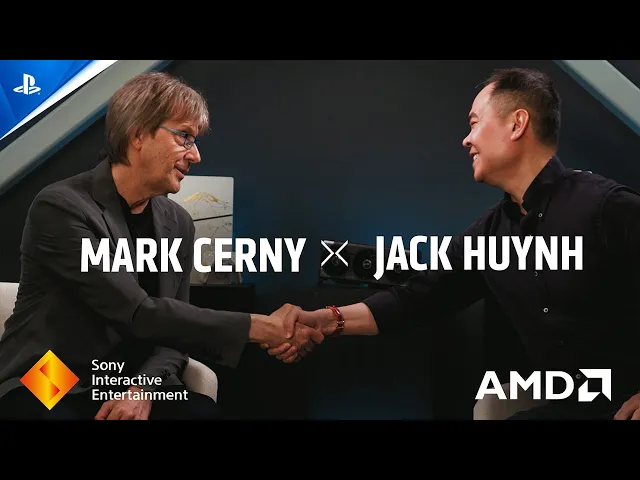
Official information is limited to the aforementioned Project Amethyst, as part of which Mark Cerny, lead architect of the PlayStation 5 and PS5 Pro, and AMD Senior Vice President Jack Huynh presented three technologies:
- Radiance Cores — dedicated hardware units designed to perform ray tracing and path tracing calculations faster and more efficiently;
- Neural Arrays — compute units combined into a single system that works as a scalable AI accelerator. They are meant to improve upscaling and neural rendering, including FSR and PlayStation Spectral Super Resolution;
- Universal Compression — a compression technology that analyzes and optimizes data transfer inside the GPU in real time, reducing the load on memory bandwidth and lowering power consumption.
Beyond that lies the territory of rumors and unconfirmed leaks. The main source of information about the specs of the future PlayStation is a series of videos on the YouTube channel Moore's Law Is Dead. Although its author is considered a relatively reliable insider (for example, he accurately described the PS5 Pro specs), and some of his information has been confirmed by other journalists and insiders, the leak should still be taken with a healthy dose of skepticism. If only because the first Moore's Law Is Dead video was published before the memory crisis began, and some of the PS6 details were allegedly taken from AMD documents dating back to 2023.
So, to sum up the available information, Sony is developing two next-generation consoles at once: a home console codenamed Orion and a handheld called Canis.

According to the leak, the home Orion will get a monolithic AMD system-on-chip with seven or eight high-performance Zen 6c cores and two power-efficient Zen 6 LP cores. The main cores will handle games, while the Zen 6 LP cores will take over the operating system and background services. According to Moore's Law Is Dead, this will free up about 20% of CPU resources for gaming tasks.
The graphics will be built on the AMD RDNA 5 architecture and will feature 52 compute units running at 2.6 to 3 GHz. The GPU's theoretical performance is estimated at 34–40 teraflops.
Orion is said to output 4K at 120 frames per second with ray tracing. This most likely refers not to native resolution but to the use of PSSR neural upscaling and other image reconstruction methods. According to Moore's Law Is Dead, Orion is 2.5–3 times faster than the PS5 in rasterization and 6–12 times faster in ray tracing, and with upscaling factored in, the overall gain could reach 4–8 times.
In September 2025, Moore's Law Is Dead allowed for 30 or 40 GB of unified memory, but in February 2026 another reliable insider, Kepler_L2, pointed to a configuration with 30 GB of GDDR7.

The second system, Canis, will be a full-fledged handheld console that can be connected to a TV. The rumored device is credited with four Zen 6c cores, two power-efficient Zen 6 LP cores, around 16 AMD graphics compute units, 24 GB of RAM, and a monolithic chip made on a 3 nm process. Other reported features include a touchscreen, a microSD slot, an M.2 SSD slot, video output via USB-C, and dock support. If the leaks turn out to be accurate, Canis could be significantly more powerful than the Steam Deck and Nintendo Switch 2. Both the home and handheld consoles are also said to be backward compatible with PS5 and PS4 games.
However, there is a lot of conflicting information about Canis. Some experts doubt that Sony will be able to combine a cutting-edge manufacturing process, a new architecture, a large amount of memory, and a price acceptable to consumers.
How Much Will PlayStation 6 Cost?
The most pressing question amid the memory shortage and rising electronics prices is the price of PlayStation 6.

The concerns are understandable: if the PS5 Pro costs $900 in the US and the Steam Deck OLED costs between $789 and $949, the price of a much more powerful device risks shooting into the stratosphere. However, things are not that simple.
First, Sony is in a much better position than many other gaming companies when it comes to buying memory and other components. Thanks to huge order volumes, long-term contracts, and established relationships with manufacturers, the tech giant can count on significant discounts. As a result, the production cost of PlayStation 6 may turn out to be considerably lower.
Second, Sony has historically been willing to sell consoles at a loss to quickly build an audience for a new device, because the company makes most of its profit from game sales, subscriptions, and additional content on the PlayStation Store. This sets it apart from Valve, whose representatives openly stated that the company does not plan to subsidize the Steam Machine the way game consoles are subsidized.
On the other hand, at the June investor meeting mentioned above, SIE President Hideaki Nishino said the company will not sell hardware at a significant loss. He also stressed that Sony's priority is not growing the number of active users at any cost but increasing the profitability of its current user base.

In any case, if the situation on the memory and component market does not change (and most forecasts suggest it won't), a $300–500 price for PlayStation 6 looks unlikely. Estimates vary widely, but the key fork in most forecasts lies around the psychologically important $1,000 mark. Some experts believe Sony will try to keep a "three-digit price," while others do not rule out the console crossing that line.
The most optimistic forecast comes from Moore's Law Is Dead. In April 2026, he estimated the cost of the home PS6's components at around $743 and suggested a launch price of $749, which is $151 less than the current price of the PS5 Pro in the US. That figure, however, excludes import tariffs: with them, by his own math, the price would be $949.
A more pessimistic picture emerges from insider Kepler_L2's posts. In March, he put the PS6's component cost at around $760, and at the end of June he wrote that it had since risen by roughly $200, to almost $960. Add assembly, shipping, marketing, and retail markups, and without Sony subsidies the retail price could easily top $1,000.
Newzoo market intelligence director Manu Rosier believes base next-gen models are likely to stay under $999 for psychological and marketing reasons.
Circana senior director Mat Piscatella, in turn, says a next-gen price above $1,000 is possible, even likely. A lot may also depend on how buyers react to price hikes on current-generation consoles around the GTA 6 launch: if Rockstar's hit drives a significant increase in PS5 Pro sales, Sony will have an additional reason to raise the price of the PS6. In September, UK price comparison service idealo reported that in the week GTA 6 pre-orders opened, demand for the PS5 Pro on its site jumped 348% week over week, and in the week of the August Extended Look showcase it rose 144%.

Thus, insider and expert estimates fall within an extremely wide range, from $749 to over $1,000. Reaching the lower price point would require both a drop in memory costs and substantial subsidies from Sony at the same time, while if the shortage persists, the PS6 will most likely cost $1,000 or more.
When Will PlayStation 6 Come Out?
Judging by everything, Sony originally planned to release PlayStation 6 at the end of 2027. Several factors point to this. First, this timing fits the rhythm of recent generations: 6 years and 8 months passed between the PS2 and PS3, and seven years each between the PS3 and PS4 and between the PS4 and PS5. Second, a number of insiders reported it, including Kepler_L2 and Moore's Law Is Dead.

However, as memory prices soared, reports of a possible delay began to appear more and more often. In February 2026, Bloomberg, citing people familiar with the company's thinking, reported that Sony was considering pushing the next PlayStation back to 2028 or even 2029. In June, Embracer Group's annual report cited the same scenario, attributing it to analysts. Ampere Analysis analyst Piers Harding-Rolls believes the PS6 is unlikely to come out before 2028. Analysts warn that expensive hardware will scare off some buyers. Ampere Analysis estimates that if next-gen consoles launch at $1,000, they will sell 38% fewer units over their first five years than the PS5 and Xbox Series. And MST Financial analyst David Gibson predicted back in January that Sony would extend the PS5's life cycle and that the PS6 would not arrive before 2029.
Nevertheless, Kepler_L2 continues to insist on a holiday 2027 launch. Moore's Law Is Dead also considers a delay unlikely. According to him, production was originally scheduled for the second quarter or mid-2027. He also notes that Sony has contracts with AMD and TSMC and has already booked TSMC production capacity, so it is much easier and cheaper for the company to overpay for memory and components now than to renegotiate contracts and postpone the launch of a platform that is already finished.
It is quite possible that Sony itself has not yet settled on an exact date. In May 2026, Sony CEO Hiroki Totoki said the company had not yet decided when the next-generation console would launch or at what price. He expects memory to stay very expensive in fiscal 2027 (which ends in March 2028) due to the ongoing supply shortage, so Sony is modeling various scenarios, from cutting the cost of other hardware components to new ways of selling the product and even changing its business model.
Why PlayStation 6 Might End Up Unwanted
I have already written in detail about the console crisis and the less-than-rosy prospects of the next generation in my piece Why the Current Generation of Consoles Is the Worst in History. Here, let's focus on the main problems PlayStation 6 itself could face.

The first and most obvious one is the weakness of the PS5 generation. For decades, the main advantage of Sony consoles was relatively affordable access for the mass audience to the latest releases. Exclusives that set the platform apart from the competition played an equally important role.
What do we have in the PS5 generation? A lack of strong exclusives (the last unambiguous success was Ghost of Yotei), a glut of sequels, failed live-service projects, and Sony's key games coming to PC. For example, Sony's biggest exclusive of 2026 so far, Marvel's Wolverine, got a reserved reception from critics (75 on Metacritic), while players are divided. You can find out what is wrong with the Wolverine game in our Marvel's Wolverine review.
In turn, as Sony consoles get more expensive, they are becoming less attractive to the mass audience and are gradually turning into premium devices for the wealthiest buyers. According to data from analytics firm Circana, in recent years the audience buying gaming hardware in the US has shifted toward households with above-average incomes.
Besides, Sony never fully managed to create the feeling of a true new generation. The first years after the PlayStation 5 launch were marked by a global shortage, followed by a long cross-gen period: Horizon Forbidden West, Gran Turismo 7, and God of War Ragnarök all came out on both PS4 and PS5. As a result, the transition to the new generation dragged on, and at times it feels as if the PS5 only truly came into its own a couple of years ago. Against this backdrop, Sony will have a hard time explaining to the audience why they should buy the next, and probably more expensive, console right now, when the current generation has not yet fully become outdated for many.

The second problem is Sony's tarnished reputation, which could shrink its loyal audience. In recent years, the Japanese company seems to have been deliberately destroying PlayStation's positive image: exclusives coming to PC, failed live-service projects, studio closures, mass layoffs, price hikes, absurd restrictions for PC players, and so on. The loudest scandal, the abandonment of discs, showed that Sony has either forgotten how to talk to its most active audience or no longer considers its opinion important. Instead of explaining the decision and trying to rein in the wave of backlash, the company disappeared from social media for almost a week, as if hoping users would grumble for a while and then stop.
Yes, for the most part all these scandals affect only a relatively small segment of hardcore fans. But they are the ones who form the core of the community, buy new devices first, and shape the brand image that the mass audience looks up to. And right now, in the eyes of many gamers, PlayStation's image is negative.
Finally, Sony's problems cannot be viewed separately from the overall state of the console market. In recent years, the console audience has been growing slowly and gradually aging. According to Newzoo estimates, in 2025 it numbered 645 million people, compared to 936 million PC players and roughly 3 billion mobile gamers.
According to Newzoo, in 2025 consoles accounted for about 22% of the gaming industry's revenue. In 2019, by the company's estimates at the time, their share was around 30%, but Newzoo has since revised its methodology, so the comparison is approximate. At the same time, in the most promising markets, such as China, India, and Southeast Asia, users prefer PCs, smartphones, and free-to-play online games.

What Could Save PlayStation 6?
The failure of PlayStation 6 is not a foregone conclusion. Sony still has a huge audience, a recognizable brand, renowned studios, and one of the largest gaming ecosystems. By the end of June 2026, PS5 shipments had exceeded 95 million units, so the new generation will not start its life cycle from scratch but with a multi-million base of potential buyers and a huge library of games.
The PS6's main advantage may turn out to be its price relative to other gaming devices. The memory crisis and rising component costs affect not only Sony but other manufacturers as well. Even at $1,000, PlayStation 6 may turn out to be one of the most affordable ways to get "next-gen performance." A comparable gaming PC will probably cost significantly more, while competing consoles and handhelds will face the same rising production costs.
Strong exclusives can restore Sony's reputation in the eyes of the audience. The company has been through a similar period: the expensive PS3, which had a rough launch, trailed the Xbox 360 for a long time, but a steady stream of releases like Uncharted 2, God of War 3, Heavy Rain, and other major projects gradually changed attitudes toward the platform.

Something similar could happen at the end of the PS5's life cycle. Everything depends on the quality of upcoming exclusives, and, just like with the PS3, the final chord of the generation could be a Naughty Dog project, Intergalactic: The Heretic Prophet.
Finally, if its price is relatively low, PlayStation 6 could set a new technological standard for the entire industry. Extra computing power will make it possible to improve object physics and destructibility, as well as create more advanced lighting, animation, and character behavior simulation systems. This is not only about image quality but also about the emergence of fundamentally more complex, realistic, and sophisticated games.
With PlayStation 6 in wide circulation, developers will get a single platform whose capabilities they can target when creating new games, and cutting-edge graphics technologies will no longer be costly experiments for individual projects. It is consoles, with their huge audience, that can turn promising developments into full-fledged industry standards.
A handheld PlayStation could become an additional advantage. If the rumors are confirmed, the next generation will consist of a pair of home and portable devices with a shared library. This approach would allow Sony to compete not only with traditional consoles and gaming PCs but also with the Steam Deck and Nintendo Switch 2.
***
The success of the PS6 will depend on whether Sony can offer gamers a good deal: modern hardware at a price lower than a comparable PC, full backward compatibility, strong exclusives, and technologies that clearly surpass the capabilities of the PS5.
What should PlayStation 6 have for you to actually want to buy it? And what is the maximum price you would be willing to pay for Sony's new console? Share your thoughts in the comments.
Which PlayStation is the best Sony console ever?
-
 Will The PS6 Be Cheaper Than The PS5 Pro? Insider Warns Gamers Not To Fall For Sony's Price Hikes
 -
 Insider Tempers Expectations for PS6: No 10x Performance Boost, Real Ceiling is 3x
 -
 Ampere Analysis warns $1,000 PS6 and Xbox Project Helix could hurt sales
 -
 Sony’s gonna strike first: portable PS6 landing before Steam Deck 2
 -
 PS6 Disc-Free Future Could Block Store Access in 121 Countries