
iPhone Duo First Reviews: The Pros and Cons of Apple's Foldable
 Evgenia Zavyalova
In early fall 2026, Tim Cook stepped down as Apple's CEO, handing the role to John Ternus. Many experts, media outlets, and ordinary users saw this as the start of a new era for the company — one that should bring technological breakthroughs, or at least a resolution to its existing problems.
But the symbol of change — Apple's first big product under Ternus — turned out, unexpectedly for many, to be the foldable iPhone Duo. Why unexpectedly? Foldable smartphones have been on the market for years, and instead of creating something fundamentally new, Apple simply joined other manufacturers (Samsung, Huawei) that have already released several generations of such devices. On the other hand, Apple has rarely been first to explore new technology directions. More often, it takes an already-familiar idea and turns it into a mass-market, profitable product — that's exactly what happened with touchscreen smartphones, tablets, and smartwatches.
Did that strategy work this time? Let's see how experts and ordinary users received the foldable iPhone Duo.
iPhone Duo specs, briefly
Apple wouldn't be Apple if it didn't turn the launch of what is, on paper, an ordinary foldable smartphone into a show. The company unveiled the iPhone Duo on September 9, 2026, set the release date for October 23, and opened preorders on October 16. So journalists got a chance to evaluate the device even before the first units reached stores, and the early media reviews significantly fueled public interest in it.

What is Apple actually offering buyers? As already noted, the foldable smartphone concept is far from new. By the time the iPhone Duo arrived, other manufacturers had spent years refining the idea, but never solved the core trade-off: the buyer gets more screen space but has to live with a more complex build, a higher price, and extra limitations. And Apple doesn't solve that trade-off either.
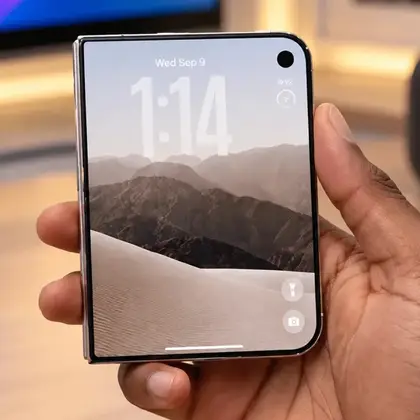
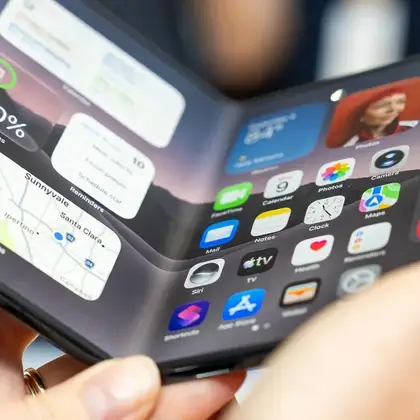
Folded, the Duo gives users a 5.4-inch outer display; unfolded, it reveals a 7.6-inch inner OLED panel. The design follows Apple's usual playbook: a titanium body, a polished finish, and two color options — Star White and Night Sky. The device's real star is the hinge connecting the two halves — made up of more than a hundred components — with internal support elements meant to help the body stay rigid.

Performance comes from Apple's own A20 Pro chip. Two batteries are rated for up to 44 hours of video playback on the outer screen and up to 31 hours on the inner one. The back houses two 48-megapixel cameras — a main sensor and an ultra-wide.
Closed, the iPhone Duo fits in a pocket; opened, it can be used for reading, gaming, video, and running several apps at once. The question is how often an owner will actually use that second configuration — and whether Apple has already convinced buyers, right at launch, that years after the first foldables appeared, its version is the one worth buying.

Do you think iPhone Duo will be comfortable for playing mobile games?
Preorders: scarcity as marketing
Apple's marketers earn their keep. Preorders for the iPhone Duo opened on October 16, and shipping estimates started slipping almost immediately. American buyers who missed the first wave of orders were, by October 19, looking at waits stretching into January 2027. In the UK, delivery windows stretched out by several months too. You can still place an order — this isn't a full halt in sales, just the first batch of fast-delivery stock running out. Apple's online store had to cap purchases at two iPhone Duo units per customer, apparently to keep resellers from buying in bulk.

For Apple, this is the ideal scenario from a public-perception standpoint. The device hasn't even hit retail shelves yet, and buyers are already lining up for it. As a result, the phone becomes not just an expensive product, but something people have to hunt for.
That said, we don't know how much of this scarcity Apple itself engineered. The company hasn't disclosed preorder numbers, so it's unclear whether demand is genuinely that high or whether supply was simply limited. Some outlets reported manufacturing issues even before sales began: building a foldable phone is harder and slower than a regular slab phone, on top of the industry's well-known component-supply troubles.

The main question remains open: how many units will Apple sell once the hype settles down? Early preorders show that the most dedicated fans are willing to pay for the new device, but once the "diehards" get theirs, it'll be the average buyer's turn — and they're usually far pickier about price-to-value.
iPhone Duo pros: what early users liked
The first iPhone Duo reviews appeared even before retail sales officially began. Lucky early testers got to spend a few days with the device: checking how the hinge holds up, judging the display quality, and testing the software features. So what are the standout strengths people are pointing to?
Pro one. A big, usable screen
Unfolded, the 7.6-inch display is great for reading articles, watching video, working with documents, and running two apps side by side. You can open a browser on one side and notes on the other. You can compare products without constantly switching tabs, or keep a video call open next to a document. For people who do a lot of work from their phone, these use cases can genuinely save time.

Pro two. The crease is barely visible
The most talked-about feature of foldable phones is the crease line on the inner display. For several generations, manufacturers have tried to make it less noticeable. Apple has nearly solved the problem, not just through the panel's construction but also with a nanotexture coating that scatters reflected light. Looking at the screen head-on, the crease is invisible.

Pro three. The hinge and build quality
Another strength of the Duo is how solid the whole device feels. The hinge moves smoothly, and both halves of the body stay securely locked when closed. The phone can be propped at different angles for video calls, watching clips, or showing information on a table. Long-term durability will only really show up over extended use, but based on the first few hours, reviewers have no complaints about build quality.

Pro four. Solid performance and battery life
In benchmarks, the device's performance was comparable to the iPhone 18 Pro and iPhone 18 Pro Max. The interface runs smoothly, apps switch quickly, and multitasking shows no noticeable lag. The Duo's body can run a bit warmer than the iPhone 18 Pro's, but that doesn't meaningfully affect performance. Battery life holds up well too: under moderate use, the Duo can get through a full day without a charger.

As we can see, the Duo doesn't fall behind Apple's flagship models in performance or battery life, while adding a folding screen on top. The question is whether that's enough to justify the price.
iPhone Duo cons: what the buyer is really paying for
Price is the Duo's biggest downside, and that's been clear since the device was unveiled. It starts at $1,999 for the base 256GB configuration, and for that kind of money, buyers are entitled to expect more than just an unconventional build — they expect it to beat cheaper models outright. But that edge isn't there: the iPhone 18 Pro, which costs roughly $800 less, can handle almost the same tasks, and even beats the foldable newcomer on cameras.
So what specifically bothers some users?
Con one. Weaker cameras than the iPhone 18 Pro
On paper, two 48MP modules look solid: a main camera and an ultra-wide (the same one used in the iPhone 18 Pro). But the key difference from the flagships is that the Duo has no telephoto lens. 2x zoom here comes from cropping the main sensor, and anything beyond that relies on digital zoom. On top of that, the main camera isn't built on the new module from the iPhone 18 Pro, so the variable aperture Apple showed off this year isn't present on the foldable either. The reason is simple: a thin folding body leaves little room for large optics and extra modules. The missing telephoto lens, along with the weight and the Touch ID placement, are the drawbacks reviewers mention most often. For everyday shots, the difference is barely noticeable, but anyone who frequently shoots portraits or distant subjects may find the foldable iPhone a poor fit.

Con two. Weight and thickness: compact with caveats
Apple stresses that, closed, the Duo fits neatly into a pocket. But compact shouldn't be confused with light. The device weighs 254 grams, and using it one-handed for long stretches gets tiring. It won't pass the well-known "can you open it with one thumb" test: you can't open it with one hand, since the hinge requires some effort to move. That's not a dealbreaker, since most functions don't require both hands at once, but it's something you'll need to get used to.

Con three. Mediocre sound
Some reviewers noted that the built-in speakers sound quieter and less rich than the iPhone 18 Pro's. If that opinion holds up among regular users, positioning the Duo as a device that's comfortable for watching movies and clips without headphones starts to look questionable.

Con four. Unknown long-term durability
Early reviews give a sense of build quality, but they can't tell us how the device will hold up a year or more down the line. Will the hinge develop play over time? How often will users need repairs? Those questions are still open for now. If the foldable iPhone proves reliable, the Duo could become the foundation of a whole new product line. But if screen and hinge issues start showing up regularly in the news, even strong launch sales won't shield Apple from reputational damage. After all, flaws people forgive in an ordinary flagship become unforgivable in a $2,000 gadget.
iPhone Duo memes: what people are joking about
On social media, the iPhone Duo quickly became an easy target for jokes. Even Apple's competitors couldn't resist, Samsung included. The South Korean company was quick to remind the American giant that it's been making foldables since 2019 — and to plug its own devices along the way. The most widely shared line, posted by Samsung Mobile US, basically offered to let Apple know "when it's done reheating everyone else's leftovers."

Duolingo, the language-learning company, poked fun at the "Duo" name and put its mascot on the phone's screen, looking offended that its name got used without permission.

Reactions across forums and discussion boards were mixed. Some users praise the design; others don't see the point of swapping their regular phone for a very expensive device that doesn't outperform cheaper Apple flagships. Jokes about the price were especially popular — that kind of humor follows pretty much every expensive Apple product — along with jokes about its usefulness and practicality for the average user.
Would you buy yourself an iPhone Duo?
***
Sales of the iPhone Duo have only just begun, so it's too early to say definitively whether Apple's device was met with triumph or disappointment. Many buyers won't get their units until January 2027, and that will almost certainly spark a fresh wave of discussion about the Duo's pros and cons on social media.
If consumers end up satisfied, the iPhone Duo could mark the start of a new chapter in the iPhone's history. Apple's competitors would then have to step up their game, and foldable phones would become cheaper and more mainstream. But there's also a chance the Duo stays a niche product, popular mainly with gadget enthusiasts and professionals who need a folding screen for work.
What can be said for certain right now is that Apple managed to make the launch of a foldable iPhone a major event. The Duo has already become an object of desire, but it hasn't yet faced the full test of everyday mass use. And it's the coming months that will show whether Apple can turn this interest into lasting success.
-
 PlayPort Brings Local Windows Gaming to iPhone Without Jailbreaking
-
 iPhone Duo inner screen replacement costs $999 — almost half the smartphone's starting price
-
 iPhone Duo Sells Out in Just 30 Minutes in the US
-
 iPhone Duo Uses a Flexible Graphite Pipe in Its Hinge to Spread Heat
-
 A Questionnaire for Assessing Anxiety and Depression on the PHQ-9 and GAD-7 Scales Found on iPhone
-
 27 Best Games Like Call of Duty: Shooters Set in the Past, Present and Future