John Ternus, CEO of Apple: Biography, Career, and What Changes Under Him
 Evgenia Zavyalova
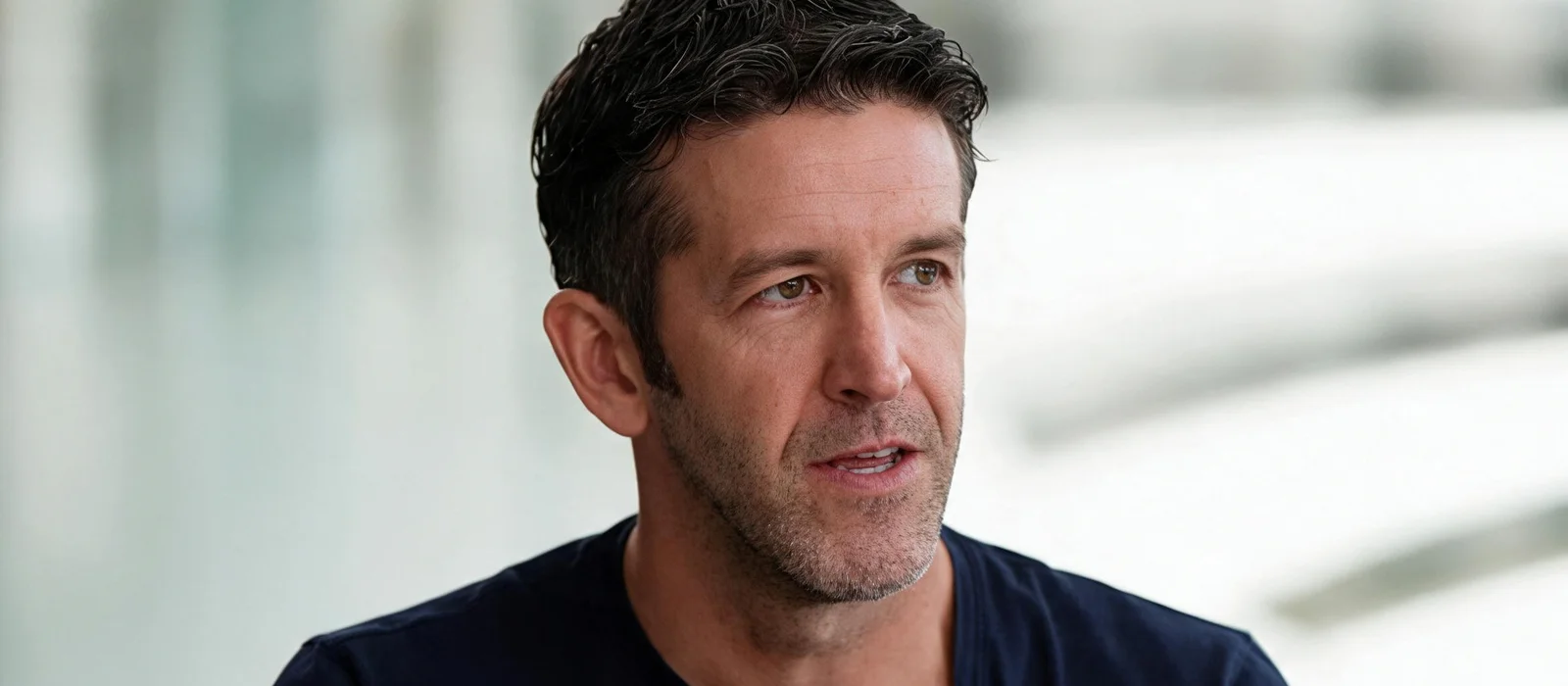
John Ternus is the chief executive officer of Apple: he took the job on September 1, 2026, succeeding Tim Cook. He is 51 and an engineer by training. Ternus has been at the company since 2001 — he joined in the Steve Jobs era, became vice president of hardware engineering in 2013, and from 2021 was in charge of all of Apple's hardware: iPhone, iPad, Mac, and the watch.
He ran his first keynote as head of the company on September 9, 2026. Sweeping flyovers of the California coastline, the camera settling on a figure, Tim Cook appearing on screen — only to wave it off: "No, no, no, not me," before pointing across the room: "That's your guy." The stage itself is nothing new to Ternus, who has been introducing Macs and iPads since the late 2010s. The difference is that he used to present his own work while Cook made the calls.
If Jobs was the strategist who set Apple's direction and Cook the manager and marketer, Ternus is the engineer. That, really, is what every conversation about him comes down to: whether his appointment means Apple is turning away from selling more of what it already makes and back toward the technology itself.
Full name: John Patrick Ternus
Age: 51, born in May 1975 in California
Role: CEO of Apple since September 1, 2026; also serves on the company's board of directors
Education: University of Pennsylvania, bachelor's degree in mechanical engineering and applied mechanics
Path at Apple: joined the product design team in 2001, became vice president of hardware engineering in 2013, and joined the executive team as senior vice president in 2021
Career highlight: a key role in moving the Mac off Intel processors and onto Apple Silicon
Pay: target compensation of roughly $58 million for fiscal 2027 — $3 million in salary, the rest in stock
Family: married with children — he shares no further details
Predecessor: Tim Cook, who ran Apple from 2011 and stayed on as executive chairman of the board
Biography and Education: Who John Ternus Is
People had been naming him as Cook's likely successor long before it happened, and yet Ternus remains something of a dark horse. His official biography is thin on details — he doesn't even reveal the city where he was born, only the state.

At the University of Pennsylvania — one of the most prestigious in the US — Ternus earned a bachelor's degree in mechanical engineering and applied mechanics, along with a minor in psychology. He swam for the university team, and his senior project was a feeding device for people with paralyzed arms: it translated movements of the head and neck into the movement of a spoon. The work took the Procter & Gamble prize for best student paper at a conference on applied mechanisms and robotics.
After graduating in 1997, Ternus took a job as an engineer at Virtual Research Systems, working on virtual reality headsets — back when VR was expensive, niche kit for labs and professionals, nowhere near a mass market.

In 2001, Ternus joined Apple's product design team. Among other things, he worked on the Cinema Display monitor. By his own account, he once spent a night past midnight on a supplier's factory floor counting, under a loupe, the grooves on the screws that hold the monitor's casing together. The supplier had cut 35 of them instead of the specified 25 — and Ternus insisted on 25.
I distinctly remember stepping back for a minute and thinking to myself, "What the hell am I doing? Is this normal?" I realized it might not be normal, but it's right. It's right because I'd already spent months working on that product, and if you're going to spend that much time on something, you should put in your very best effort. Maybe a customer notices, maybe they don't, but either way, it mattered to me to know that my teammates and I had considered everything about it and done the very best job we could.
He told the screw story to students at his old university — and it explains more about him than any line in the official bio.
Career at Apple: Twenty-Five Years Inside the Company
He climbed the ladder fast. Within three years he'd made manager, but he turned down a private office, choosing to stay in the open room with his team.

Through the mid-2000s Ternus ran hardware development for the Mac, then played a key role in launching new product lines — the iPad and AirPods. In 2013 he was named vice president of hardware engineering, and in 2021 he joined Apple's executive team as senior vice president — and from that point everything physical Apple made was his: iPhone, iPad, Mac, wearables. The only thing outside his remit was services — the App Store, iCloud, Apple Music.

That isn't an abstract "area of responsibility" — it's three quarters of Apple's business. In fiscal 2025 the company took in $416 billion, and $307 billion of that came from the categories Ternus ran. The iPhone alone accounts for half of all revenue: $209.6 billion.
The career highlight is Apple's break with Intel processors: Ternus played a key role in the hardware side of the move to the company's own chips. The switch restored the Mac's standing on performance and efficiency. He's also the one who convinced leadership to build a separate operating system for the iPad: iOS, shared with the phones, wasn't unlocking what the tablet could do. The MacBook Neo launch and the Apple Watch roadmap were his too.
Materials and durability are a line of work all his own. Under Ternus, Apple developed a recycled aluminum alloy now used across several product lines, brought 3D-printed titanium to the Apple Watch Ultra, and made its devices markedly easier to repair. Less exciting than a new model reveal — but this is exactly what builds a reputation for hardware that doesn't fall apart.

Since the iPhone 12, Ternus has owned the hardware of the entire iPhone lineup — the return to flat-edged casing, the rollout of 5G and OLED displays. The iPhone Air, the thinnest iPhone ever made, came out of his team, which developed new manufacturing techniques to fit the internals into an ultra-thin body. The foldable iPhone Duo is his as well.
There are misses too. Ternus was one of the main champions of the Touch Bar, the touch strip that replaced the function keys on the MacBook. It never caught on, and Apple eventually dropped it.

Which Apple product do you consider the most important and valuable?
John Ternus's Personal Life: Family, Hobbies, and a Habit of Saying Nothing
Remarkably little is known about Ternus's personal life — even by Apple standards, where executives rarely open up. He's more private than his predecessor: no personal blogs, almost no interviews about himself, not even a hometown on the record.
Ternus is married and has children, but he doesn't name his wife or his kids, and there are no family photos in the public domain. The business press has gone through his career in detail and still says almost nothing about his family — there simply isn't anything on the record. He barely does social media at all — no personal blog, no Instagram, just an account on X where an occasional post about a new Apple product shows up.
The one hobby he talks about happily is driving fast. Ternus laps California's Laguna Seca circuit in a Porsche in under 1:40, and separately takes colleagues along on off-road rally runs in Washington state. For an engineer who spent two decades making sure hardware survives punishment, it's a fitting way to spend a Saturday.

How Much John Ternus Earns
This part Apple does disclose — it has to by law. Per filings with the US Securities and Exchange Commission, the CEO's salary is $3 million a year. Another $55 million is the target value of his fiscal 2027 stock award: about $58 million in total, though that's a target rather than a guaranteed sum. Three quarters of the award depends on how Apple's shares perform against the rest of the S&P 500 — fall short and it pays out less. The remaining quarter simply vests over four years.
For comparison, Cook's package ran to about $47 million in recent years. And for all the zeros, Ternus doesn't crack the top 20 highest-paid executives at US public companies. By big-business standards, this is modest.
A Nice, Conservative Guy: What He's Like as a Leader
Around Apple, Ternus is described as one of the nicest, most level-headed people in leadership. The reputation rests on his willingness to listen and his reluctance to look for someone to blame when things go wrong. Staff also see him as more decisive than Cook. People who spoke to Bloomberg put the difference like this: bring Cook option A and option B and he won't pick one, he'll work through a series of questions instead. Ternus picks — even if the call later turns out to be wrong.
To ordinary users he comes across as the guy next door who simply loves technology and is happy to talk about it for hours. The calm voice, the lack of pretension, and the knack for explaining hard things have long won over Apple fans.
At the same time, Ternus is described as a conservative who's careful with money and wary of new products. He was skeptical about the self-driving car project, about the Vision Pro headset, and about the HomePod smart speaker. That draws criticism inside the company too: some engineers argue he did less to push breakthrough technology into products than his predecessors running hardware.

What Ternus Inherited from Tim Cook
Cook did well: he took over a company making $108 billion a year, and by mid-2026 Apple was booking $467 billion. On July 28, 2026, it crossed $5 trillion in market cap for the first time ever — though only intraday, closing the session just below the line. Only one company had managed it before: Nvidia.

The rest of the inheritance is less flattering. Apple's pace of technological progress has slowed: for years now the company has mostly polished what it already sells — a slightly bigger battery, a slightly faster chip. The Apple Car was scrapped, the VR headset slowed down. And in the AI race the company fell behind Google and OpenAI: the big Siri overhaul promised back in 2025 missed its date, and Apple had to apologize for the delay.
What Changes at Apple Under Ternus
The main hope pinned on an engineer at the top is a return to technology for its own sake, the way it was under Jobs. People want a breakthrough — even though breakthroughs come hard these days, Apple included. The physical limits of microelectronics no longer allow performance gains simply by shrinking transistors. Add rising component costs and the memory crisis, and it's clear why even one of the world's most valuable companies has no easy answers.
The first product Ternus presented as head of the company is the foldable iPhone Duo: pre-orders open on October 16, 2026, it reaches stores on October 23, and pricing starts at $1,999. It inspired some — Apple's first bold move in the iPhone lineup in a decade. It left others cold: the foldable market is niche and long since taken by Samsung and Huawei, so Apple is doing what others already did, only pricier.

The niche really is tiny: IDC expects foldables to make up around 2% of all smartphone shipments in 2026. From there, though, the numbers work in Apple's favor. Counterpoint Research expects the company to take roughly a quarter of the segment by the end of 2026 — second only to Samsung, pushing Huawei down to third. And IDC expects the entire smartphone market to collapse by a record 16.7% in 2026 on the back of the memory crisis, leaving foldables as the only category still growing. Largely because Apple showed up.

The second front is artificial intelligence. Apple showed the AI-powered Siri at its developer conference in June 2026 and began rolling out the beta on September 14 alongside iOS 27. The assistant draws on your messages, photos, and calendar and understands what's in an image; personal context is handled on the device itself, while heavier requests go to Apple's encrypted servers. At launch it only spoke English, with other languages promised before the end of 2026.

Then there's what Apple would rather not discuss: the home robot, smart glasses, the next generation of the headset. As of autumn 2026 the company has said nothing concrete about any of them, and Ternus himself is known for being careful with new categories. How hard he pushes on any of it remains an open question.
What new things are you expecting from Apple in the coming years?
***
Apple in the Jobs era was a company of ideas; under Cook, a company of efficiency. Under Ternus it may become a company of engineers. He knows every screw in its products, thinks analytically, pushes details to the limit, and knows how to talk to people — his own staff and the public alike.
Judging him will be simple enough. If Apple ships a category that didn't exist before within a few years, the bet on an engineer paid off. If the company keeps adding two percent of battery life a year, we'll have to admit the problem was never Cook.


