
For the First Time in History: An NVIDIA Graphics Card Breaks the 4 GHz Barrier
 Arkadiy Andrienko
The OGS team, renowned for their achievements in extreme overclocking, became the first in the world to overclock the GeForce RTX 5090D graphics card on the Blackwell chip to 4002 MHz on the core. For the first time, an NVIDIA GB202 GPU from the Blackwell family has managed to hit the 4 GHz mark.
The record was set using a GALAX GeForce RTX 5090D HOF OC Lab graphics card, which features dual 16-pin power connectors and a 36-phase VRM, ensuring stable operation at extreme frequencies. Cooling was handled by a Bitspower Strata LN2 evaporator and Kryonaut Extreme thermal paste, which helped keep GPU temperatures in check even under such an aggressive overclock.
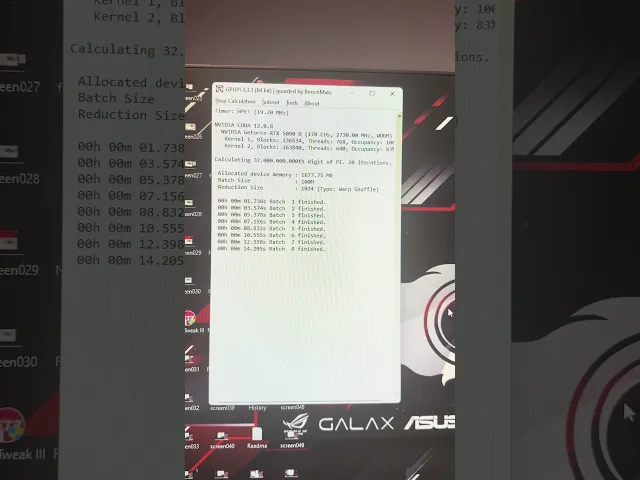
To achieve the 4 GHz frequency, the OGS team replaced the standard 27 MHz oscillator with a modified Elmor ECB board, allowing them to raise the base clock to 28.7 MHz and boost all GPU frequencies by 6.3%. The GDDR7 memory frequency was also bumped up to 1860 MHz, which is nearly equivalent to 30 Gbps.
In the GPUPI v3.3 32B benchmark, the system delivered a score of 35.377 seconds, beating the previous world record by more than a full second. The test setup included an ASUS ROG Maximus Z790 Apex Encore motherboard and an Intel Core i9-14900KF processor, providing maximum platform performance.
The absolute world record for GPU frequency is still held by the Radeon RX 9060 XT at 4769 MHz. Nevertheless, for the Blackwell architecture, OGS's result stands as a new benchmark.
What's your take on overclocking? Have you ever pushed your CPU or GPU beyond its limits? Share your experiences in the comments!
-
 ZLUDA v6 Released: AMD Radeon GPUs Now Run NVIDIA PhysX Games With Major Performance Boost
 -
 Anthropic Claude Models Now Run on NVIDIA GB300 Blackwell Ultra in Azure, Accelerating Enterprise AI
 -
 NVIDIA Reportedly Cancels GeForce RTX 5050 9 GB GPU Due to Overlap With RTX 3060 12 GB
 -
 The NVIDIA App doesn't steal FPS the way gamers feared — but one of its features does hit performance after all
 -
 NVIDIA Keeps the DLSS Ball Rolling: Four More Games Get Support for Cutting-Edge Tech