
Palworld 1.0 Review: Is It Still "Pokémon with Guns"?
 Evgenia Zavyalova
When Palworld launched into Early Access at the beginning of 2024, it became an overnight sensation: over 5 million copies sold in its first three days, a peak concurrent player count of 2 million—the second-highest in Steam history—and servers buckling under the flood of players. Some gamers were thrilled to finally get a Pokémon-like experience on PC, especially one made by an indie studio rather than the "greedy Nintendo." Meanwhile, fans of the original Pokémon franchise accused the developers of Palworld of copying ideas and assets, with some even going so far as to send them death threats.
As usually happens, the initial hype eventually died down. Pocketpair, however, continued polishing the game, fixing bugs and steadily expanding it with new content. Then, in July 2026, after two and a half years in Early Access, Palworld finally received its full release. The patch notes alone stretched to an astonishing 27-page PDF.
So, is the release version of Palworld worth returning to if you only played it in Early Access—or spending 60 hours on if you're jumping in for the first time? Let's find out.
Platform: PC (Ryzen 7 8700F, NVIDIA RTX 5060, 32 GB RAM);
Playtime: 22 hours.
System Requirements
Minimum: Intel Core i5-3570K, 16 GB RAM, GeForce GTX 1050, 40 GB SSD;
Recommended: Intel Core i9-9900K, 32 GB RAM, GeForce RTX 2070, 40 GB SSD.
A Less-Than-Perfect Reputation
As we've already mentioned, Palworld has always had a controversial reputation. On one hand, many gaming outlets quickly declared it a masterpiece simply because it attracted enormous player numbers—despite the fact that commercial success and genuine quality are far from being the same thing.

On the other hand, controversy has followed Palworld ever since launch. In 2024, Nintendo and The Pokémon Company officially filed a lawsuit against Pocketpair, accusing the studio of patent infringement, while the gaming community continues to debate just how similar the game's creatures—known as Pals—are to Pokémon.
Palworld has also often been described as a Frankenstein's monster stitched together from other games' ideas: its UI and fonts resemble those of The Legend of Zelda: Breath of the Wild, its survival and grinding mechanics clearly draw inspiration from ARK: Survival Evolved, and the Pals inevitably invite comparisons to Pokémon. The nickname "Pokémon with Guns" has followed the game ever since, leading many players to dismiss it as lacking an identity of its own—even though Pocketpair had already experimented with creature-taming mechanics in its previous title, Craftopia.

With that in mind, let's try to judge Palworld on its own merits, setting aside both its controversial reputation and the usual allowances made for Early Access games.
How much time did you spend playing Palworld during Early Access?
Tame, Survive, Build, Fight
Back in 2024, Palworld felt like a competently assembled collection of gameplay systems that lacked a unifying core, staying afloat largely thanks to players' fascination with Pokémon. After five to ten hours, however, it became clear that building and crafting quickly grew repetitive, while the gameplay revolved around relentless grinding that was practically mandatory if you wanted to defeat any of the bosses. The game didn't even have a proper story, meaning it lacked a real sense of purpose. By the time of the full release, the developers had managed to address many of these shortcomings (for a detailed breakdown of every addition and change, check out our guide to the Palworld 1.0 update).

The game now features a proper storyline complete with both main and side quests. Your character arrives on the Palpagos Islands with a vague but tangible objective: clear the towers and reach the World Tree, the final area that wasn't accessible during Early Access. Each tower is guarded by a boss, and defeating them requires taming Pals—adorable creatures with valuable abilities. To breed them and ensure your own survival, you'll need to establish and expand a base, gathering the resources necessary to keep everything running. In doing so, the developers have finally tied together the game's survival, building, and crafting systems into a more cohesive whole.
Your first couple of hours will be spent doing the usual survival-game chores: gathering wood and stone, crafting an axe and pickaxe, and putting together a basic shelter. Your character has both hunger and temperature meters to manage. Virtually every action in the game—even cooking meat—earns experience, allowing you to level up. Each new level unlocks additional technologies to research while also granting attribute points that can be invested in health, stamina, attack power, and other stats (Palworld is featured in our lists of the best survival games on PC and the best survival games on PS4 and PS5).

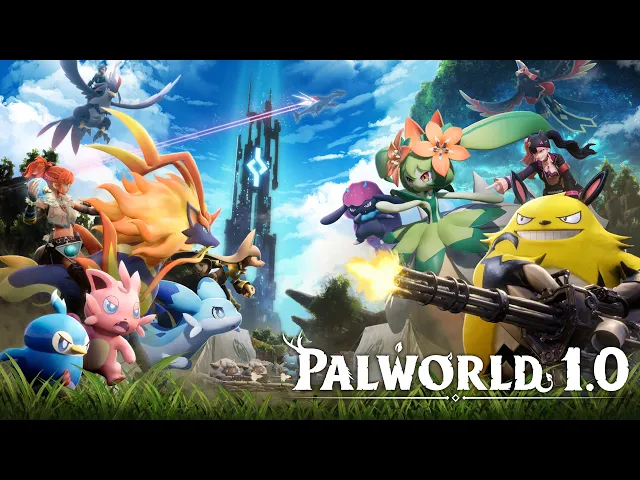
The game's defining feature is, without question, the Pals. Without them, Palworld would simply blend into the sea of generic survival games that flood digital storefronts. Pals serve as workers at your base, companions in combat, mounts for exploration, and... food. To capture one, you first have to weaken it by beating it with a club or another weapon, then throw a Pal Sphere—the game's equivalent of a Poké Ball. Once caught, that Pal is yours to use however you see fit.
First, you can bring a Pal into battle. Unlike the turn-based combat of Pokémon games, Palworld has you fighting alongside your companions in real time, wielding spears, bows, assault rifles, and even rocket launchers. Many Pals deal elemental damage, making them especially effective against powerful enemies. Their abilities can also be improved through breeding. Similar to Mewgenics, you can cross different Pal species to create unique hybrids. This mechanic becomes particularly valuable later in the game, once you've captured most of the available species.

Second, if a Pal isn't particularly useful in combat, you can assign it to your ranch, where it'll passively produce food and valuable resources such as eggs, milk, wool, and even Pal Spheres.
Finally, Pals can serve as a tireless—and unpaid—workforce, automating production and dramatically reducing the amount of grinding required. They can mine stone, chop trees, water crops, and craft items at workbenches. Even combat-oriented Pals have their place in your industrial operation: Fire-type Pals smelt ore and cook food, while Electric-types keep your generators running.

In short, Pals make almost every aspect of the game easier for the player. What do they get in return? Kicks—and outright abuse. Need wool for clothing? You can simply beat an adorable sheep-like Pal with a club. Back in 2024, Palworld shocked many players with its unapologetic cynicism and cruel treatment of its creatures. You can literally work these cute companions to exhaustion or butcher them with an oversized cleaver for meat and crafting materials. Palworld may look like a Pokémon clone at first glance, but Pokémon games are fundamentally kind-hearted. Palworld, by contrast, is deliberately cruel.
The Evil Twin of Pokémon
In Nintendo's Pokémon games, Pokémon are the heart of the experience. They're your companions, your partners, and the entire gameplay loop revolves around catching them, training them, battling alongside them, and ultimately becoming the Champion. Without your Pokémon, victory is impossible.
In Palworld, by contrast, Pals are expendable. You capture them so they can work for you, making the grind faster and more efficient. They're not companions—they're living tools, useful for fighting bosses and automating your base. Killing a Pal for resources is considered perfectly normal, and you can even feed its meat to other Pals. This design philosophy has more in common with Mewgenics and Conan Exiles (see our review of Mewgenics for more on that comparison). You could even argue that Palworld is essentially a slave-owner simulator—except your labor force consists of adorable fantasy creatures instead of humans. If that premise makes you uncomfortable, Palworld probably isn't the game for you. Exploiting miserable little Pals and slaughtering them without consequence isn't a side activity—it's one of the game's core mechanics, as cynical as that may sound.

The grinding and deliberately slow progression haven't gone anywhere, either. The first 20 hours are genuinely entertaining—especially in co-op (for good reason, Palworld is featured in our roundup of the best co-op games, alongside plenty of other excellent multiplayer experiences). After that, however, the repetitive nature of the gameplay becomes increasingly difficult to ignore. Bosses have absurdly large health pools, and sooner or later you'll slam into the game's infamous grind wall. Progression slows with every level, and unlocking stronger weapons means crafting almost everything you can and attacking practically anything that moves. In that sense, Palworld is much like every other survival game: only a small percentage of players will actually see it through to the end.

What's most important to you in games like Palworld?
***
You can confidently say that Palworld has successfully graduated from Early Access, joining the ranks of games like Subnautica, Satisfactory, Rust, Grounded, and The Long Dark. It hasn't transformed into a masterpiece over the past two and a half years, but it has made meaningful improvements across the board: bugs are now rare, progression has been refined, and the game has gained a proper story, quests, treasure chests, bosses, dungeons, new Pals, and plenty of additional content.
If you've been waiting for the full release before giving Palworld a try, now is the right time—the game is finally complete. On the other hand, if you bounced off it because of the grind, the slow progression, or its ruthless treatment of Pals, there's little reason to come back. Those core design choices haven't changed.

And if what you're really want is Pokémon-style creature collecting, breeding, and turn-based battles, Palworld still isn't a substitute. It has outgrown the label of "Pokémon with guns" and become a survival game with an identity of its own—one built around exploiting creatures, automating production, crafting, and grinding. The "Pokémon" here are tools rather than lifelong companions, and you're unlikely to form the same emotional attachment to them.
As for the game's cruelty and cynicism... Palworld is no crueler than the people who made it—or the people who play it.
Survival games
- Best Survival Games on PS4 and PS5: 40+ Picks from The Last of Us to Subnautica
- Best Survival Games on PC: 65+ Picks from Valheim to Subnautica
- 15 Clones: Games Like Rust
- Best Open World Games: TOP-100 from Skyrim to GTA 6 (2026)
- Best Open-World Games for Low-End PCs and Laptops in 2026
- Best Viking and Norse Mythology Games: Strategy, Survival, and Action RPGs
- 70 Best Horror Games of All Time (2026)
- TOP-30: Best Hunting Games on PC & Consoles
- Best Soviet Post-Apocalyptic Games: Top Picks Inspired by USSR Aesthetics
- Best Roguelike Games: 35 Picks from Hades to Slay the Spire 2
-
 Palworld 1.0 Update: All Changes and Patch Notes
 -
 Palworld Egg Incubator Guide: How to Build It and Hatch Pals
 -
 Palworld 1.0 New Resources Guide: How to Find Soralite, Paloxite, and More
 -
 Palworld 1.0 Glider Guide: How to Fly Without Pals
 -
 Palworld Best Flying Mounts: Fastest Pals and Where to Find Them