
Rusty Lake Series Phenomenon. Twin Peaks in the Form of a Point‑and‑Click
 Полина Малиновская
The Dutch studio Rusty Lake made its name with the point-and-click quest series that shares its name. The story of this universe began all the way back in 2013 with Samsara Room (re-released in 2020). That said, 2015 is generally considered the true starting point, when the first free chapters of Cube Escape came out.
Later, the studio released a whole lineup of paid but very affordably priced games: Rusty Lake Hotel, Rusty Lake Roots, Rusty Lake Paradise, The White Door, The Past Within, and Underground Blossom.
The entire Rusty Lake series is thoroughly steeped in the spirit of David Lynch's cult classic Twin Peaks. You can feel it in everything, from the visual aesthetic to the surreal story and the rules that govern this unsettling yet magnetic universe. In this article, I'll take a close look at the phenomenon and the internal logic that makes it tick.
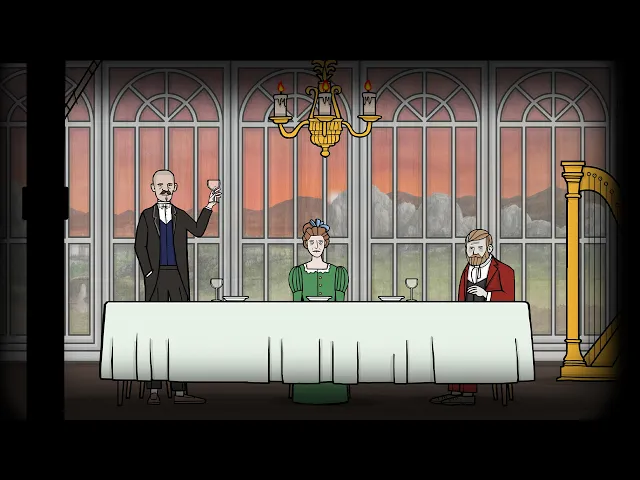
The phenomenon of The Past Within
For a long time, Rusty Lake games remained strictly solo experiences — exploring this strange world meant going in alone, one-on-one with yourself. But with the release of The Past Within, the studio took a bold leap. The project marked a genuine technical breakthrough for the developers: the game shipped in 3D and offered a full-fledged co-op mode.

The key twist is that the two partners exist in different time periods: one explores the Past, the other the Future. Since each player only sees their own screen, the only way to move forward is through communication. Players have to describe locations verbally, compare details, and work together to find the connections between events.
A single, shared ecosystem of mysteries
Rusty Lake's games aren't just a string of sequels — they form a tangled maze of shared characters, storylines, and secrets. Each installment offers only a tiny fragment of the mosaic, so finishing the entire series doesn't guarantee you'll actually understand everything. If anything, new releases often send players deep into the past, turning what already seemed settled completely upside down.

This isn't a series for casual dabbling: you can't just breeze through a couple of chapters and grasp what's going on. Getting closer to solving the mystery of Rusty Lake means gathering scattered details piece by piece, cross-referencing hidden symbols, and mentally revisiting old storylines.
And even then, the creators always keep the final answer just out of frame. They deliberately push players to keep hunting for the missing pieces, again and again (Related: 35 Hardest Games For PC and Consoles in 2026).
How does Rusty Lake handle its protagonist?
In classic point-and-click quests, the main character is usually front and center. The player has a clear sense of whose story they're living through. A great example is Daedalic Entertainment's games, where the plot revolves around specific characters — be it Rufus from Deponia or Noah and Renee from Silence. (also on topic: the history of point-and-click quests)
There's also the opposite approach, seen in Fireproof Games' The Room series. There, the protagonist's identity is nearly erased, and pure puzzles and room exploration take center stage instead.
Rusty Lake balances somewhere between these two extremes. On one hand, the character's identity matters a great deal to a story that spans several generations of a single family. On the other, the developers almost never spell out exactly who you're playing as. You often start solving puzzles in a state of complete disorientation, with no real understanding of your role.
Sometimes the creators do drop hints: in Cube Escape: Birthday, for instance, it's clear from the very first seconds that you're controlling nine-year-old Dale Vandermeer. In other installments, though, the hero's name comes up with zero explanation, and their significance is only revealed several games later, when they show up as a supporting character.

This approach turns figuring out your own identity into a detective quest all its own, and forces you to scrutinize every detail with paranoid precision.
How does Rusty Lake tell stories without words?
There are no endless dialogues, elaborate cutscenes, or an off-screen narrator spoon-feeding you the plot. Instead, the story lives in the environment itself: in interior details, strange objects, and the mechanics of the puzzles. The player isn't just a participant in events — they're a detective and interpreter, forced to piece together scattered clues on their own (further reading: 19 Best Detective Games on PC and Consoles: Murder Mysteries, Deduction Puzzles & Detective Sims).
The studio's games are strikingly quiet. Character voices are rare, but every action taken with a character delivers an important clue. Notes and letters show up more often, but they're not always addressed to the player — more often than not, you're just an outside observer. This approach is on full display in Rusty Lake: Roots and Rusty Lake Paradise, the two most story-dense installments in the series. In Roots, the story of the Vanderboom family is told through a family tree, from which we learn only names and degrees of kinship. It's up to the player to piece together the characters' personalities, hidden motives, and family conflicts on their own, gathering information bit by bit across 34 short episodes.

How can a shrimp in Rusty Lake matter more than a key?
Solving puzzles in Rusty Lake through ordinary logic is a waste of effort. Most of the riddles hinge on the absurd transformation of objects. A regular flowerpot here can turn into the start of something surreal: you bury a seed, water the soil, and instead of a flower, a human hand grows out of it. The world of Rusty Lake runs on its own rules, where the astonishing is treated as the absolute norm.
The developers are just as clever with player expectations. A hiding spot here could be almost anything: an egg, a safe, a jewelry box, or an old dresser. But the reward for your effort is rarely predictable, especially if you're new to the series — you might spend ages on a fiendishly hard puzzle, finally crack open that coveted drawer, and find nothing but a regular shrimp inside. And, paradoxically, in this particular ecosystem, that shrimp might turn out to be far more useful than any key.

This breaking of expectations is exactly what gives the series its charm. The developers make you forget the rules of other quests, and even real-life common sense. Thanks to that approach, the puzzles never get stale: hours into the game, Rusty Lake still manages to surprise you, throw you off balance, and deliver solutions you could never have predicted.
How does Rusty Lake charm instead of scare?
Despite its grim reputation, Rusty Lake isn't a classic horror game. Beneath the imagery of death and mysticism lies a heavy dose of black comedy. The studio strikes a near-perfect balance between the eerie and the comedic, making you feel disgust, confusion, and laughter all at once (more on topic: TOP-15 psychological horror games guaranteed to break your mind).
All this absurdity is delivered completely deadpan. Characters do things that would otherwise be shocking to the core, but here they're woven into the world's everyday logic. It's precisely that unshakable composure from the characters that turns terrifying scenes into grotesque comedy.
The black humor comes through especially clearly in puzzles built around anatomy. The player regularly has to carry out actions that induce genuine discomfort: reaching into someone's brain through a bullet wound or a severed ear; installing a ticking clockwork mechanism in place of a heart; counting the teeth in someone's mouth.

This body horror isn't aiming to scare you. It simply underscores the surreal nature of Rusty Lake, where the line between nightmare and pure absurdity is stretched to its breaking point.
How do Rusty Lake's spaces work?
Despite their apparent simplicity, the locations in Rusty Lake games are remarkably interactive. Typically, a room is just a cube with a minimal set of furniture, but you can touch, open, or use almost every single object in it.
Thanks to that minimalism, the player's focus shifts quickly: instead of clicking around the screen at random hunting for hotspots, you start hunting for hidden meaning in the objects themselves and how they've been arranged.

How did cubes become memory?
To decode Rusty Lake's logic, you need to understand its central symbol: cubes. In the series' lore, memories don't exist as abstract images inside someone's head — they exist as fully tangible physical objects. Memory here is a resource, something that can be extracted, preserved, handed off to someone else, or destroyed. The cubes are clearly sorted by color and property: white cubes hold pleasant moments from the past; black cubes embody painful, dark experiences; and gold cubes tie characters' fates together.
This entire system is anchored to Rusty Lake itself. It's not just a body of water — it's a mysterious living entity that feeds on the constant churn of other people's memories.

This whole framework also fundamentally changes how you perceive the locations. At first glance, the rooms in Rusty Lake seem like standard quest-game set dressing, but over time you realize — these aren't real spaces at all. What we're actually looking at are a kind of mental containers — enclosed, cube-shaped spaces holding individual emotions, traumas, and life stages of the characters.
Here's an old cabinet with secret compartments. So what's inside it?
How do objects tell a story across centuries?
Certain items travel from one game to the next. At first, they look like ordinary decor or just another tool for a puzzle, but over time they turn into symbols.
The most recognizable example is the grandfather clock. Popping up across different installments, it works as a trigger: the player subconsciously understands this clock is more than just furniture.

The characters' personal items play a similar role. This is shown most vividly in Rusty Lake Hotel, where every guest leaves behind their own "visual signature": Mr. Deer is associated with a Bloody Mary cocktail; Mr. Rabbit with magic tricks and a black top hat.
Several games later, those same attributes suddenly resurface in completely different contexts, letting you connect events separated by decades within the story, along with characters shown in their various different forms.
Recurring objects are a unique language Rusty Lake uses to speak to its audience. In a world fixated on themes of reincarnation and the endless cycle of life and death, these visual motifs act as a compass. Fans use them to unfailingly trace characters' fates across generations, figuring out who any given character used to be in a previous incarnation.
How does Rusty Lake scare without jump scares?
Back in the eighteenth century, writer Ann Radcliffe split fear into two types: terror and horror. Terror is the anxiety and mounting tension before the unknown; horror is the shock of a head-on collision with the monster. Rusty Lake's games masterfully use both mechanisms, but most often, they work through two specific tricks: doors and shifting spaces.
In the world of Rusty Lake, a door isn't just a way out of a room. It simultaneously symbolizes both salvation and the greatest danger. In the Cube Escape series, opening the door is often the final goal. But eventually, a chilling realization sets in: just because you can't get out doesn't mean nothing can get in.
You don't have control over the room. At any moment, a stranger could appear beyond the threshold without warning, shattering the illusion of safety. The door peephole serves as a tool all its own: you might catch a silhouette through it, which only heightens the sense of danger.

Most of the games in the series use a first-person view, with rooms made up of four walls and a ceiling. You switch between them instantly, and that turns every turn of the screen into a risk zone. You genuinely have no idea what's waiting for you the next second, right behind your back.
The developers have turned this trick into a fine art through subtle, unnoticed rearrangement of locations. While you're deep in concentration on some puzzle, with the camera locked onto a single detail, the game quietly changes the room behind your back. You turn around, and something in the familiar interior is already off: an object has vanished, a shadow has appeared by the window, or a giant eye now sits where the chandelier used to be. There are no deafening jump scares here, but that quiet, paranoid erosion of trust in reality is exactly the kind of terror Radcliffe wrote about.
The phenomenon of Rusty Lake
The journey Rusty Lake has taken is genuinely impressive. Starting out with Flash games, the developers grew a massive universe with intricate lore and a distinctive visual style. Today, it's become a full-fledged transmedia phenomenon, where the line between game and reality has been stretched to its limit. The developers moved beyond the confines of the screen long ago, turning the exploration of their universe into a multi-layered quest spread across all kinds of platforms (also on topic: Best Games to Play in 2026: Top Picks Across PC, PS5, Xbox & Switch).
This was especially clear during the franchise's tenth anniversary. The free interactive project The Mr. Rabbit Magic Show wasn't just a gift for fans — it was a massive puzzle that led up to the announcement of a major new game, Servant of the Lake. Meanwhile, the studio has been actively branching into new formats: shooting short films, publishing tabletop RPGs, and developing additional storyline projects.
One of the studio's most ambitious experiments was the short film Paradox, released alongside the game Cube Escape: Paradox. The two are genuinely intertwined: the film hides codes needed to understand the game, and the game helps you make sense of what actually happened on screen.

***
Rusty Lake doesn't let the player relax in the comfy chair of a passive observer, casually clicking through puzzle after puzzle. You inevitably become part of the madness. The world of Rusty Lake breaks familiar logic, makes you doubt things you thought were obvious, and forces you to search for hidden meaning in absolute absurdity.
And even once the credits roll on whichever installment you just finished, you won't get any tidy answers. Instead of a period, the creators always leave an ellipsis, leaving the player alone with new questions, unsettling imagery, and that bittersweet feeling of having brushed up against a mystery that can never be fully solved.


