

Sea Walker Saga Preview — Floating Islands in an Endless Ocean
 Evgenia Zavyalova
Fans of science fiction, dystopia, and post-apocalyptic stories might remember the 1995 film Waterworld, starring Kevin Costner. In it, humanity faced a global catastrophe, and the survivors were forced to adapt to life amid an endless ocean. Waterworld flopped at the box office, but it became a cult classic over time, and the developers of Sea Walker Saga from indie studio Antelus Games don't hide the fact that it inspired them.
Sea Walker Saga takes the concept of ocean survival as its foundation but offers its own take on a flooded planet. Here, people don't just drift on makeshift rafts and fight over resources — they've learned to build entire mobile islands equipped with complex machinery and weaponry. The game tries to be an RPG with character progression, a strategy game about managing your own base, a survival sim, and even a third-person shooter all at once. How well did the developers manage to combine all these mechanics?
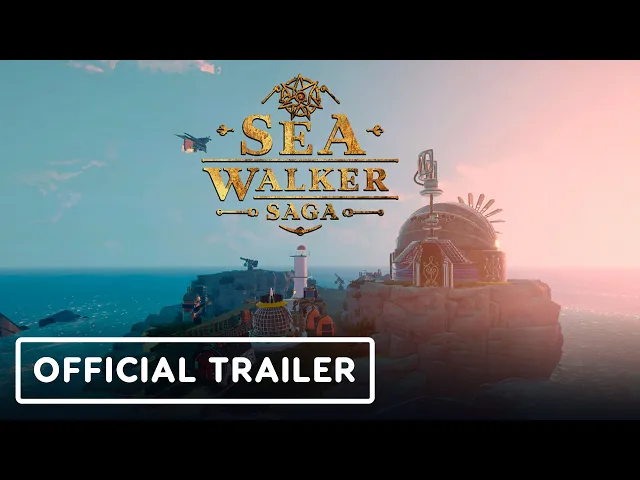
Battle Islands and Steampunk
Sea Walker Saga can't be called a game adaptation of Waterworld — that would be too much for a modest indie studio like Antelus Games to pull off. Instead of copying its cinematic inspiration, the developers added an alternate 19th-century history, unusual vehicles, and an adventurous sci-fi atmosphere to the survival formula. The result is a peculiar mix of post-apocalypse and steampunk, where rusted metal structures hide the remnants of a lost civilization, and the horizon holds not rafts of survivors, but entire islands.

Sea Walker Saga takes place in 1878, in a world ravaged by a flood that swallowed almost all of the land. To survive, humanity invented "Isla Movimi" — artificial floating islands capable of moving across the water on their own thanks to steam engines and machinery. These islands became centers of a new civilization, home to settlements, workshops, trading posts, and defensive structures. Defense is a necessity, since old threats — pirate raids and fights over scarce resources — have carried over into the new world.

The story setup is fairly standard: the protagonist sets out in search of their father — a brilliant researcher and inventor. Before disappearing, the father left behind several clues tied to a mythical continent whose existence is disputed among the survivors. The hero's main means of transportation becomes their own floating island, which doubles as a vehicle, a home, a headquarters, and a base for operations.
Which survival-at-sea game do you think is the best?
Building, Battles, and Deep-Sea Exploration
Sea Walker Saga's gameplay alternates between exploring locations, completing quests, fighting, and upgrading your base with gathered resources.

The core of the gameplay is the floating island. It's not just a hub where the hero rests between missions, but a complex structure that requires constant upgrades. Essentially, the island is the equivalent of a massive cruiser that needs to be armed to fend off enemy island-ships.

Gradually, the humble floating shelter turns into a full-fledged combat platform capable of standing up to larger enemy islands. If you build a hangar on your island, battles move from ranged combat into the skies: the game lets you use aircraft against your enemies.

When the hero lands on another location, the familiar island-management controls give way to third-person action. The character has to personally engage enemies in firefights, take cover, dodge attacks, and pick the right moment to return fire. There are even boss fights that force players to change tactics and keep moving.

Finally, the game lets you dive to the ocean floor in a bathyscaphe to search for sunken objects, valuable items, and various secrets. As the adventure progresses, a jet ski becomes available, making it much easier to travel across the water's surface and gather resources. Ocean exploration becomes more dynamic, and the journey itself more varied.

Which post-apocalyptic setting do you find most interesting?
***
Sea Walker Saga is an example of a game that stands out through an unusual idea and a mix of genres. Steampunk aesthetics and its own twist — battles between floating islands — were added to a universe inspired by Waterworld. The game's biggest hook is the variety of situations and the mix of mechanics from different genres — survival, shooter, and RPG. Players get to build a base, fight naval battles, pilot planes and bathyscaphes, and search for treasure on the ocean floor.
This is also where the game's main weakness lies: each individual mechanic feels unremarkable. The game's concept is more ambitious than what the indie studio can currently deliver, so the mechanics don't all feel equally deep. The RPG elements, for instance, aren't as deep as one might hope, and the naval battles grow repetitive.
The game is also let down by its less-than-cutting-edge visuals. Still, there's hope that once it leaves early access (whenever that happens), we'll see solid improvements to an interesting concept.
-
 41 Best Games Like Skyrim in 2026: Open-World RPGs to Play After Skyrim
-
 20 Best Games Like Atomic Heart to Play in 2026: From BioShock to Soviet Sci-Fi Shooters
-
 27 Best Games Like Call of Duty: Shooters Set in the Past, Present and Future
-
 TOP-21 Best Games Like Dark Souls: Souls-likes on PC and Consoles
-
 130 Best Open-World Games in 2026: From Skyrim to Elden Ring