
What We Saw at the TSMC Museum: A VGTimes Report from Taiwan
 Rodion Ilin
At Computex 2026 in Taipei, we saw plenty of interesting new technologies and devices that major manufacturers will use to attract buyers in the coming years. But once we found ourselves in Taiwan’s capital, one of the key centers of the global semiconductor industry, we decided not to limit ourselves to exhibitions and show floors. After Computex, we went to the TSMC Museum of Innovation. This is not just an exhibition about a single company, but an opportunity to see how the industry developed — an industry without which there would be no modern graphics cards, gaming consoles, smartphones, servers, or most of the everyday electronics we rely on today.

The TSMC Museum of Innovation is not located in Taipei, but in Hsinchu — a city whose importance to Taiwan can be compared to Silicon Valley’s role in American IT. This is where TSMC’s headquarters and part of the company’s key infrastructure are located. TSMC’s factories produce chips for iPhones, NVIDIA graphics cards, AMD processors, and countless other devices.
The museum itself is small and is arranged more like an educational exhibition than a classic technology museum with workshops, machines, and factory tours. Inside, it tells the story of TSMC’s creation, the development of integrated circuits, and the business model that helped the company become the world’s leading contract chip manufacturer.

Admission is free, but entry is only available by prior reservation. A random tourist cannot simply walk in on a whim. Even so, the museum is worth visiting — especially for any gamer. After all, it is genuinely interesting to see where the roots of our favorite PCs, consoles, and handheld devices come from.

The museum’s opening multimedia area is a short immersive video before the main exhibition. In essence, it explains the museum’s central idea: integrated circuits have become the invisible foundation of modern life, while TSMC helps turn its customers’ designs into real semiconductor chips.

Visitors then enter the main exhibition. Here, TSMC immediately connects chip production with everyday electronics: the screens show circuit boards from smartphones and other devices, while enlarged wafer models — silicon discs containing many dies — can be seen on the ceiling.
A wafer is one of the key symbols of the semiconductor industry. Many future chip dies are created simultaneously on this round plate. Later, they become a smartphone processor, a graphics card, a gaming console, or a server, but the process begins with plates like these.
The interactive stand lets visitors assess the evolution of different categories of electronics — from computers and gaming consoles to cameras, smartphones, watches, cars, and even refrigerators. Naturally, we were most interested in consoles. This section clearly shows how home gaming evolved from monochrome systems with a couple of built-in games to cartridge-based consoles, disc-based systems such as the Sega Dreamcast, and modern multimedia platforms with VR and online features. For TSMC, this is a way to communicate its main point: the evolution of consumer technology directly depends on how complex and powerful the chips inside it become.

In the same interactive section, visitors can switch from gaming consoles to computers. The museum shows the evolution from mainframes that occupied entire rooms to workstations, home PCs, laptops, and modern tablets.
Another interactive screen shows the evolution of graphics processors. Visitors can switch between generations of graphics cards and compare resolution, transistor count, computing power, and in-game effects.
Over the past couple of decades, graphics cards have evolved from simple 3D graphics acceleration to ray tracing and complex real-time visual effects. At the end, visitors can enable a comparison of Cyberpunk 2077 with ray tracing and DLSS. Without upscaling, the frame rate drops sharply, while with DLSS enabled, the game becomes noticeably smoother.
Despite all the controversy surrounding DLSS 5, upscalers remain a revolutionary technology. Thanks to them, many modern AAA blockbusters can run on mid-range hardware — despite complex visual effects, high resolutions, and ray tracing. Want examples? Take a look at our list of the most optimized games.

Nearby, there is a similar interactive screen dedicated to mobile processors — the chips that power smartphones, apps, games, cameras, connectivity, and the device interface.
Using 2008 as an example, the specifications look extremely modest today: 65 nm, clock speeds measured in hundreds of megahertz, low screen resolution, and slow data loading. But chips like these stood at the beginning of the modern mobile era. Today, smartphones have become so powerful that they can comfortably handle ports of PC and console games. You can see this for yourself, for example, in our list of the best strategy games for mobile devices.

A gamepad is a simple example showing that even an ordinary gaming console consists of dozens of microchips: according to the museum’s estimate, a system like this contains around 39 chips.
The museum focuses not only on consumer electronics, but also on the history of TSMC itself. Here, visitors can see early company documents: a presentation by TSMC founder Morris Chang, one of the key figures in the history of the modern semiconductor industry, to the Taiwanese government on the development of the very-large-scale integration industry, as well as TSMC’s 1986 business plan for investors.
In essence, this is where the future semiconductor empire began. Chang’s idea was not simply to build another factory, but to create a contract manufacturer that would not design its own chips to compete with its customers, but would instead help other companies turn their designs into real microchips.

On a separate map, the museum shows that TSMC has long since expanded beyond Taiwan. The company’s main capacity is still concentrated on the island, but it also has factories and production sites in the United States, Japan, China, and Germany.

This part of the museum is called How TSMC Unleashes IC Innovation. Here, several screens can be moved by hand along the wall, revealing different layers of the same chain: TSMC’s customers, types of microchips, production, market shares, and end-user devices. The point of the exhibit is to show that TSMC does not operate in a vacuum. The company stands between chip designers and the enormous market for finished electronics.

Separate stands cover Morris Chang’s education, his work in the United States, his return to Taiwan, and the creation of a company that chose not to compete with its customers using its own processors, but instead offered to manufacture their microchips at advanced factories.
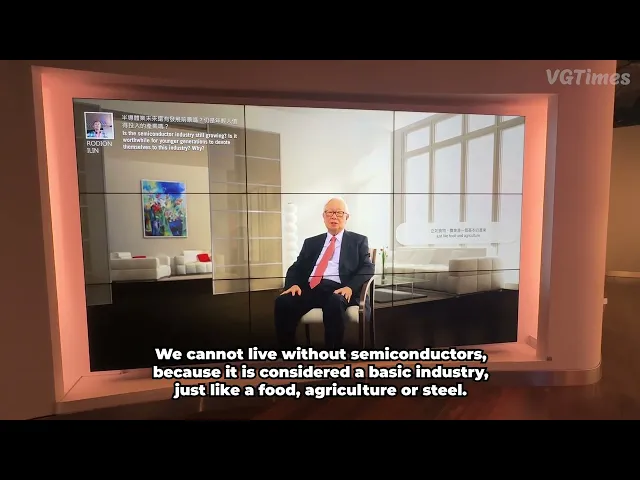
At the end of the Morris Chang section, there is an interactive screen with a virtual interview featuring TSMC’s founder. This is, of course, not a direct conversation with Chang himself: the visitor selects a topic, adds a name and photo, and then the question appears on a large display next to a pre-recorded answer.
We asked whether the semiconductor industry continues to grow and whether young specialists should consider building a career in it. The answer was predictably optimistic: according to Chang, the industry still has a major future ahead of it.
Where do gamers notice the biggest impact of modern chip technology?
***
The TSMC Museum of Innovation makes one thing clear: behind modern games, consoles, graphics cards, and handheld PCs stands a massive industry that ordinary users almost never see directly. In the comments, tell us what kind of technology production facility you would like to see for yourself.

Computex 2026
- NVIDIA ARM Laptop Processors: Is This Finally Happening at Computex 2026?
- ASUS Shows Off New ROG Ally X20: OLED Is There, but No Serious Upgrade
- Graphics Cards, Monitors, and AI: GIGABYTE Brought Its Full Arsenal of New Gear to Computex 2026
- VGTimes at Computex 2026 in Taipei. The summer's biggest event for tech enthusiasts
- Acer Shows Off a Laptop at Computex 2026 That's Almost Indistinguishable From a Desktop PC, Plus an Ultrabook Cheaper Than the MacBook
- GIGABYTE Showed Laptops at Computex Where AI Controls Almost Everything
- ADATA Showed Off An SSD At Computex That Only Unlocks With Your Smartphone
- J-Mex Unveils Human-to-Robot Motion Conversion Tech at Computex 2026
- ZOTAC’s Computex 2026 Booth Was Stolen by a Mini-PC With an RTX 5080, Oh, and a PC in a Robot Arm
- Thermaltake Showed off a Dual-PC Case and a Weird Power Supply at Computex 2026
- VGTimes Report: What GIGABYTE Showed at Computex 2026
- BenQ Shows a Football Simulator at Computex That Analyzes Every Kick of the Ball
- Silicon Power Brings Ultra-Fast SSD and Video Workflow Devices to Computex
- AverMedia Shows Off Streamer Hub at Computex with Support for Multiple Cameras and Consoles
- Maxtor Just Dropped a Next-Gen CTG12 Thermal Paste at Computex
- Not Laptops or PCs: Alienware Showed a Different Priority at Computex 2026
- NVIDIA Showed Off AI-Powered Robots at Computex
- NVIDIA Showed Off AI at Computex You Can Actually Trust to Do Your Computer Work
Article by Rodion Ilin and Fazil Dzhyndzholiia.
VGTimes has been operating since 2011 and over that time has attended dozens of exhibitions and festivals, where our journalists have gathered a wealth of exclusive material. For example, in 2019 we attended a closed showing of Cyberpunk 2077 at gamescom, in 2017 we prepared a photo report from WG Fest, in 2020 we were at the largest gaming event in Central Asia — CAGS, and we have visited IgroMir several times, where we met Hideo Kojima and other famous developers. In 2024 we traveled to the Land of the Rising Sun for TGS 2024, where we were amazed by the scale of the Tokyo event. In 2025 we witnessed one of Asia's premier gaming exhibitions — ChinaJoy in Shanghai. We also made it to the Thai edition of gamescom 2025 in Bangkok, and at the start of this year attended CES 2026 in Las Vegas.
-
 AverMedia Shows Off Streamer Hub at Computex with Support for Multiple Cameras and Consoles
 -
 VGTimes Report: What GIGABYTE Showed at Computex 2026
 -
 Maxtor Just Dropped a Next-Gen CTG12 Thermal Paste at Computex
 -
 Silicon Power Brings Ultra-Fast SSD and Video Workflow Devices to Computex
 -
 NVIDIA Showed Off AI-Powered Robots at Computex
 -
 27 Best Games Like Call of Duty: Shooters Set in the Past, Present and Future