EU Kids Act Explained: How It Could Change the Internet and Gaming
 Anastasiia Sokolova
In September, the European Commission unveiled the EU Kids Act, a proposal to protect children online. It covers social media, AI chatbots, and video games. Key measures include age verification, parental controls, and restrictions on game mechanics that encourage children to spend too much time on these services. The proposal has not been adopted, but it has already sparked an outcry. Stop Killing Games founder Ross Scott called it the biggest threat his movement has faced, while popular YouTubers warned that it could “destroy” gaming and the internet.
This matters beyond the European Union, too. Gamers around the world could feel the effects, since companies with global audiences may find it easier to roll out changes worldwide than maintain separate rules for each region. So let's look at what the EU Kids Act actually proposes, how it could affect games and online services, and whether it's time to sound the alarm.
Key Points
- The EU Kids Act is a European Commission proposal to protect children online. It has not been adopted: the European Parliament and the Council of the EU still need to agree on the text, which may change;
- The proposal calls for age restrictions, safety settings, and limits on features designed to keep users engaged on social media and video platforms. AI chatbot providers would also be required to avoid interactions that could lead children to become emotionally dependent on their services;
- The proposal calls for parental controls for children under 13 in games, alongside additional safeguards for minors. The rules could also cover single-player games distributed online;
- Adults may also need to verify their age to use services without child-safety restrictions. Websites and games would receive confirmation that the user is old enough, rather than a copy of their passport;
- Despite some claims circulating online, the draft EU Kids Act does not impose a blanket ban on private servers or limit video game play to one hour a day;
- However, compliance costs and the difficulty of updating older games are legitimate concerns.
What Rules Does the EU Kids Act Propose for Social Media and AI?
First, let's look at the proposed rules for social media, video platforms, and AI services, based on the information available in mid-October. The next section will cover what they could mean for gaming. The main sources are the European Commission's published proposal and its official explainer, which was updated on October 8. The proposal is at the preparatory stage in the European Parliament. Parliament and the Council of the EU still need to agree on the text.

The European Commission, led by Ursula von der Leyen, is promoting the initiative. Its aim is to establish common rules for protecting minors across the EU. Individual countries are already introducing their own age restrictions, leaving platforms to navigate different requirements. The EU Kids Act is intended to take the form of an EU regulation. If adopted, its provisions would apply directly in every member state. Von der Leyen also emphasizes that platforms themselves must prove their services are safe for children:
Today, our children are engaging with the most sophisticated technologies ever created. Technology that was never created with their wellbeing in mind. Our KIDS Act is reversing the burden of proof — it is for platforms to show they are safe by design. And we put parents back in the driving seat, giving them the tools to help their children navigate a safer online world.
Existing EU guidelines on protecting minors already include some of these measures. As lawyers explain in an analysis by Paul Hastings, the proposal would turn those recommendations into binding requirements and complement the Digital Services Act, the EU's existing law on digital services.

One of the most significant proposals is a common set of age restrictions for social media and video platforms across the EU. These would apply to services with features the Commission considers risky for children, such as content recommendations based on user behavior, contact with strangers, or endless scrolling. For these platforms, the proposal sets out the following rules:
- Under 13: no accounts of their own;
- Ages 13–14: a restricted account created by a parent, with parental controls always enabled, preapproved contacts, and a daily usage limit of one hour;
- Age 15 and up: users could create their own accounts, but protective settings would continue to apply until they turn 18.
The proposal includes an exception for video platforms designed specifically for young children. Children aged three and up could have limited access through a parent's account, also capped at one hour a day.
Age restrictions are only part of the proposal. Social media and video platforms would also have to rethink features that keep minors glued to their screens, including infinite scrolling and autoplay without breaks, notifications unrelated to a user's actions, and rewards for returning regularly. Platforms would also need to introduce time limits so that using their services does not interfere with children's sleep or schoolwork.
Recommendation feeds for minors would also change:
- Content the child has chosen to watch or read would take priority;
- Personalization based on tracking user behavior would be turned off by default;
- Users would be able to reset their recommendations and choose a feed that does not use profiling.
The proposal also calls for changes to safety settings and the rules governing contact with minors:
- Geolocation, camera and microphone access, contact syncing, and push notifications would be disabled by default;
- Other users would need a child's consent before contacting them directly;
- Adding a child to a group would also require their consent.
The proposal would prohibit AI companions and general-purpose chatbots from simulating relationships in ways that could lead children to become emotionally dependent on them. It would also require “memory” features that carry information from one conversation into the next to be turned off by default. Developers would have to assess potential risks to children before releasing these AI services.

Even if you're an adult, the EU Kids Act could still affect you. Services would need to determine who can access features without the restrictions intended for children. You would no longer be able to sign up for an age-restricted platform simply by entering any date of birth you like. Instead, you would need to use a certified age-verification method. As the European Commission explains, users would first confirm their age in a separate app, using an electronic ID, a biometric passport, or a banking app, for example. The platform would only learn whether the user meets the relevant age requirement. It would not receive their name, date of birth, or a copy of their passport.
Not everyone with an existing account would need a new check. The proposal includes exceptions if a platform can establish with a high degree of confidence that the user is old enough. The Commission proposes considering a combination of factors, including when the account was created and payment information.
These and many other provisions of the EU Kids Act can be confusing, especially since some questions remain unanswered. For example, it is still unclear what evidence would be enough to establish the “high degree of confidence” that would allow existing account holders to skip a new age check.
EU and national regulators would enforce the rules. The largest platforms would have to draw up compliance plans and pay for independent audits. Fines for violations could reach 6% of global annual turnover.
What Rules Does the EU Kids Act Propose for Video Games?
Gaming services, including online games, would also have child-safety restrictions enabled by default. Adult players would therefore need to verify their age to access all features.
A key detail is that the proposal's definition of “online games” goes well beyond conventional multiplayer titles. Gamer’s Voice, the UK branch of Stop Killing Games, highlights this in its updated October briefing. According to its interpretation, the rules could even cover some single-player games distributed online.

Games would also be required to provide parental controls for children under 13. These would let parents limit playtime, manage their child's privacy and communication settings, and report harmful content or behavior by other players. The details of these tools have not been settled yet: the technical requirements still need to be clarified.
For minors, the proposal would also change communication rules and restrict mechanics that encourage players to return regularly, such as daily rewards and the loss of bonuses for missing a day.
Another significant change concerns digital stores and would affect customers more broadly. Stores would have to assess users' ages and prevent minors from buying or accessing apps that are inappropriate for their age.
Selling through Steam or another store would not remove game providers' obligations to add features such as parental controls to their games. The store and the game provider would each have their own requirements to meet. Age verification by the store could be part of the overall system, but the requirements for game design and parental controls would remain.

For indie developers, this would mean more work and higher costs. The proposal provides no blanket exemption for small companies. In its impact assessment, the European Commission acknowledges that these requirements are harder for small teams to meet because they have fewer resources. However, it expects ready-made third-party tools to ease the burden.
Older games pose a separate problem. There is no exemption for games released long ago that are no longer in development. In its briefing, Gamer’s Voice notes that adding the necessary features could be extremely difficult if the source code is unavailable and the original team is no longer around. Keeping these games on sale and maintaining support could therefore become less profitable or technically challenging.
People running fan servers for multiplayer games could also face new child-safety obligations. The question is which of those servers would fall within the EU Kids Act's scope. According to Gamer’s Voice, a private server for friends would probably not be covered. For public servers that take payments, run ads, or accept donations, the key question is whether operating them counts as economic activity.
Finally, these requirements are tied to serving users in the EU, not to where a developer is based. Companies outside the EU would therefore also need to account for them if they offer their games to European players. As I noted at the start, the effects could extend beyond the region. For example, if a server shared by players in several countries shut down because adapting it to the rules proved too difficult, players outside the EU would lose access, too. This is a hypothetical scenario, but it illustrates how the EU Kids Act could affect players worldwide.
Why Is the EU Kids Act Facing Criticism?
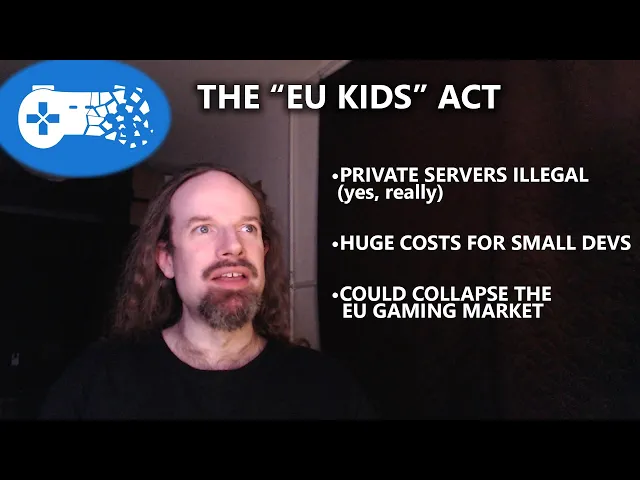
On September 30, Ross Scott, the creator of the YouTube channel Accursed Farms and founder of Stop Killing Games, published a video criticizing the EU Kids Act. His movement campaigns to preserve access to purchased games after support ends. Scott now fears the proposal could undo that work. Early in the video, he says:
I want to talk about the biggest threat to stop killing games to date. Actually, this is bigger than stop killing games. It's more like a bomb that could implode the whole video games industry.
Scott stresses that his objection is not to the idea of protecting children from social media and chatbots. Had the proposal stopped there, he says, he would not have made the video at all. He takes issue with the provisions that affect video games and adults. In his view, the focus on protecting children is overshadowing the risks to games and adult users.
He first highlights what he considers an overly broad definition of “online games.” Under his reading, the requirements could apply to virtually every digitally distributed game, including single-player titles. He also raises questions about physical copies of games that connect to the internet to download patches. Scott is frustrated that the document makes it hard to distinguish a regular game from a regulated service:
This reads more like a philosophy question than a law proposal.
One of his biggest concerns is the future of fan-run servers. In Scott's interpretation, these servers would become illegal to operate unless they were updated to meet the new requirements. He uses running his own Unreal Tournament or Minecraft server as an example. He believes this could also put ordinary players at risk when they keep their favorite games alive after official support ends.
This proposal is the polar opposite of the Stop Killing Games movement. We want games to remain reasonably playable after support ends, especially ones that are played online. The EU Kids Act wants to make playing online games after support ends illegal and shake down studios for selling them in the first place.

Scott is also concerned about older games: he believes the new obligations would apply even to titles released twenty years ago.
Age verification also raises privacy concerns for Scott. In the video, he discusses the need to provide identifying information and reminds viewers that companies entrusted with users' data regularly suffer security breaches.
His objections do not end there. Scott mentions restrictions on gaming sessions lasting more than an hour and a requirement to block screenshots. He even raises the possibility of problems for Linux distributions if requirements to determine users' ages extend to operating systems. He sees the unclear wording as a cause for concern in its own right.
Scott predicts substantial costs and a long list of additional tasks for developers. In his view, simply buying an off-the-shelf age-verification tool would not be enough: studios would have to update their games and meet the remaining requirements themselves. The estimates he cites put costs in the hundreds of thousands of dollars. He sees the lack of a blanket exemption for small teams as particularly damaging:
So yeah, let's make small developer lives hell and charge them a third of a million dollars or so every year in perpetuity for them to sell in the EU.
Scott expects major publishers to be able to absorb the extra costs, while making games available to EU users would become too expensive for independent developers. He also suggests that less competition from indies could benefit larger companies.
Scott's preferred outcome is for the EU Kids Act to be scrapped. If that is not possible, he proposes at least exempting games that are not run for profit or do not collect personal data. He believes these exemptions would help protect small developers and the ability to keep playing older online games:
Like, this act should not apply to games that aren't being run for profit or games that aren't collecting personal information in the first place.
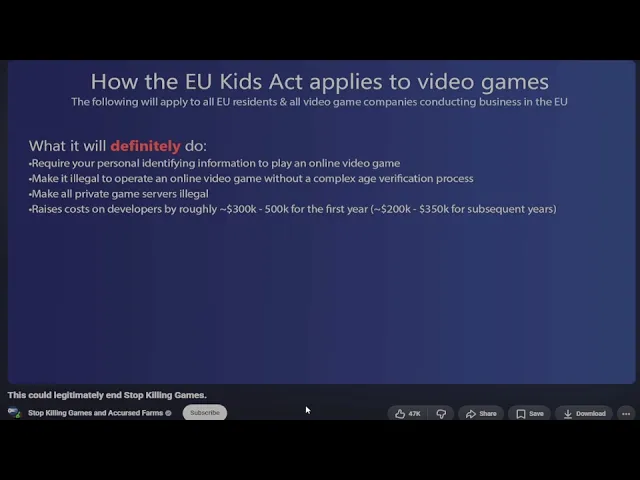
Other major YouTubers have joined the debate. Charlie White, known as MoistCr1TiKaL, addressed the topic in a video titled EU Trying to Destroy Gaming. Right-to-repair advocate Louis Rossmann published EU kids act explained: how Europe plans to ruin the internet. His video covers games as well as the implications of age checks for privacy, anonymous users, and access to online services.
The rights organization Electronic Frontier Foundation has also criticized the proposal. In its analysis, EFF warns that age barriers could limit access to information and undermine privacy for all users. It also argues that the lack of exemptions for small companies could strengthen the position of tech giants.
Finally, industry association Video Games Europe warns against blanket age checks for games and players. It urges policymakers to consider children's right to play and access culture alongside their safety, and to tie requirements to specific risks.
How Justified Are the Concerns About the EU Kids Act?
There are reasons to worry, but critics' most sweeping claims are not fully supported. Additional obligations for gaming services do not automatically mean every fan-run server will be banned. Nor do the proposed measures currently point to the complete collapse of indie gaming in Europe.
Claims Not Supported by the Proposal
The authors of the Gamer’s Voice briefing mentioned earlier explicitly say it would be an overstatement to claim that the proposal criminalizes game preservation, bans all private servers, or requires identity checks in every game. The organization still opposes the proposal, however, and sees it as a threat to small developers and gaming heritage.
Some of these criticisms can be checked directly against the text of the proposal:
- In his video, Ross Scott mentions a ban on gaming activities lasting more than an hour. The proposal contains no such ban. The proposed one-hour daily limit would apply to some children's accounts on social media and video platforms. In games, parents would be able to set their own time limits for their child;
- There is no blanket ban on taking screenshots in games, either. The relevant provision concerns minors' data and posts on social media and video platforms. Article 15, which covers games, does not extend that provision to them;
- The proposal does not require every Linux distribution to introduce age checks. But if an operating system provider already has age confirmation obtained through a check that meets the proposal's standards, it would have to enable sharing it with services covered by the regulation. This would require the user's consent and apply only when the service needs that confirmation to comply with the rules.
Age Verification and Personal Data

The proposal does not require users to send identity documents to game developers. As the European Commission explains, games and websites would only be told whether a user meets the relevant age requirement.
But the risks of data breaches and verification errors remain, along with difficulties for people who cannot prove their age. EFF has raised concerns about privacy and internet access.
Potential Costs for Developers
Critics put the potential costs of complying with the EU Kids Act in the hundreds of thousands of dollars, but those figures are estimates. How much studios would actually have to spend is still unclear.
Developers would first need to add the new features to their games and then maintain them. The European Commission expects costs to drop significantly after the initial changes. Ross Scott fears developers would still have to spend large sums every year. So the question is not just how much it would cost to update a game, but how much its ongoing maintenance would cost.
Where the Proposal Stands
There is no final law yet. As of mid-October, the EU Kids Act is at the preparatory stage in the European Parliament. The European Commission is also accepting feedback on the proposal until December 3.
Next, the European Parliament and the Council of the EU, which represents the governments of EU member states, will need to consider the proposal. Both can propose amendments and must agree on the same text. As the explanation of the legislative procedure makes clear, the legislation cannot be adopted without that agreement. The proposal does not have to go through all three readings: the two institutions can reach an agreement earlier.

The final version could differ substantially from the current draft. Lawmakers could clarify which games and servers are covered, add exemptions, change the obligations, or adjust the time allowed for compliance. But there is no guarantee that the disputed provisions will be relaxed: the final rules could also be stricter.
Under the current proposal, most requirements would apply six months after the regulation enters into force.
What do you think of the EU Kids Act in its current form?
***
There are good reasons to follow the EU Kids Act closely and challenge its controversial or vague provisions. But claims that all private servers will be banned or that the European gaming market will collapse should be treated with caution. The scale of the impact will depend on the final text, the implementation requirements, and how feasible those requirements are for developers to meet.
What do you think? Would you be willing to verify your age in games and on social media to protect children? Or would these checks create too many problems? Share your thoughts in the comments.
FAQ
Quick answers about the proposed rules and what they could mean for users.
What Is the EU Kids Act, and Has It Been Adopted?
It is a European Commission proposal to protect children online, presented in September 2026. As of mid-October, it has not been adopted. The European Parliament and the Council of the EU must agree on the final text, so the disputed provisions could still change.
What Age Restrictions Are Proposed for Social Media?
On social media and video platforms covered by these rules, children under 13 would not be allowed to have accounts of their own. Users aged 13–14 would have restricted accounts created by their parents. From age 15, users could sign up independently, but protective settings would remain in place until they turn 18.
What Changes Are Proposed for AI Chatbots?
Developers would be required to avoid simulating relationships that could make a child emotionally dependent on the chatbot. “Memory” of past conversations would have to be turned off by default. These AI services would need to be assessed for risks to children before release.
Would Adults Have to Send Their Passport to Every Website and Game Developer?
No. Under the proposed system, users verify their age through a separate tool, and the service only learns whether they meet the relevant age requirement. Users would not have to send the service a copy of their passport, their name, or their date of birth. Some existing account holders could avoid a new check if the platform is already sufficiently confident about their age.
Would the Rules Only Apply to Multiplayer Games?
Not necessarily. The proposal's definition of online games is broad enough to potentially cover single-player titles distributed online. The criteria are still unclear.
Would Gaming Be Limited to One Hour a Day?
The proposal contains no general one-hour daily limit on video games. A limit of that kind is proposed for certain forms of access to social media and video platforms for children. In games, parents would be able to set their own time limits for their child.
Would Fan-Run and Private Servers Be Banned?
There is no blanket ban. According to Gamer’s Voice, a private server for friends or family could fall outside the rules. Public servers are more complicated: the key issue is whether operating them counts as economic activity.
Why Are Indie Developers and Older Games a Particular Concern?
The proposal provides no blanket exemption for small teams or older games. Indie developers have fewer resources to implement and maintain the required features, while an older game may no longer have an active development team or accessible source code.
Could the EU Kids Act Affect Players Outside the EU?
Yes, but that does not mean European rules would automatically become mandatory worldwide. The requirements would apply to companies providing the relevant services to users in the EU. If a company chooses to use the same features and settings across all regions, users elsewhere will feel the changes, too.
Money, Scandals, Phenomena
- The CS2 Skin Economy: Billions of Dollars, Million-Dollar Knives, and a $2 Billion Crash in 30 Hours
- The Biggest Thefts and Hacks in Gaming History: The $620 Million Axie Infinity Hack, Stolen CS2 Skins, and the GTA 6 Leak
- Star Citizen Has Raised a Billion Dollars — and Still Hasn't Come Out
- GTA Controversies: Lawsuits, Bans, and Hot Coffee
- Why Graphics Cards Are So Expensive in 2026: How AI Ate the Memory Supply
- Why have videogames become so expensive, and will they get even more expensive?
- Why Millions of People Click on Bananas, Cookies, and Cows: How Idle Games Have Hacked Our Brains
- What Are the Backrooms? Levels, Entities, Games, and Movie Explained
- Rusty Lake Series Phenomenon. Twin Peaks in the Form of a Point‑and‑Click
- Rideshare "Stimulator": What Kind of Game Is It and Why Did It Spark an AI Controversy?
- AI Is Already Taking Jobs in Game Development — Just Not Where We Expected
- DLSS 5 — Graphics Revolution or Marketing Gimmick? Let's Cut Through the Hype
- Why the Ocarina of Time Remake Announcement Divided Fans — Uncanny Valley, Politics, and Nostalgia
- Why AI Researchers Are Leaving OpenAI, Anthropic, and Google — and What They’re Warning About
- How GTA 5 Made More Money Than Any Movie Ever
- AI in Games: Why Players Boycott Studios Over AI Art and Voices
- How Much Money Has Genshin Impact Made and Why Gacha Is Cooling Off
- Sued for Being Too Addictive: How the Makers of Fortnite, Roblox and Minecraft Ended Up in Court
- The $250 Million AI Chat: How Krafton Asked ChatGPT to Escape Subnautica 2's Founders — and Lost
- What Was Found in the 12TB Steam Leak: Early Builds of GTA 3, Mafia 2, and Valve Games
- How Graphics Card Prices Spiraled: Mining, Scalpers, and Prices No One Could Believe
- The Live-Service Graveyard: How the Industry Burns Billions on Games That Die in Weeks
- Minecraft in Elden Ring and TNT in RDR2: The Wild AI Mashups That Broke the Internet — What's Real and What You Can Download
- Is Deadlock Out? Valve's Invite-Only Game Sets a New Player Count Record
- PS5 Jailbreak: What Relapse Offers and What You Risk
- EU Kids Act Explained: How It Could Change the Internet and Gaming
-
 20 Best Games Like Atomic Heart to Play in 2026: From BioShock to Soviet Sci-Fi Shooters
 -
 Best Games to Play in 2026: Top Picks Across PC, PS5, Xbox & Switch
 -
 TOP-20 Best Games Like Dark Souls: Souls-likes on PC and Consoles
 -
 Best Games for Women on PC and Consoles: A Selection for Every Taste
 -
 38 Best Games Like Skyrim in 2026: Open-World RPGs to Play After Skyrim