
EU Gaming Law Plans and You: Kid Mode, In-Game Currency, Loot Boxes
 Fazil Dzhyndzholiia
European regulators want to change how games sell virtual currency, reward daily logins and protect younger players. For you, that could mean clearer skin prices, different refund rules, changes to voice chat and daily rewards — and unresolved questions about keeping older games playable.
Three separate initiatives are driving the debate. Consumer authorities are already challenging how Valorant, Minecraft, Clash of Clans, Candy Crush Saga and five other games sell in-game currency. The proposed KIDS Act would require protective settings for younger players and adults whose age hasn't been confirmed. The planned Digital Fairness Act could address loot boxes and other monetization practices, though no draft has been published yet.
These measures are at different stages. The currency cases rely on existing consumer law, while the KIDS Act still needs approval and could change substantially. Meanwhile, developers and game-preservation campaigners are questioning how broad requirements would affect small studios, older games and fan-run servers.
This article examines what could change in the games you play, what regulators are already demanding, and which concerns remain unresolved. It also separates the age checks players already encounter from the EU proposals still being debated.

Three Weeks, Three Different Things
The panic started before there was anything official to read. On September 14 and 15, news outlets reported on leaked drafts of the KIDS Act, and the story that spread was simple: children under 15 would be banned from online games. On September 16, Ursula von der Leyen, head of the European Commission, announced the KIDS Act in her State of the Union speech. The same day, the German site netzpolitik.org published the leaked draft in full. Later that day, Epic Games CEO Tim Sweeney, whose company makes Fortnite, responded on X to a post saying the EU was "reportedly preparing to ban kids under 15" from social media, AI chatbots and online games. "The apps and games of today are the paintbrushes and tree forts of yesterday," he wrote, as Kotaku reported.
On September 17, the Commission officially presented the proposal, which only starts the lawmaking process. Apart from technical edits and one added explanatory paragraph, the legal text matches the leaked draft. Then, on September 30, the panic escalated. Stop Killing Games, the campaign against publishers shutting down games people have paid for, released a video by its founder, Ross Scott, titled "This could legitimately end Stop Killing Games." That evening, the r/gaming post linking to the video appeared. On October 2, penguinz0 reacted to Scott's video with his own, though he did note that the text is only a draft and won't take effect soon. By October 7, the Reddit post had more than 13,000 upvotes.
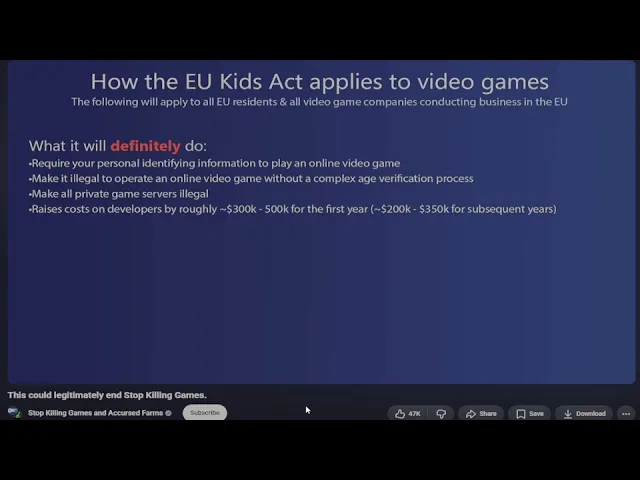
The same day as Scott's video, in an unrelated move, the Commission announced that EU consumer authorities were taking action against nine game companies over in-game currency. Part of why the fear spread so fast lies in what the draft's 99 pages say, and in what they don't.
What the Draft Actually Says: Kid Mode Until You're Confirmed as an Adult
The KIDS Act, short for "Keeping Internet Digital Spaces Accountable and Trustworthy," is a proposed regulation. If it passes, it would apply directly in every EU country, with no need for each one to pass its own law. It covers social media, video platforms, app stores, operating systems, AI chatbots and online games, as long as they're accessible to minors. Its rules for social media and AI chatbots are laid out in a separate EU KIDS Act explainer. Von der Leyen summed up the idea in one line: "Our KIDS Act is reversing the burden of proof — it is for platforms to show they are safe by design." In the Commission's framing, regulators today have to prove harm after the fact. Under the draft, the biggest social media and video platforms would have to submit an independently audited compliance plan, and online games would have to be safe by design, as would social media, video platforms, AI chatbots and app stores.
Almost every game that children can access would be covered. Under the draft, it doesn't matter whether a game is free or paid, or whether it runs locally on your device or remotely in the cloud. The draft's preamble, the introductory section that explains its goals, excludes games available "exclusively through physical media, without any online component enabling their access, distribution, or purchase," and educational games run by schools are exempt as well. In practice, apart from those school games, the games most likely to stay outside the rules are disc-based ones with no online features at all: no download, no online purchase and no online play. A single-player game bought on Steam would most likely be covered, but it's unclear what the rules would require of a game with no chat, accounts or online features. Companies based outside the EU would be covered too if they offer games to players there. The draft doesn't define "accessible to minors," so games meant only for adults are a gray area.
For players under 18, the companies that provide a game would have to:
- Stop using rewards and penalties to push players to log in at set times or more often. The draft bans "incentivising engagement at regular times," including through "penalties or loss of benefits for failing to engage regularly."
- Stop sending notifications the player didn't trigger, such as reminders to come back and play, and turn push notifications off by default.
- Keep the microphone, camera and location sharing off by default.
- Make sure strangers can't start a conversation with a minor unless the minor approves it, and that nobody can add a minor to a group without the minor's agreement.
- Give parents tools to set time limits and manage settings and contacts. Children under 13 could play only with those parental controls in place.
The Commission's own Q&A directly names one target of the first requirement: "'streak' mechanics that penalise a child for not returning every day." Candy Crush Saga, rated PEGI 3 (suitable for all ages under PEGI, the games industry's own age-rating system in Europe), has used this kind of mechanic. According to the game's fan wiki, its Daily Treat Machine, added in 2021, fills up after 30 daily logins in a row, and once the machine is full, missing a single day sets it back to day 25.
The most important word in the draft, though, is "default." The streak ban, notification limits, privacy settings and contact rules above would stay in place until the game has confirmed that the player is an adult. Entering a birth date doesn't count, because the draft rules out self-declaration as an age check. "Self-declared age is explicitly not enough," the Commission writes about its new age rules. So if you're an adult and don't confirm your age, you'd get kid mode, with no streak rewards, the microphone off by default and strangers unable to start a chat unless you approve it.
The check itself is designed to reveal as little about the player as possible. Games could use different methods, but each method would have to tell the game only that you're 18 or older. This approach is known as a zero-knowledge proof. Every EU country would have to offer at least one free way to prove your age. And existing accounts may not need a check at all. "Where a platform can already tell with high confidence that a user is an adult, no new check is needed, so most adults will notice nothing," the Commission says, pointing to signals such as an account's age or a saved credit card.
Some changes would reach you before you even launch a game, because app stores would have duties of their own. Every app, including games, would need an age rating based on a publicly available method, and minors couldn't buy or download apps rated above their age. The draft doesn't make PEGI mandatory. It mentions PEGI only in the preamble, as an example for future codes of conduct drawn up with the industry.

What the draft doesn't do may surprise you more: it doesn't directly ban loot boxes in games. It does ban exposing minors to "variable reward systems" (such as loot boxes) and requires prices to be shown in real money. But those rules, set out in Article 13, cover social networks and video platforms, and a separate article extends them to AI chatbots. They don't cover games. For games, the preamble says young players "should benefit from the same protection," but the draft leaves the actual rules to codes of conduct drawn up with the industry. Several other rules don't apply directly to games either: built-in limits on use during school and sleep hours, a ban on screenshots of children's content and rules against social comparison. Instead, time limits in games would be set through parental controls, and push notifications would have to respect school and sleep hours.
The draft makes no exception for small studios, stating that "small and micro enterprises are not exempted from this Regulation, since they may equally provide harms to minors." The Commission says fines could reach 6% of a company's global annual revenue. Game platforms such as Roblox would be policed through the enforcement system of the Digital Services Act, the EU law that already regulates big online platforms. For games that aren't platforms, national authorities would oversee compliance and set penalties in line with the Digital Services Act.
None of this changes anything until the European Parliament and EU governments agree on a final text. Parliament debated the proposal in a plenary session on October 6 but, as of October 15, hadn't yet assigned a committee to handle it. The Commission is collecting public feedback until December 3, and it hopes for a quick deal: Henna Virkkunen, the EU's digital chief, told MLex on October 9 that negotiations could conclude by spring 2027. Law firms are more cautious. Freshfields notes that similar laws have taken about two years on average, and Wilson Sonsini thinks the rules are unlikely to apply before 2028. Once the law enters into force, companies would have another six months before the rules apply. That's the text as written, but the internet read it very differently.
Private Servers, ID Checks and the 15+ Rumor: Which Fears Hold Up
Many of the alarming claims work like rumors from datamined patches: they come from early reports on the leaked draft or from treating the worst-case reading as fact.
"Kids under 15 will be banned from online games"
Not in the draft. The under-15 limit would apply only to personal accounts on social media and video platforms with risky features. The Commission's Q&A is clear: "The age rules apply to social networking and video-sharing services with proven risky features." The draft sets no minimum age for games at all. Children under 13 could play only with parental controls in place, and teens would have protective settings on by default. The 15+ version of the story came from reports written before the text was published, and Epic CEO Tim Sweeney was responding to that version.
"You'll need to show your ID to play online"
The Commission's Q&A answers this directly: "Will I have to show my ID card to a platform? Is this the end of online anonymity? No, and no." A game wouldn't see your documents, only a yes or no on whether you're an adult. Without confirmation that you're an adult, however, you'd get kid mode. Stop Killing Games argues that voice chat would be switched off for every unverified player, so adults who rely on it would come under pressure to verify their age. An old account or a saved credit card might be enough for that. The draft itself doesn't single out voice chat: it requires the microphone to be off by default and bars strangers from starting a conversation with a young player who hasn't approved it. Another provision requires games to let young players control their communication settings, so it's unclear whether voice chat would really stay off.
"Private servers will become illegal"

On September 20, Stop Killing Games posted on Mastodon that the KIDS Act "will make private servers illegal as proposed by the @EUCommission right now" and asked followers to tell lawmakers to "vote no and scuttle this bill." The draft doesn't ban servers, and it doesn't even mention them. The open question is whether someone running a server counts as a "provider" of an online game and, if so, whether they would have to meet the same obligations as a publisher. EU rules of this kind normally apply to paid services, but the draft says free games are covered too, so a server isn't automatically exempt just because it's free of charge.
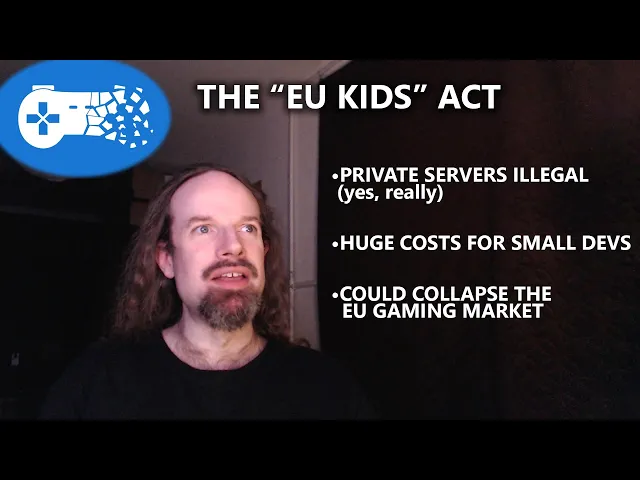
YouTuber Louis Rossmann, a right-to-repair advocate who opposes the draft, presented a detailed analysis in his own video. In his reading, a server that sells ranks or perks, or runs ads, would probably be covered, while a free, invite-only server for friends probably wouldn't. But there's no explicit exemption, so a court could rule either way.
Whether a covered server would also need age checks is disputed. The draft says only that kid mode stays on until a player is confirmed as an adult. But it also requires that kids under 13 play only with parental controls, which is hard to guarantee without knowing players' ages. Gamer's Voice, the UK chapter of Stop Killing Games, acknowledges in its briefing that "it would overstate the Proposal to claim that it criminalises preservation activity, bans every private server, or places every game behind an identity check." Preservation activity here means efforts to keep old games playable. Even so, the group wants the text amended.
"Old games will be deleted, and the law is retroactive"
Nobody would be punished for anything done before the law applies, and nothing in the draft orders anyone to delete games. But there's also no exception for older titles, so if a game is still sold or played online in the EU once the rules apply, it would have to comply. For a 15-year-old game whose studio has closed, adding parental controls and kid mode may simply not be possible. Gamer's Voice warns that compliance costs could push some providers to restrict availability or pull out of the EU. As the group notes, that would be a choice, not something the draft requires.
"Daily rewards will be banned for everyone"
Partly true. For minors, the draft bans rewards that push players to log in at regular times, and because kid mode is the default, adults who don't confirm their age would be affected too. Andreas Lober, a lawyer analyzing the draft for GamesIndustry.biz, concluded that login bonuses "will often be prohibited." Adults who verify their age would keep them.
"Linux will become illegal"
No. Operating systems would be covered, but the draft says only that an operating system that already has information about your age would have to share it with apps if you consent. Nothing requires an operating system to ask for your age. Louis Rossmann raises another open question: who counts as the "provider" of a volunteer-run Linux distribution, and whether its software repositories (the official online catalogs you install programs from) qualify as app stores. Gamer's Voice goes further, arguing that people distributing online games, "which could include those packaged in a Linux distribution's repositories," would be covered. The draft does exclude open-source software-sharing platforms, but it's unclear whether that exclusion extends to a distribution's repositories.
"Indie developers will pay hundreds of thousands to comply"
That figure comes from Stop Killing Games' own estimate, which puts the cost of keeping one online game compliant at $300,000 to $500,000 in the first year and $200,000 to $350,000 each year after that. The Commission's analysis of the draft's impacts is a staff working document, not a full impact assessment. Citing an external study, it says that integrating a third-party age check should cost most small and medium-sized services "in the hundreds of euros or low thousands of euros, although the evidence base remains limited." The same document says UK services often reported modest setup costs, in the tens of thousands of pounds, though some cited higher ones. It gives no figure for parental controls or product redesigns. Lauro Fava, a partner at the law firm Pinsent Masons, told EUobserver the Commission had "arguably downplayed" the cost of compliance. Both sides are working from estimates, and those estimates measure different things: Stop Killing Games' figure covers far more than an age check, including parental controls and engineering work, while the Commission's figure covers only adding an age check.
So the scariest claims mostly fall apart, but the costs, the missing exemptions and the privacy of age checks raise serious questions. Those are the questions the people fighting over this draft are really arguing about.

Who Wants the KIDS Act Tougher, Narrower or Gone
Supporters. The 5Rights Foundation welcomes the proposal but wants stronger, consistent protection across games, AI services and educational technology. It argues that children's safety shouldn't be left to industry self-regulation.
The games industry. Video Games Europe supports protecting children but opposes sweeping age-assurance requirements across every game and player. It wants PEGI and Germany's USK ratings to become the “de facto standard” for games in Europe.
The European Games Developer Federation (EGDF) also wants a narrower approach. It is asking for exemptions for nonprofit hobby projects, including games made at game jams, and wants lawmakers to consider extending the school exemption to games used in libraries, hospitals and museums.
Digital rights groups. European Digital Rights argues that age checks don't address harmful design. It also warns that providers could sidestep protections by simply labeling their services “18+.” The Electronic Frontier Foundation objects to the spread of invasive age checks and the consequences for privacy.
Stop Killing Games. The game-preservation campaign wants fans to remain able to run games after publishers shut down official support. Founder Ross Scott sees the proposal as a threat to that goal, and the campaign has urged supporters to ask lawmakers to reject it. While EGDF is seeking specific exemptions, Stop Killing Games is calling for the bill to be dropped.
These arguments concern a proposal still being debated. Age checks are already reaching players through national rules and platform policies.
Age Checks Are Already Here, and the KIDS Act Isn't Why
The Electronic Frontier Foundation's warning isn't abstract: many players already face age checks. They come from national laws, mostly outside the EU, and from companies' own decisions. The methods range from a saved credit card to a face scan that estimates your age.
In the UK and Australia, Steam gives access to store pages for mature games only if you have a credit card saved on your account. In the UK, Valve says debit cards aren't accepted. In Australia, Steam switched to this system in September, and the country's online safety regulator, eSafety, wasn't convinced. A spokesperson told nine.com.au that making a credit card the only way to verify age is "unlikely to meet the 'fairness' requirement contained in these terms," a reference to Australia's new industry codes for age-restricted content. The comment isn't a ruling or a fine, but the regulator says it's in talks with Valve.

Xbox asks players in Australia, Brazil, Singapore and the UK to verify their age. In Australia and Brazil, unverified accounts can't buy or download new 18+ games.
Some of these checks have reached the EU too. In Ireland, PlayStation requires adults to verify their age, and unverified accounts can't use voice chat, text chat, party chat or streaming, though they can still play and buy games. The same rule applies in the UK. Roblox has required a facial age estimate for chat in the Netherlands since December 2025 and worldwide since January 2026. Roblox also faces the EU's strictest platform rules: on August 31, the Commission designated it a very large online platform under the Digital Services Act. The extra duties that come with the designation, such as assessing and reducing risks, must be met by January 2027.
On September 23, Discord started rolling out age checks globally, including in the EU. Discord says more than 90% of users won't have to do anything, because their age group is estimated from account signals. Still, players have reason to be wary. In 2025, hackers breached one of Discord's support vendors, and photos of IDs that about 70,000 users had submitted in age-related appeals may have been exposed. Discord says it has since fully retired the manual review process run by that vendor.
The EU has its own age-verification app, which the Commission declared ready for deployment in April 2026. EU countries can still customize it, and a Commission recommendation asks them to roll out age verification by the end of 2026. The Commission's nonbinding 2025 guidelines for online platforms already say that a platform using age checks "should offer on its platform more than one age assurance method." Australia's regulator made the same point about Steam.
Age checks are about who you are. The EU case that could change your games sooner is about what you pay.
If a game asked you to prove you're an adult, what would you do?
In-Game Currency: What EU Regulators Want Publishers to Change
EU consumer regulators are already challenging how games sell virtual currency. On September 30, the Consumer Protection Cooperation (CPC) network, which brings together consumer authorities across the EU and wider European Economic Area, launched coordinated actions against nine companies:
- Riot Games (Valorant)
- Mojang (Minecraft)
- Supercell (Clash of Clans)
- King (Candy Crush Saga)
- Ubisoft (For Honor)
- Crytek (Hunt: Showdown 1896)
- InnoGames (Forge of Empires)
- Plarium (Mech Arena)
- Playrix (Gardenscapes)

Activision Blizzard faces a separate action over Diablo Immortal and Call of Duty: Mobile, led by Italy's competition authority with regulators in Norway and Denmark. That case also covers addictive design, parental controls, marketing to children and account bans. Fortnite isn't named in either action.
The currency cases rely on existing consumer law. The CPC network's March 2025 principles explain how regulators interpret that law; they aren't legally binding by themselves. The main demands are:
- Show real-money prices for currency and the items bought with it, with clear information before purchase.
- Don't obscure costs through multiple currencies or conversions.
- Let players buy the amount they need rather than force them to purchase excess currency.
- Respect the 14-day right to cancel, including for unused currency.
- Don't change currency values or remove purchased items under unfair terms.
- Use safe parental-control defaults, protect children from spending pressure and don't exploit big spenders.
“No one should need a calculator to figure out what they are spending in a video game,” said Agustín Reyna, director general of the consumer organization BEUC.
Refunds are a major sticking point. The 14-day cancellation right already exists, but buyers of digital content can lose it if they agree to immediate delivery and acknowledge that they are giving up that right. Store terms such as Supercell's use this waiver. Regulators argue that it shouldn't cover unused currency.
Video Games Europe and EGDF dispute the regulators' legal interpretation, including their approach to refunds. The groups have offered alternative measures: approximate real-money prices, flexible top-ups and limited refunds for completely unused currency packs. The offer is conditional on resolving what they describe as legal uncertainty.
Regulators remain dissatisfied. The Dutch consumer authority ACM says the industry's proposals don't sufficiently address the problems.
No fines or public compliance deadline have been announced in these actions. National authorities can take enforcement measures, including fines, if the concerns remain unresolved. There is no fixed timetable for changes to the games' shops.
The practical impact depends on how each game sells currency and handles purchases and refunds.
Game by Game: What Could Change in Valorant, Minecraft, Fortnite and More
The games differ in how they handle the issues regulators are targeting, and in some cases the KIDS Act would add rules of its own. So far, we haven't found public comments or announced store changes from any of the nine companies in response to the actions.
Valorant
Take a single 1,775 VP Premium skin. The smallest Valorant Points pack is 475 VP, so with packs of that size you'd need four (1,900 VP), which leaves 125 VP unused. On refunds, Riot already comes close to the regulators' principles. According to its support page, "Only unused in-game content and unused VP purchased within the last 14 days are eligible for a refund." The game, rated PEGI 16, has daily missions and a limited-time Night Market that sells random skins at random discounts.
Minecraft

The smallest Minecoins pack is 320 coins, and a skin pack can cost 490 coins. The cheapest option is two of the smallest packs (640 coins), which leaves 150 coins unused. Minecraft's official FAQ takes a hard line: "All purchases for Minecoins are final and cannot be refunded," with an exception for unauthorized purchases. That no-refund policy is at odds with the regulators' principle on the 14-day right to cancel. The currency setup in Minecraft, a PEGI 7 game, is also getting more complicated. On PlayStation, Minecraft already uses Minecraft Tokens, which can't be converted into Minecoins. Starting October 27, Minecoins bought on a Nintendo device (Switch or Switch 2) will work only on Nintendo systems, and Minecoins bought elsewhere from then on won't work on those systems. Coins that players already own will move to a legacy wallet that still works across compatible platforms. The principles warn against making players keep track of several currencies, but it's unclear whether separate wallets for different platforms fall under that warning.
Fortnite
Fortnite isn't part of the CPC action, and Epic already does some of what regulators are asking for. Since October 14, 2025, players have been able to top up V-Bucks with exactly the amount they need on Xbox, Nintendo Switch, PC, mobile and the web, but not in the PlayStation Store. Some recent reports presented the feature as new, but Epic introduced it about a year before the September 30 action and gave no reason for the launch. In March 2026, Epic made V-Bucks more expensive, so $8.99 now buys 800 V-Bucks instead of 1,000, and a top-up of 50 V-Bucks costs $0.99. That makes top-ups about 1.8 times as expensive per V-Buck as the $8.99 pack.
The PlayStation Store still doesn't offer exact top-ups, so buying a skin that costs 1,200 V-Bucks there takes two packs of 800 V-Bucks (€17.98 in the German PlayStation Store) and leaves 400 V-Bucks unused. Players with a linked Epic account can instead buy the exact amount they need in Fortnite's web shop, because V-Bucks are shared across PlayStation, PC and Xbox.
The KIDS Act would still apply to Fortnite, as it would to almost any online game. Epic has faced European regulators before. In 2024, the Dutch ACM fined the company €1.125 million over what it found were unfair practices aimed at children in the Fortnite shop, and in January 2026, a Rotterdam court rejected Epic's challenge.
Clash of Clans
In February 2026, Supercell announced a Gold Pass overhaul for Clash of Clans, a PEGI 7 game, and the changes went live in March, months before the KIDS Act draft and the September 30 action. The update rebuilt the Gold Pass around stamp cards and daily tasks that don't expire, and Supercell explained that "if you miss a day, you're not falling behind." It also removed a bonus for buying the pass several seasons in a row. These changes eliminate the penalty for missing a day, a mechanic the KIDS Act draft would ban for minors. On refunds, though, Supercell's store terms say that buyers agree to immediate delivery and "thereby lose the statutory right of withdrawal," meaning the 14-day right to cancel. Under the regulators' principles, that waiver shouldn't apply to unused currency.
Candy Crush Saga

According to the game's fan wiki, Candy Crush Saga's Daily Treat Machine drops back to day 25 (out of 30) if you miss a day after filling it, which fits what the KIDS Act draft calls "loss of benefits for failing to engage regularly." The wiki lists the smallest pack at 10 Gold Bars, while a full set of lives costs 12, so paying with Gold Bars means buying two packs and being left with 8 spare bars. The game is currently rated PEGI 3, so it's open to players of any age. If the KIDS Act passes in its current form, Candy Crush would be a likely candidate for a redesign.
For Honor and Hunt: Showdown 1896
Both games are rated PEGI 18, so the KIDS Act may matter less for them than the currency principles do, though the draft doesn't define exactly which services count as accessible to minors. For Honor's currency, Steel, is both earned in matches and sold for real money. Because earned and purchased Steel are held in one balance, it may be hard for players to tell which part counts as unused purchased currency. Steel also buys Scavenger crates with random gear. In Hunt: Showdown 1896, the 1,150 Blood Bonds pack costs €9.99 in the German Microsoft Store. Hunt's fan wiki shows that Event Passes have cost 1,000 Blood Bonds, so one pack leaves 150 Blood Bonds unused.
The rest of the list, and games that aren't on it
The other three games named by regulators are free-to-play titles, mostly played on mobile and in the browser: Forge of Empires, Mech Arena and Gardenscapes. Genshin Impact, Roblox and EA Sports FC aren't on the CPC list. Genshin, however, uses three linked currencies (Genesis Crystals, Primogems and Intertwined Fates), a setup the principles tell companies to avoid. Its Welkin Moon pass gives rewards only on days you log in, so the reward for a missed day is lost. And Genshin's Wishes, the game's paid random pulls, are the kind of mechanic the planned Digital Fairness Act may or may not cover, which is why that proposal matters even before its draft is published.

Loot Boxes and the Digital Fairness Act: The Fight Still to Come
The Digital Fairness Act (DFA) is a planned EU law that would update consumer protection rules for online services. It would include rules on dark patterns (design tricks that push you to buy or to keep using a service), addictive design and subscriptions. Officially, the Commission plans to present it in the fourth quarter of 2026. The Commission's provisional schedule, dated September 29 and published by an independent newsletter on the Digital Fairness Act, lists the DFA in a "Consumer package" for the Commission's November 11 meeting, but the document itself warns: "The planning is indicative." No draft has been made public, so it's still unclear whether the DFA will cover loot boxes or in-game currency.
On loot boxes, the European Parliament has already made its position clear. On November 26, 2025, lawmakers voted 483 to 92, with 86 abstentions, for a resolution calling for "prohibiting loot boxes and other randomised content such as wheels of fortune, prize wheels, card packs in exchange for real money in games that are likely to be accessed by minors." But a resolution isn't a law. In its reply to the resolution, the Commission promised only to "rigorously assess if the bar of consumer protection needs to be further improved in these issues."

The industry and its critics disagree sharply. In its response to the Commission's DFA consultation, Video Games Europe wrote about paid random rewards: "There is no reasonable justification to prohibit these features in video games." The group argues that players always get at least one item, unlike in gambling. The consumer group BEUC wants the DFA to ban premium virtual currencies, paid loot boxes and pay-to-win mechanics outright. The Dutch regulator ACM recommends banning loot boxes and virtual currencies, especially in games played by minors. Stop Killing Games has also asked its supporters to press lawmakers to write its demands into the DFA.
Belgium shows how hard it can be to keep paid loot boxes out of games. In 2018, Belgium's Gaming Commission found that paid loot boxes in the games it examined counted as gambling under Belgian law. Enforcement has proved difficult, though: a study published in 2023 found paid loot boxes in 82 of the country's 100 highest-grossing iPhone games, as noted in this breakdown of lawsuits over addictive game design.
A more concrete change has come from the industry itself. Since June 2026, PEGI has rated newly submitted games like this:
- With paid random items: PEGI 16 by default.
- With daily rewards: at least PEGI 7.
- With penalties for missing a day: at least PEGI 12.
PEGI's re-rating of older games covers only paid random items. On October 6, PEGI announced that it had started raising digital-only games that sell such items from PEGI 3, 7 or 12 to PEGI 16, though it hasn't said which games are affected. The KIDS Act, the currency case, the DFA and PEGI all move at different speeds, and those speeds decide when any of it would reach the games you play.
What Could Change for You, and When
Right now. No new EU law applies to games yet, although big platforms such as Roblox already have obligations under the Digital Services Act. If you play outside the EU and the wider European Economic Area, the EU's own plans don't apply to you directly. Companies can still choose to apply changes worldwide. The age checks you may already see come from the platforms themselves and from national laws, mostly in countries outside the EU. PEGI's ratings, meanwhile, have started to change.
Fall 2026. The nine game companies have been asked to bring their practices into line with EU consumer law, and no deadline has been announced. Changes to the in-game stores of Valorant, Minecraft or Clash of Clans could come before any new law, but cases like this can take years. The Digital Fairness Act could be presented on November 11, though that date isn't final. Anyone, including players, can send feedback on the KIDS Act to the Commission until December 3.
2027. Negotiations between the European Parliament and EU governments on the KIDS Act are expected. The Commission hopes for a deal as early as spring, while the law firm Freshfields notes that similar laws have taken about two years on average. This is when exemptions for small developers, old games and private servers could be added to the KIDS Act or rejected. Talks on the DFA would start once the Commission has presented it.
2028 or later, by one law firm's estimate. If the KIDS Act is adopted, its rules would start to apply six months after it enters into force: kid mode by default, no streak rewards for minors and age ratings in every app store.
Laid out in order, it looks a lot less like the end of gaming than the videos suggested.
The Bottom Line
The viral warnings go further than what the draft explicitly says. It contains no express ban on private servers, and its age-checking framework is designed to confirm adult status without giving a game your identity documents. That still leaves questions about privacy, compliance costs and how the rules would apply to volunteers keeping older games playable.
Changes to in-game currency could arrive sooner, through agreements with publishers or enforcement under existing law. But regulators and the industry remain divided over purchases and refunds, including the 14-day right to cancel.
The absence of an explicit ban doesn't guarantee that every game or fan project could meet the proposed requirements. Much will depend on how lawmakers define the obligations and who gets an exemption. Those negotiations deserve attention: can rules meant to protect children also leave room for small developers and the volunteers who keep old games alive?
How much in-game currency is left over in your accounts from packs that didn't match the price?
Frequently Asked Questions
Short answers to common questions about the EU's plans for games.
Is the EU banning kids under 15 from playing video games?
No. The under-15 limit in the draft EU KIDS Act would apply only to personal accounts on social media and video platforms with risky features. The draft sets no minimum age for games: children under 13 could play only with parental controls in place, and players under 18 would get protective default settings. The KIDS Act is still only a proposal, not a law.
Will I need to show ID to play online games in the EU?
Not to the game itself. Any age check would have to reveal only one thing to the game: whether you're an adult. The Commission says that if a platform can already tell with high confidence that you're an adult, for example from your account's age or a saved credit card, no new check is needed. If nothing confirms you're an adult, you'd get kid mode, the protective default settings meant for minors.
Does the EU KIDS Act ban private servers?
No, servers aren't mentioned in the text. The question is whether people who run servers, especially ones that sell ranks or show ads, would count as game providers and have to add protections for minors. There's no explicit exemption yet. Gamer's Voice, the UK chapter of Stop Killing Games, wants one added, while Stop Killing Games itself has asked supporters to tell lawmakers to vote the bill down.
When will the EU KIDS Act take effect?
Not soon. The European Parliament and EU governments still have to agree on the text. The Commission hopes talks could end as early as spring 2027, while the law firm Wilson Sonsini thinks the rules are unlikely to apply before 2028. Once the law is in force, companies would get six more months before the rules apply.
Is the EU banning in-game currencies such as V-Bucks or Valorant Points?
Not now. EU consumer authorities want nine companies, including Riot, Mojang, Supercell and King, to show real-money prices, stop pushing players to buy more currency than they need and respect the 14-day right to cancel purchases of unused currency. Fortnite isn't among the targeted games, and no fines have been issued. The Dutch regulator ACM and the consumer group BEUC do want the planned Digital Fairness Act to ban paid virtual currencies, at least in games minors play, but no draft of that law has been published.
Are loot boxes banned in the EU?
Not at the EU level. Belgium's Gaming Commission concluded in 2018 that paid loot boxes in the games it examined were gambling, but a study published in 2023 still found such loot boxes in 82 of the country's 100 top-grossing iPhone games. The European Parliament has called for a ban on paid loot boxes in games that kids are likely to play, but its resolution isn't binding. The Digital Fairness Act, which could be presented in November, may address loot boxes. Since June 2026, PEGI, the industry's own rating system, has given newly submitted games with paid random items a default rating of 16.
Do the EU's plans affect players outside the EU?
Not directly, unless you live in Norway, Iceland or Liechtenstein. The KIDS Act draft would cover any company offering games to players in the EU, wherever it's based. The action over in-game currency covers consumers across the European Economic Area, that is, the EU plus Norway, Iceland and Liechtenstein. Companies can still choose to apply any changes worldwide rather than build separate EU versions.
Money, Scandals, Phenomena
- The CS2 Skin Economy: Billions of Dollars, Million-Dollar Knives, and a $2 Billion Crash in 30 Hours
- The Biggest Thefts and Hacks in Gaming History: The $620 Million Axie Infinity Hack, Stolen CS2 Skins, and the GTA 6 Leak
- Star Citizen Has Raised a Billion Dollars — and Still Hasn't Come Out
- GTA Controversies: Lawsuits, Bans, and Hot Coffee
- Why Graphics Cards Are So Expensive in 2026: How AI Ate the Memory Supply
- Why have videogames become so expensive, and will they get even more expensive?
- Why Millions of People Click on Bananas, Cookies, and Cows: How Idle Games Have Hacked Our Brains
- What Are the Backrooms? Levels, Entities, Games, and Movie Explained
- Rusty Lake Series Phenomenon. Twin Peaks in the Form of a Point‑and‑Click
- Rideshare "Stimulator": What Kind of Game Is It and Why Did It Spark an AI Controversy?
- AI Is Already Taking Jobs in Game Development — Just Not Where We Expected
- DLSS 5 — Graphics Revolution or Marketing Gimmick? Let's Cut Through the Hype
- Why the Ocarina of Time Remake Announcement Divided Fans — Uncanny Valley, Politics, and Nostalgia
- Why AI Researchers Are Leaving OpenAI, Anthropic, and Google — and What They’re Warning About
- How GTA 5 Made More Money Than Any Movie Ever
- AI in Games: Why Players Boycott Studios Over AI Art and Voices
- How Much Money Has Genshin Impact Made and Why Gacha Is Cooling Off
- Sued for Being Too Addictive: How the Makers of Fortnite, Roblox and Minecraft Ended Up in Court
- The $250 Million AI Chat: How Krafton Asked ChatGPT to Escape Subnautica 2's Founders — and Lost
- What Was Found in the 12TB Steam Leak: Early Builds of GTA 3, Mafia 2, and Valve Games
- How Graphics Card Prices Spiraled: Mining, Scalpers, and Prices No One Could Believe
- The Live-Service Graveyard: How the Industry Burns Billions on Games That Die in Weeks
- Minecraft in Elden Ring and TNT in RDR2: The Wild AI Mashups That Broke the Internet — What's Real and What You Can Download
- Is Deadlock Out? Valve's Invite-Only Game Sets a New Player Count Record
- PS5 Jailbreak: What Relapse Offers and What You Risk
- EU Kids Act Explained: How It Could Change the Internet and Gaming
- Bloodborne PC Port and AI: Can Fans Port Games Without Permission?
- WARDOGS vs. Call of Duty: Can a $40 Shooter Hurt Modern Warfare 4?
- When and How Will AI Destroy Humanity? 5 Scenarios, Rated by AI
- Is Xbox Dying in 2026, or Just Being Told to Pay Its Own Way?
- How Valve Makes Billions from Steam — and Why It’s Facing Lawsuits
- Witcher 3 Remastered Player Count: Are Old Games Beating New Ones?
- Why EA Is Closing BioWare and What Comes Next for Mass Effect
-
 EU Kids Act Explained: How It Could Change the Internet and Gaming
-
 Best Games to Play in 2026: Top Picks Across PC, PS5, Xbox & Switch
-
 Stop Killing Games, Explained: Why You Don't Really Own the Games You Buy
-
 Zombie Shooters: The Best Games on PC, PS4, PS5, Xbox, and Switch
-
 27 Best Games Like Call of Duty: Shooters Set in the Past, Present and Future